

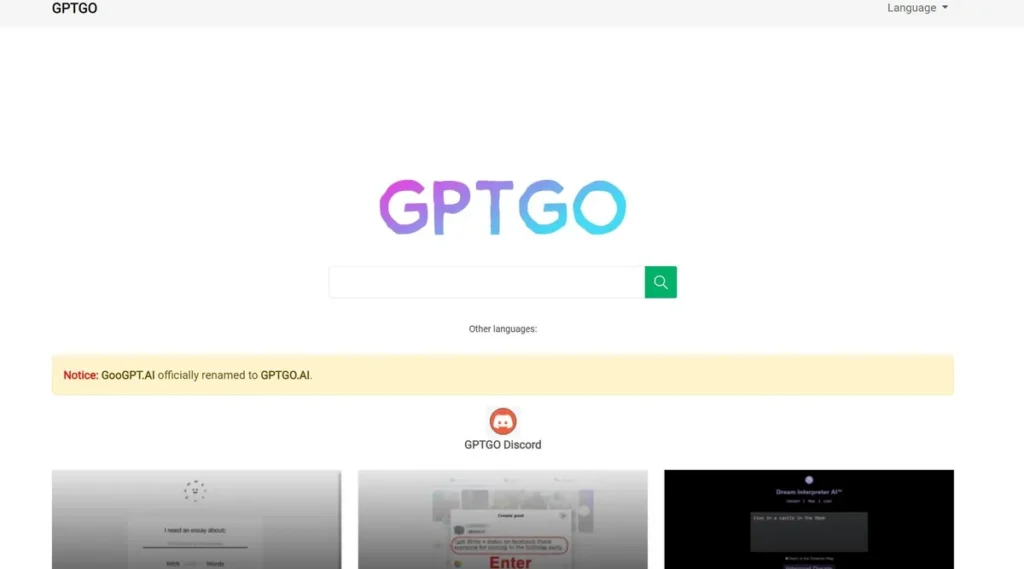
What is GPTGO?
GPTGO is a platform designed to give businesses direct access to generative AI models. The core idea is to provide a simpler way to use complex AI for practical tasks like market research, automating internal workflows, or enhancing search capabilities. Instead of requiring a dedicated data science team, the platform aims to package this technology into an accessible tool for content creation, data analysis, and even code generation. For a small business, this translates to leveraging sophisticated AI without the typically high overhead associated with it.
Key Features and How It Works
GPTGO’s functionality is built around a few core components designed for business application. Here’s a direct breakdown of what it offers and how it works:
- Direct Access to AI Models: GPTGO connects to powerful generative AI models. For a business, this means the outputs for tasks like writing marketing copy or summarizing research reports are based on current, sophisticated technology. This should translate to higher quality and more relevant results for your queries.
- Simplified Dashboard: The platform is accessed through a dashboard designed to be intuitive. The goal is to reduce the technical barrier, allowing team members without a background in AI to interact with the models, input queries, and retrieve results without a steep learning curve or extensive training.
- Custom Model Training: A key feature is the ability to train the AI on your company’s specific data. This allows you to create a model tailored to your industry’s jargon, customer support history, or internal documentation. This leads to more accurate and contextually aware outputs, moving beyond generic AI responses.
- API Access: For businesses with existing software, GPTGO provides API access. This allows your developers to integrate the AI’s capabilities directly into your current applications, such as a CRM, an internal search tool, or a customer service platform, enabling the automation of specific workflows.
Pros and Cons
Before investing time and resources, it’s essential to weigh the practical benefits against the potential drawbacks.
Pros
- Potential for Increased Efficiency: By automating or accelerating tasks like drafting emails, generating reports, or creating initial code snippets, the tool can save significant employee time, freeing them up for higher-value work.
- Accessible AI for Non-Experts: You don’t necessarily need an AI specialist on staff for basic use. The simplified interface means marketers, analysts, and support staff can potentially leverage the technology directly.
- Customization for Niche Needs: The ability to train models on your own data is a significant advantage, allowing you to create a proprietary tool that understands your specific business context and terminology.
Cons
- Implementation and Training Time: While designed to be user-friendly, there’s still a learning curve. Fully integrating this into your workflow and training your team to use it effectively requires an upfront investment of time.
- Dependency on Connectivity: The platform is cloud-based, meaning a stable and fast internet connection is non-negotiable for reliable performance. This can be a factor for remote teams in areas with poor connectivity.
- Potentially Unpredictable Costs: Heavy use, especially with custom model training and frequent API calls, could lead to unpredictable expenses depending on the final pricing model.
Who Should Consider GPTGO?
GPTGO is not a one-size-fits-all solution. Its value is most apparent for specific business functions and teams:
- Marketing and Content Teams: Businesses that need to produce content at scale—blogs, social media posts, ad copy, product descriptions—can use it to create first drafts and generate ideas, though human editing and oversight remain critical.
- Business and Data Analysts: Teams tasked with sifting through large volumes of text-based data for market research, sentiment analysis, or trend identification can use GPTGO to accelerate the process of summarizing and interpreting information.
- Developers and IT Departments: For generating boilerplate code, debugging simple issues, or creating documentation, the tool can serve as a productivity aid for technical staff, reducing time spent on repetitive coding tasks.
- Internal Operations: Companies looking to build intelligent internal tools, such as a smarter search for company documents or an automated system for answering common HR questions, could leverage the API to build custom solutions.
Pricing and Plans
At the time of this review, specific pricing tiers for GPTGO were not publicly available. The platform offers a free trial to allow businesses to test its core features, followed by subscription plans presumably scaled to usage levels, feature access, and the number of users. For any business, the key will be to evaluate the return on investment based on the final cost structure. For the most accurate and up-to-date pricing, please visit the official GPTGO website.
What makes GPTGO great?
Why do so many generic AI tools feel disconnected from the unique challenges of your business? GPTGO’s standout feature is its direct answer to this problem: custom model training. While many platforms offer access to powerful AI, they often provide one-size-fits-all solutions. GPTGO allows you to fine-tune the AI using your own datasets. This means you can create a model that understands your company’s specific terminology, customer interaction style, and internal processes. This level of personalization moves the tool from a general-purpose assistant to a specialized, integrated part of your operations, which is where the real competitive advantage lies.
Frequently Asked Questions
Is GPTGO secure enough for sensitive business data?
Data privacy and security are critical concerns. While GPTGO’s security rating is reasonably strong, any business planning to use the custom model training feature with proprietary or sensitive customer data must thoroughly review the platform’s data handling and privacy policies to ensure they meet strict compliance and security requirements.
Do I need a developer to use GPTGO?
For basic tasks like generating content or conducting research through the dashboard, no development knowledge is required. However, to integrate GPTGO into your existing software or build automated workflows using the API, you will need a developer or someone with technical expertise.
How does GPTGO differ from other widely available AI chat tools?
While it may use similar underlying technology, GPTGO’s focus is on business integration and customization. Key differentiators include the ability to train custom models on your own data and the provision of an API for building automated workflows—features not typically central to consumer-facing chat applications.
What kind of support is available if we run into issues?
GPTGO provides a set of tutorials and documentation to help users get started. Based on our evaluation, the available support and resources are adequate for general use. However, businesses that require dedicated, immediate support should investigate the service level agreements (SLAs) that may be available in higher-tier subscription plans.