



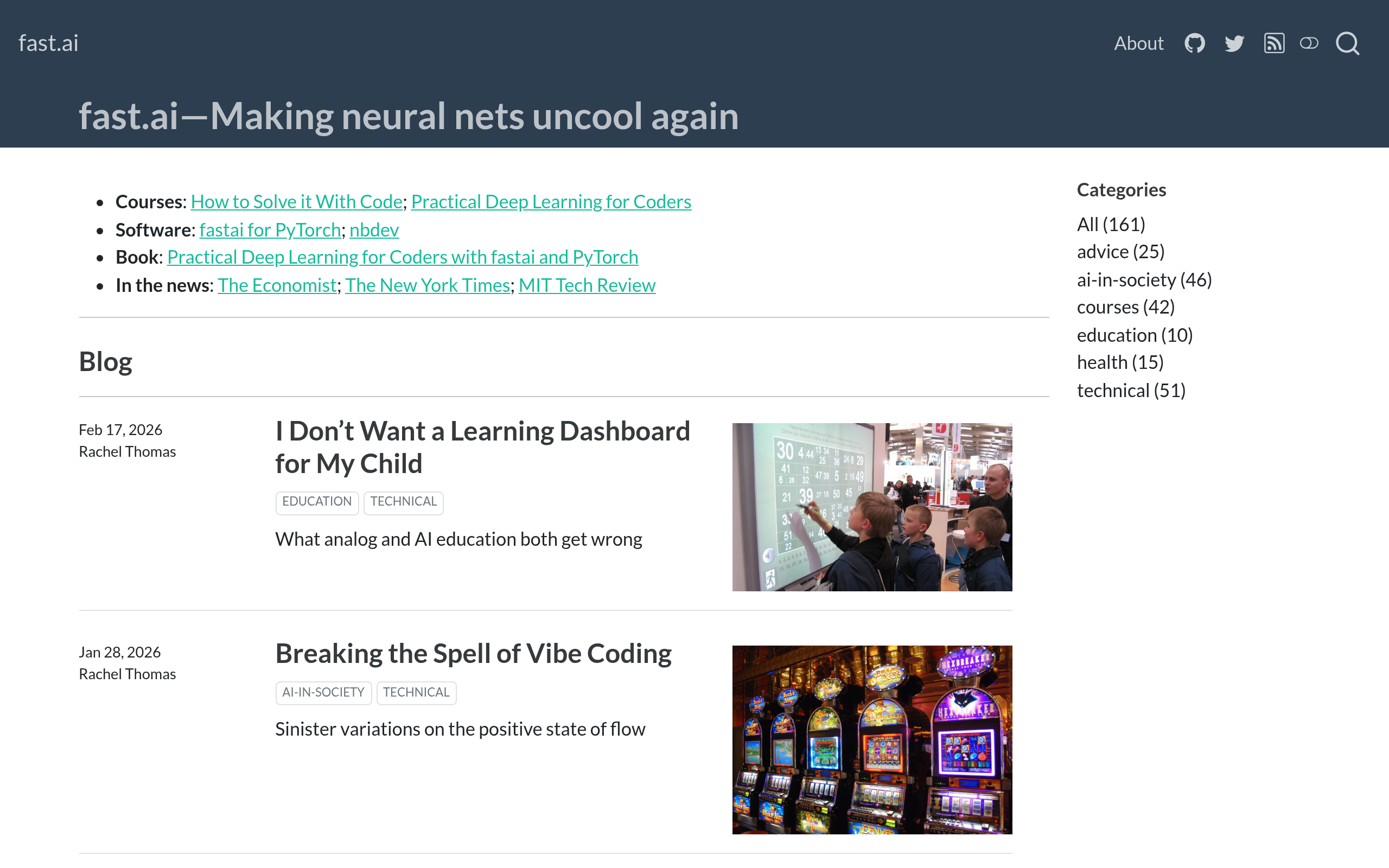
What is Fast.ai?
Many developers expect deep learning to require a PhD in mathematics and months of studying linear algebra. Fast.ai delivers the exact opposite. You get a practical approach that gets you training neural networks on day one. The creators believe making AI accessible matters more than gatekeeping the math behind it.
Created by the research organization fast.ai, this platform combines an open-source library built on PyTorch with free video courses. It targets software engineers who want to build artificial intelligence applications. You can train image recognition models or text classifiers using just a few lines of Python. The library handles the complex boilerplate code behind the scenes.
- Primary Use Case: Training deep learning models for vision, text, and tabular data with minimal boilerplate code.
- Ideal For: Software developers transitioning into machine learning.
- Pricing: Starts at $0 (Free) : Open-source with no hidden premium tiers.
Key Features and How Fast.ai Works
The platform splits into three main areas. You get the software library, the development tools, and the educational content.
High-Level Deep Learning API
- DataBlock API: Defines data loading pipelines, but complex custom datasets require dropping down to PyTorch primitives.
- Learning Rate Finder: Runs a mock training session to find optimal hyperparameters, though it sometimes suggests rates that cause divergence.
- One-Cycle Policy: Schedules training for faster convergence, limited to specific optimizer types.
- Mid-level API: Grants access to internal components for custom data augmentation, requiring deeper framework understanding.
Development and Engineering Tools
- nbdev: Converts Jupyter notebooks into searchable documentation and Python packages, but the workflow frustrates developers used to VS Code.
- fastcore: Adds functional programming features to Python, which creates a steep learning curve for standard Python developers.
Educational Resources
- Course v5: Provides over 20 hours of video content covering foundations to deployment, but assumes you already know basic Python.
- Community Forums: Offers a database of over 100,000 posts, though finding current answers for older library versions takes time.
Fast.ai Pros and Cons
Pros
- High-level abstractions let developers achieve top results with minimal boilerplate code.
- The top-down educational philosophy enables practical application before teaching complex math.
- Integration with the PyTorch ecosystem ensures access to modern research and hardware acceleration.
- The platform operates under an Apache 2.0 license for unrestricted commercial use.
- Strong focus on software engineering best practices improves code quality.
Cons
- The nbdev workflow confuses developers accustomed to traditional IDEs like VS Code.
- Documentation for the latest library versions relies too much on source code comments.
- Debugging errors within the high-level API demands deep knowledge of the underlying PyTorch framework.
- Rapid update cycles sometimes introduce breaking changes in experimental features.
Who Should Use Fast.ai?
- Software engineers: You know Python and want to add machine learning to your skill set. The top-down teaching style fits your background.
- Researchers: You need to prototype models fast before writing custom PyTorch training loops. The high-level API saves hours of setup time.
- Budget-conscious teams: You want enterprise-grade tools without paying licensing fees. The Apache 2.0 license allows full commercial use.
- Non-coders: If you cannot write Python, the course and library will overwhelm you. Look at no-code tools instead.
Fast.ai Pricing and Plans
Fast.ai costs nothing. The organization operates on a free model. You will not find any paywalls here.
- Fast.ai Courses: $0/mo. You get full access to all video lessons and notebooks.
- fastai Library: $0/mo. The software uses an Apache 2.0 license for unrestricted commercial use.
- nbdev & fastcore: $0/mo. These development tools remain free forever.
There are no hidden premium tiers or trial periods. You only pay for the cloud GPU compute time you rent from third-party providers (like AWS or Paperspace) to run your models. The software itself remains free.
How Fast.ai Compares to Alternatives
Similar to Keras, Fast.ai provides a high-level API that hides complex math behind simple function calls. But Keras runs on top of TensorFlow, while Fast.ai builds on PyTorch. Keras integrates better into Google cloud environments. Fast.ai offers more modern default training techniques out of the box. Both tools target beginners, but Fast.ai pushes you toward modern research practices faster.
Unlike Hugging Face, which focuses on pre-trained transformer models for NLP, Fast.ai provides a broader foundation. Hugging Face excels if you just need to download and fine-tune a language model. Fast.ai teaches you how to build computer vision, tabular, and recommendation systems from scratch. You will learn more about the underlying architecture with Fast.ai.
The Best Deep Learning Starting Point for Coders
Software developers who want practical machine learning skills get the most value here. You will train real models in your first hour. The free courses provide excellent guidance. But if you want to understand the deep mathematical theory before writing code, look elsewhere. University courses offer better theoretical foundations. If you just need a quick NLP API without learning the fundamentals, choose Hugging Face.