



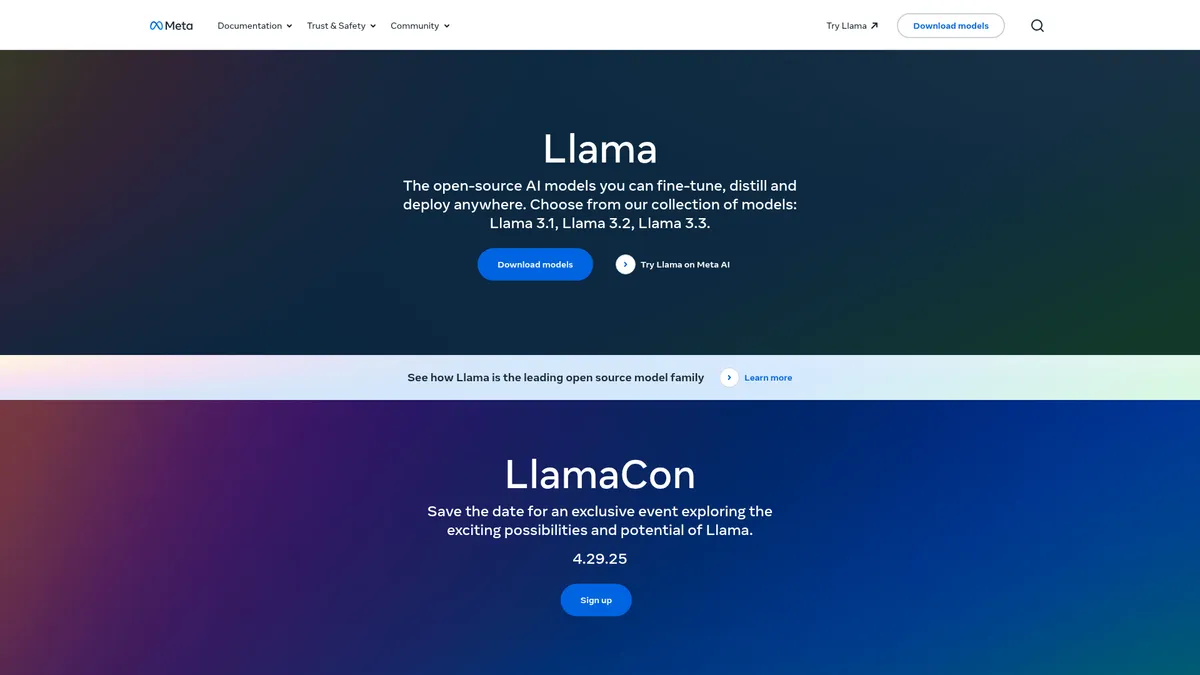
What is Llama?
Llama is a collection of open-weights large language models built for developers who need custom AI applications. You can run these models on your own hardware or access them through cloud providers.
Meta Platforms created this model family to give engineers an alternative to closed ecosystems. It solves data privacy concerns by allowing local deployment. The primary audience ranges from solo developers building mobile apps to enterprise teams analyzing massive datasets.
- Primary Use Case: Deploying local, privacy-focused AI agents and analyzing large document repositories.
- Ideal For: Developers and enterprise engineering teams.
- Pricing: Starts at $0.02 per 1M input tokens (Llama 3.2 1B API) or free for self-hosting.
Key Features and How Llama Works
Context Windows and Data Processing
- 10M Token Context: Llama 4 Scout processes massive input windows for long-form data analysis. This limit handles thousands of pages but requires significant RAM.
- Multimodal Vision: The models reason across text and image inputs simultaneously. Image processing consumes tokens much faster than plain text.
Deployment and Integration Tools
- Llama Stack: This standardized API connects toolchains across cloud and local devices. It reduces vendor lock-in but requires initial configuration time.
- Mobile Optimization: Specialized kernels run on Qualcomm and MediaTek chipsets. This works well for edge execution but drains battery life on older devices.
Safety and Fine-Tuning
- Llama Guard 3: An integrated safety model filters inputs and outputs. (I found these filters often block completely benign coding prompts).
- PEFT Integration: Developers use LoRA and QLoRA for fine-tuning via Hugging Face. This requires basic Python knowledge and compatible hardware.
Llama Pros and Cons
Pros
- Open-weights accessibility allows full local deployment for maximum data privacy.
- The 10-million-token context window in Scout outperforms most proprietary competitors.
- Native integrations exist for AWS Bedrock, Google Vertex AI, and Azure.
- API pricing starts at just $0.02 per 1M input tokens, beating GPT-4o costs.
Cons
- The commercial license restricts companies with over 700 million monthly active users.
- Running the 400B Maverick model locally requires multiple expensive H100 GPUs.
- Safety filters trigger false-positive refusals too often.
- There is no native consumer chat interface included out of the box.
Who Should Use Llama?
- Enterprise Data Teams: You can process massive internal document repositories using the 10M context window without sending data to OpenAI.
- Mobile App Developers: The 1B and 3B models run directly on edge devices for offline AI features.
- Non-Technical Users: This is not a good fit. You need coding knowledge to deploy these models since there is no ready-made chat application.
Llama Pricing and Plans
Meta offers a freemium model based on how you deploy the technology.
The Community License costs $0 per month. This allows free self-hosting for individuals and businesses with fewer than 700 million monthly active users. You must provide your own hardware.
The Llama 3.2 1B API costs roughly $0.02 per 1M input tokens. It includes a 128k context window optimized for mobile devices.
The Llama 4 Scout API costs $0.08 per 1M input tokens. This tier unlocks the massive 10M token context window and vision-language capabilities.
The Llama 4 Maverick API costs $0.15 per 1M input tokens. This provides access to the 400B parameter frontier model with a 1M token context window.
Enterprise Tier pricing requires a custom quote. You must buy this if your application exceeds 700 million monthly active users.
How Llama Compares to Alternatives
Similar to Mistral AI, Llama provides open-weights models that you can run locally. Mistral often focuses on smaller, highly efficient models for European languages. Llama offers a wider range of sizes, from 1B mobile models up to the massive 400B Maverick.
Unlike Claude, Llama requires you to build your own chat interface or use a third-party platform. Claude provides a polished web app out of the box. However, Llama gives you complete control over your data privacy by allowing offline deployment.
Best AI Model for Privacy-Conscious Developers
Llama delivers incredible value for engineering teams who need strict data control and massive context windows. Solo developers with basic Python skills will also enjoy the cheap API access.
Non-technical users should look elsewhere.
If you just want a ready-to-use AI assistant without writing code, Claude is a much better option.