

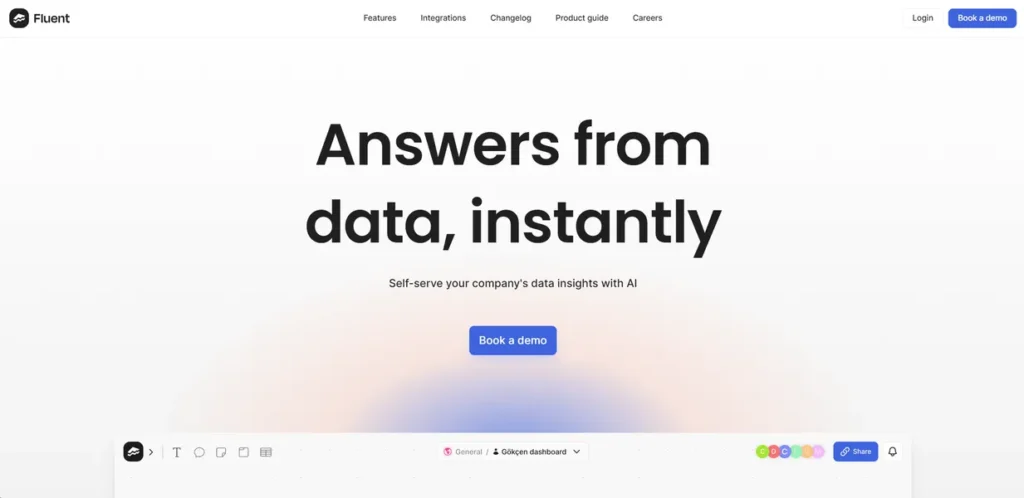
What is Fluent?
Fluent is an AI-powered data analysis platform that functions as an abstraction layer between a user and their database. It ingests natural language questions and translates them into executable SQL queries, effectively creating a conversational interface for data warehouses. From a development standpoint, its primary function is to offload the burden of writing routine, ad-hoc queries from technical teams to the business users who need the insights. By democratizing data access through a simplified interface, Fluent aims to reduce the dependency on engineers and analysts for standard reporting and data exploration, thereby increasing organizational velocity.
Key Features and How It Works
Fluent’s architecture is built around several core technical components designed to provide a secure and efficient query pipeline.
- Natural Language Processing (NLP) Engine: This is the core of the platform. The engine parses user input to identify intent, entities (like metrics and dimensions), and filters. It then programmatically constructs a database-specific SQL query. The accuracy of this translation is critical to the tool’s reliability.
- Data Source Connectors: Fluent integrates with common data warehouses and databases. These connectors are responsible for establishing secure, authenticated connections and transmitting the generated SQL for execution. The robustness of these connectors determines the platform’s compatibility within a given tech stack.
- Collaboration Hub: The platform provides a shared environment where teams can view query histories and share insights. This functions as a centralized repository, preventing redundant data pulls and ensuring that decisions are based on a consistent set of queries.
- API and Chat Integrations: Fluent exposes its functionality through integrations with tools like Slack and Microsoft Teams. This allows users to query data asynchronously from within their existing communication workflows, treating the tool as an intelligent chatbot connected to their data backend.
- Security and Governance Framework: The platform employs bank-grade encryption for data in transit and at rest, alongside multi-factor authentication (MFA). Its data governance features allow administrators to define fine-grained access controls, curating which datasets are available to specific users or roles.
Pros and Cons
Pros
- Reduced Engineering Overhead: Offloads the significant workload of ad-hoc data requests from business units to a self-service platform, freeing up developer time for core tasks.
- Increased Data Accessibility: Lowers the technical barrier to data interaction, enabling faster, more autonomous decision-making for non-technical stakeholders.
- Strong Security Architecture: Implements enterprise-grade security standards, including end-to-end encryption, MFA, and granular access controls, which are critical for handling sensitive data.
- Seamless Workflow Integration: Natively integrates into existing communication tools like Slack and Teams, minimizing context switching and embedding data analysis into daily operations.
Cons
- Query Opacity: The NLP-to-SQL translation layer can be a ‘black box,’ making it difficult to debug, validate, or optimize the underlying query that Fluent generates.
- Performance Bottlenecks: The platform’s query performance is ultimately constrained by the processing power and configuration of the connected data warehouse, not the tool itself.
- Limited Deep Analysis: The system is not designed for highly complex, multi-stage queries or advanced statistical analysis that requires direct SQL manipulation and optimization.
- Integration Ecosystem Constraints: While growing, the current list of supported data sources may not cover niche databases or less common data platforms, requiring custom integration work.
Who Should Consider Fluent?
From a technical implementation perspective, Fluent is best suited for organizations aiming to empower non-technical teams while maintaining strict data governance. This includes:
- Business Intelligence (BI) Teams: Can use Fluent to provide business stakeholders with a secure self-service portal for standard reporting, reducing the BI team’s ticket queue.
- Product Managers and Marketers: Ideal for professionals who need to query user behavior, funnel metrics, or campaign performance data without needing to learn SQL or rely on an analyst.
- Engineering Leads: Can deploy Fluent as a controlled gateway to production or analytical databases, granting access without exposing the underlying infrastructure.
- Data-Driven Startups: For early-stage companies without a dedicated data analyst, Fluent can serve as a cost-effective and accessible entry point to data-driven operations.
Pricing and Plans
Fluent operates on a freemium model, offering plans designed for both individual users and growing teams.
- Free: This plan is ideal for individuals or small teams getting started with data analysis. It typically includes a limited number of queries per month and allows connection to a single data source.
- Pro: Priced at $9.99 per user per month, the Pro plan offers unlimited queries, connections to multiple data sources, advanced collaboration features, and priority technical support.
What makes Fluent great?
Fluent’s single most powerful feature is its natural language processing engine that effectively abstracts away the complexity of SQL for non-technical users. This abstraction is more than a convenience; it fundamentally alters how business teams interact with data assets. By removing the query language barrier, it transforms a data warehouse from a siloed resource, accessible only via technical gatekeepers, into a dynamic, queryable asset for the entire organization. For development teams, this shift means fewer interruptions for simple data requests and more time dedicated to building and maintaining the core data infrastructure. The successful implementation of its API-first design, demonstrated through its chat integrations, further solidifies its value as a tool built for modern, collaborative workflows.
Frequently Asked Questions
How does Fluent handle complex queries with multiple joins or subqueries?
Fluent’s NLP is optimized for straightforward analytical questions that translate to relatively simple SQL. While it can handle basic joins implied by the data schema, highly complex queries with multiple subqueries, CTEs, or advanced window functions may not be interpreted correctly. For such tasks, direct SQL access remains the superior approach.
What are the security protocols for connecting to a private data warehouse?
Fluent adheres to industry-standard security protocols. Connections to private data warehouses typically require IP whitelisting, the use of SSH tunnels, and secure credentials stored with bank-grade AES-256 encryption. The platform also enforces MFA for user access and provides customizable data governance rules to restrict access at the row or column level.
Can the NLP model be trained on company-specific terminology?
While the base model is generalized, enterprise-tier plans often include capabilities for custom vocabulary and schema mapping. This allows the system to learn organization-specific jargon, non-standard table names, and internal metric definitions, which significantly improves query translation accuracy over time.
What is the performance overhead of the NLP translation layer?
The translation from a natural language string to a SQL query is a computationally minimal process that typically completes in milliseconds. The primary determinant of overall query speed is not Fluent, but the performance of the connected data warehouse itself and the execution time of the generated query against the target database.