

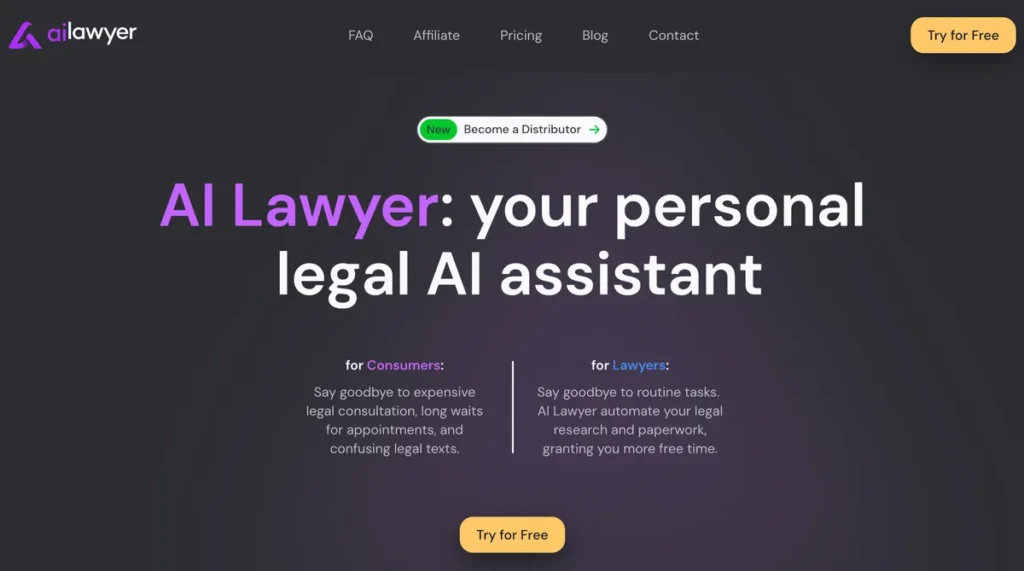
What is AI Lawyer?
From a technical standpoint, AI Lawyer is more than a simple application; it’s a platform-as-a-service (PaaS) designed to inject artificial intelligence into legal workflows. It functions as a specialized AI layer, abstracting the immense complexity of legal research and document analysis into a set of accessible, high-level tools. The system leverages a fine-tuned large language model (LLM) trained on vast legal corpora to provide its services. For legal professionals and consumers, it’s an AI assistant. For developers and IT departments, it’s a scalable, cloud-native solution designed to automate data-intensive legal processes, reducing operational overhead and accelerating case preparation through a suite of well-defined functionalities.
Key Features and How It Works
AI Lawyer’s architecture is built around several core modules designed for high performance and extensibility. Here’s a breakdown of its key components:
- Ask AI Lawyer: This feature is essentially a sophisticated Natural Language Processing (NLP) interface that queries the platform’s core legal AI model. It parses user prompts, understands legal context, and retrieves synthesized answers, effectively acting as a specialized query engine for complex legal questions.
- AI Document Handling: This module integrates advanced Optical Character Recognition (OCR) with document parsing and summarization algorithms. It can ingest various formats (including images), extract structured text, translate content, and generate concise summaries. For technical teams, this means it can be deployed to batch-process thousands of documents, standardizing data for analysis or archival.
- Internet-powered Research: Think of this feature as a highly optimized, domain-specific web crawler and indexer. Much like a finely tuned database query engine scours structured data, AI Lawyer’s research tool scans the web for relevant statutes, case law, and legal articles, returning curated and cited results in seconds. It transforms unstructured web data into actionable legal intelligence.
- Multi-platform Accessibility: The platform guarantees consistent functionality across its web, iOS, and Android clients. This is achieved through a centralized API-first design, where each client application acts as a front-end to the same core set of services. This ensures data synchronicity and a reliable user experience regardless of the access point.
- Personalization: This allows for user-level or organization-level configuration of the AI’s operational parameters. It enables users to adjust the tool’s behavior to better suit specific legal niches or internal compliance standards, making it a more adaptable component within a larger tech stack.
Pros and Cons
From a software development and integration perspective, AI Lawyer presents a compelling but nuanced value proposition.
Pros:
- API-Driven Extensibility: The availability of a custom API allows for deep integration into existing case management systems, CRMs, or bespoke enterprise applications, making it a foundational service rather than just a standalone tool.
- Scalable Cloud Architecture: Built on secure cloud infrastructure, the platform is designed for high availability and can handle fluctuating workloads, from a single user to an entire enterprise, without performance degradation.
- Workflow Automation: It effectively automates low-value, high-volume tasks like preliminary research and document summarization, freeing up development resources and legal professionals to focus on strategic work.
- Robust Security Protocols: The platform emphasizes end-to-end encryption and secure data handling, which are critical, non-negotiable requirements for any technology operating in the legal sector.
Cons:
- Integration Complexity: While an API is available, implementing custom solutions requires development resources and may present a steep learning curve for teams unfamiliar with legal tech integrations.
- Network Dependency: As a cloud-native service, it requires a stable internet connection to function. The lack of offline capabilities could be a significant limitation in certain operational contexts.
- Limited Internationalization: The current English-only focus is a major hurdle for global firms or applications requiring multilingual support, limiting its scalability across different geographic markets.
Who Should Consider AI Lawyer?
AI Lawyer is engineered for a diverse set of users who prioritize technological efficiency. Tech-forward law firms and corporate legal departments can leverage it to streamline operations and reduce billable hours spent on routine tasks. Legal tech startups can use its API as a backend to power novel applications without building a legal AI model from scratch. For individual developers and small businesses, it offers a cost-effective way to integrate powerful legal analysis tools into their products or internal workflows. Finally, law schools and academic institutions can deploy it as a practical tool to expose students to the evolving landscape of legal technology.
Pricing and Plans
AI Lawyer operates on a paid model, offering plans that cater to different usage levels. The pricing structure is designed to be accessible for individuals while providing scalable options for corporate clients.
- Pricing Model: Paid
- Starting Price: $29/month
- Available Plans: Plans begin at $29 per month. For large-scale deployments, an enterprise plan is available with custom pricing, offering features like dedicated AI models, premium support SLAs, and advanced integration capabilities. For the most current details, consulting the official website is recommended.
What makes AI Lawyer great?
What makes AI Lawyer great is its robust API and multi-platform architecture. This design philosophy elevates it from a mere application to a genuine platform. It provides the foundational building blocks for legal tech innovation, allowing organizations to embed AI-powered legal intelligence directly into their existing software infrastructure. Rather than forcing users into a walled garden, AI Lawyer offers the flexibility to be a component in a larger, customized ecosystem. This focus on extensibility and interoperability is its most powerful technical advantage, enabling a level of process automation and efficiency that standalone tools cannot match.
Frequently Asked Questions
- How does AI Lawyer handle data security and client confidentiality?
- AI Lawyer employs robust security measures, including end-to-end encryption for data in transit and at rest. It operates on secure cloud infrastructure and adheres to strict privacy protocols to ensure all client data remains confidential and protected.
- What are the limitations of the API for custom integrations?
- While powerful, the API may have usage limitations such as rate limits to ensure platform stability. Specific endpoint availability and data schema may vary. Prospective enterprise users should contact sales for detailed API documentation and to discuss high-volume requirements.
- Can the AI model be fine-tuned with a firm’s proprietary data?
- Yes, the enterprise plan offers options for creating custom, in-house AI models. This allows a firm to fine-tune the AI on its proprietary case data, documents, and legal precedents for highly specialized and accurate results.
- What is the system’s uptime and reliability record?
- AI Lawyer is built on a scalable cloud architecture designed for high availability. Enterprise clients can negotiate Service Level Agreements (SLAs) that guarantee specific uptime percentages and include provisions for premium technical support.