



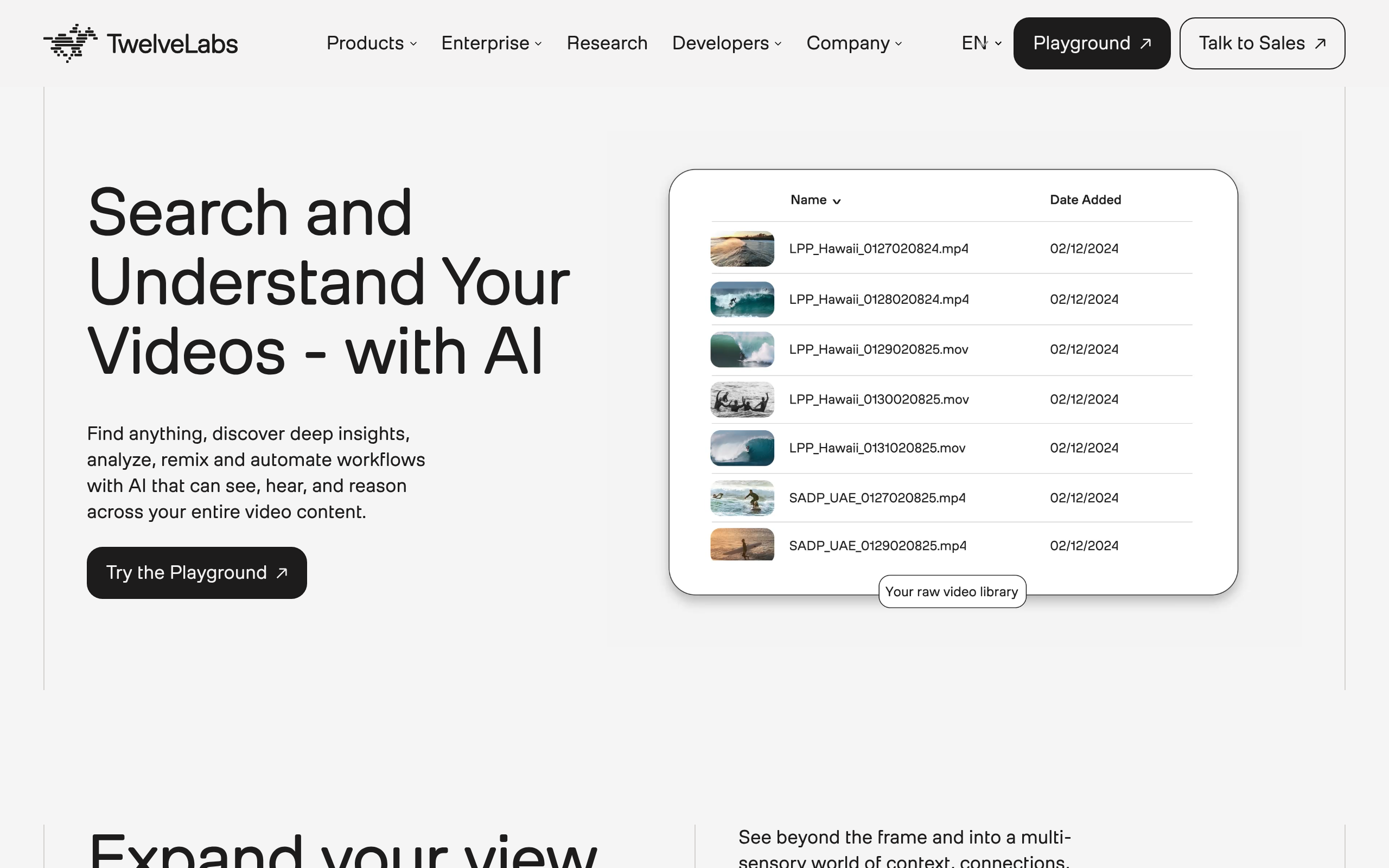
What is Twelve Labs?
Most video search engines rely on human-written tags, but Twelve Labs ignores metadata. It reads pixels, audio tracks, and on-screen text to find specific moments inside video files.
Twelve Labs Inc. built this API platform for software engineers who need to index massive video archives. It solves the problem of unsearchable media by converting video into searchable embeddings. Developers use these foundation models to build custom search, summarization, and classification tools.
- Primary Use Case: Searching through thousands of hours of video archives using natural language queries.
- Ideal For: Software developers and enterprise engineering teams building media applications.
- Pricing: Starts at $57.69 (Freemium). The developer plan charges $0.0083 per minute of indexed video.
Key Features and How Twelve Labs Works
Proprietary Foundation Models
- Marengo-2.7: A multimodal foundation model optimized for high-speed semantic search across video libraries. It limits processing to supported video formats like MP4 and MOV.
- Pegasus-1.1: A video-language model designed for generating natural language descriptions and summaries. Output length depends on the specific API parameters you set.
Search and Indexing Capabilities
- Video Indexing: Processes and stores video embeddings. The free tier restricts users to a 10-hour indexing limit.
- Semantic Search: Performs text-to-video or image-to-video searches without relying on manual tags. It requires clear visual or audio context to return accurate results.
- Temporal Localization: Identifies the exact start and end timestamps for specific events within a video clip. Accuracy drops on highly compressed video files.
Developer Infrastructure
- API and SDKs: Provides official libraries for Python, Node.js, and Go. Rate limits apply based on your subscription tier.
- Twelve Labs Playground: A web-based testing environment to experiment with search and summarization. It requires an active account to upload test files (I found the playground interface excellent for testing prompts before writing any Python code).
- Rate Limiting: Controls API traffic to maintain stability. Developer plan users start with a limit of 10 requests per second.
Twelve Labs Pros and Cons
Pros
- Delivers higher semantic accuracy compared to traditional keyword-based video metadata systems.
- Achieves indexing speeds that often exceed real-time playback for large-scale processing tasks.
- Provides clear implementation guides and highly reliable API endpoints for developers.
- Eliminates the need for manual video tagging, saving thousands of hours in labor.
Cons
- The $57.69 entry cost for the Developer plan excludes small-scale hobbyists.
- Primary model performance favors English, limiting support for complex non-English queries.
- Processing latency increases when handling very high-resolution 4K video files.
Who Should Use Twelve Labs?
- Enterprise Developers: Engineering teams building custom media asset management tools need this API to process petabyte-scale datasets.
- Content Moderation Teams: Trust and safety teams use custom classifiers to flag specific actions or objects in user-generated content.
- Not for Solo Video Editors: Freelance editors looking for a graphical interface to search their local hard drives will find this tool too technical.
Twelve Labs Pricing and Plans
The platform uses a usage-based pricing model with three distinct tiers.
- Free: Costs $0 per month. This tier provides a shared environment and caps video indexing at 10 hours. It functions as a generous trial for testing the API.
- Developer: Costs $57.69 per month. This plan unlocks unlimited indexing hours. Users pay $0.0083 per minute of indexed video (the per-minute rate adds up fast on large archives). It includes tiered rate limits starting at 10 requests per second.
- Enterprise: Custom pricing based on committed use contracts. It offers custom rate limits and dedicated support channels.
How Twelve Labs Compares to Alternatives
Similar to Google Cloud Video AI, Twelve Labs analyzes visual content to extract meaning. Google charges per specific feature like object tracking or explicit content detection. Twelve Labs charges a flat indexing rate and focuses on multimodal embeddings. Google Cloud integrates with existing Google infrastructure, while Twelve Labs requires custom integration.
Unlike Azure Video Indexer, Twelve Labs provides a dedicated web playground for rapid prompt testing without writing code. Azure Video Indexer relies on speech-to-text transcripts for search. Twelve Labs reads the actual visual pixels alongside the audio. Azure makes sense for teams locked into the Microsoft ecosystem.
The Verdict for Video Engineers
Software developers building custom media applications get the most value from Twelve Labs. The API handles the complex machine learning infrastructure, letting engineers focus on application logic. The $57.69 monthly minimum is a minor friction point for funded startups, but it deters casual users.
Solo creators or small marketing teams should look elsewhere. A consumer-facing tool like Descript offers a better graphical interface for basic video searching. Twelve Labs remains a developer platform.
Within 12 months, multimodal foundation models will process live video streams with zero latency.