

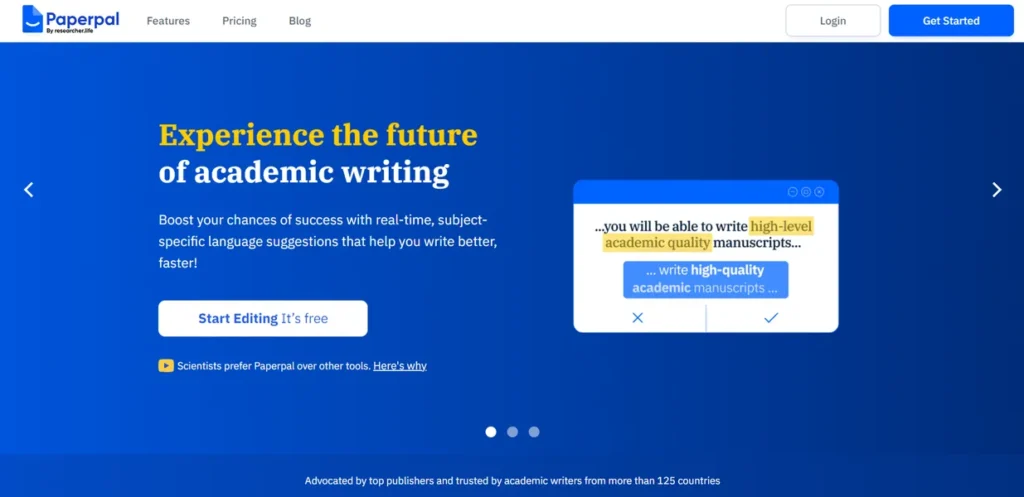
What is Paperpal?
Paperpal is a specialized, cloud-based service engineered to assist with academic and scientific writing. From a technical standpoint, it functions as an advanced language processing platform, leveraging machine learning models trained specifically on academic corpora. Unlike general-purpose grammar checkers, its backend algorithms are designed to understand the nuanced conventions, structural requirements, and terminological precision of scholarly manuscripts. It integrates directly into common writing environments, acting as an intelligent layer that provides real-time data processing for language corrections, plagiarism detection, and literature discovery. The system is built to serve a high-demand user base, including researchers, academics, and students who require uncompromising accuracy and adherence to scientific publishing standards.
Key Features and How It Works
Paperpal’s architecture is built around a core set of features delivered via its integrations. Its functionality is a testament to a well-structured system designed for high-throughput text analysis.
- Real-time Language Suggestions: This feature operates through a low-latency API that processes text snippets as the user types. The AI model analyzes syntax, grammar, and style against a massive dataset of published academic papers, providing subject-specific corrections that go beyond simple grammar rules.
- Plagiarism Checker: Functionally, this is a large-scale data comparison engine. It tokenizes the user’s manuscript and runs it against an indexed database of academic literature. The system then generates a similarity report, highlighting potential issues with clear source comparisons. The efficiency of this process suggests a highly optimized search and comparison algorithm.
- Research Feature: This component provides direct query access to an indexed database of over 250 million research articles. It allows users to validate information and find citations without context-switching, streamlining the data verification workflow.
- AI Writing Assistant: This suite of tools provides generative AI capabilities for tasks like brainstorming, summarizing, and composing professional correspondence. It’s a practical application of large language models tailored for academic communication.
- Pre-submission Checks: This automated validation tool runs a script of over 30 checks against a manuscript, covering both language and technical formatting requirements. It’s essentially a linter for academic papers, designed to reduce the probability of desk rejection due to avoidable errors.
Pros and Cons
Pros
- Specialized AI Model: The system’s strength lies in its AI, which is trained specifically on academic texts, providing contextually superior suggestions compared to generic tools.
- Robust Integration: The MS Word plugin and web editor are stable and provide a seamless user experience, indicating a well-maintained and reliable API.
- Efficient Data Processing: Real-time suggestions and plagiarism checks are performed with minimal latency, which speaks to the scalability and performance of its backend infrastructure.
- High-Level Data Security: Adherence to strict data privacy and security protocols is critical for users handling unpublished research, and Paperpal emphasizes this aspect of its service.
Cons
- Limited Extensibility: The lack of a public API prevents developers from integrating Paperpal’s services into custom workflows or other writing platforms like LaTeX editors or Obsidian.
- Closed Ecosystem: The service operates within its provided interfaces (MS Word, Web). Power users who rely on different software stacks may find this restrictive.
- Subscription Dependency: The most powerful computational features, such as unlimited checks, are gated behind a subscription, which is a standard SaaS model but can be a barrier.
Who Should Consider Paperpal?
Paperpal is engineered for a specific user profile and is most effective for those deeply embedded in the academic and scientific communities. From a software development perspective, the ideal users are those who value a turn-key, reliable service over customizability.
- Academics and Researchers: The primary user base. The tool’s feature set is directly mapped to the manuscript preparation and submission workflow.
- Graduate and PhD Students: For individuals writing theses, dissertations, and their first journal articles, Paperpal serves as a critical quality assurance layer.
- Research & Development Teams: Corporate R&D departments that publish their findings can leverage the tool to ensure their papers meet professional standards.
- Non-Native English Speakers: The language model is particularly effective at refining phrasing and correcting subtle grammatical errors that are common for non-native speakers, ensuring their research is judged on its merit, not its prose.
Pricing and Plans
Paperpal operates on a freemium model, providing core functionality for free while reserving its most computationally intensive features for subscribers. This tiered access ensures the platform remains accessible while funding its advanced capabilities.
- Free Plan: This entry-level plan offers basic language suggestions and limited access to AI features, suitable for users with minimal or infrequent needs.
- Pro Plan: Starting at $10 per month, this plan unlocks the full capabilities of the platform. It includes unlimited language suggestions, comprehensive plagiarism checks, and full access to the AI-powered research and writing assistant features.
For the most current and detailed pricing information, please consult the official Paperpal website.
What makes Paperpal great?
Struggling to find a writing assistant that understands the stringent technical and structural demands of academic publishing? What makes Paperpal a superior choice is its vertical focus. Instead of building a general-purpose writing tool, its developers have engineered a highly specialized service. Its machine learning models are not trained on generic web content but on a curated corpus of millions of peer-reviewed articles. This results in suggestions that are not just grammatically correct but contextually and stylistically appropriate for scientific discourse. The platform’s commitment to data security and the stability of its integrations demonstrate a professional-grade engineering ethos, making it a reliable tool for handling sensitive, pre-publication research data.
Frequently Asked Questions
- How does Paperpal ensure the security of unpublished research?
- Paperpal uses industry-standard encryption for data in transit and at rest. Their privacy policy ensures that user manuscripts are not used for training AI models and that all user data is handled with strict confidentiality.
- What is the technical basis for its language suggestions?
- The suggestions are generated by a proprietary AI system that combines natural language processing (NLP) with machine learning models. These models have been trained on a massive, specialized dataset of scholarly articles to recognize patterns and conventions specific to academic writing.
- Is there an API for custom integrations?
- Currently, Paperpal does not offer a public API for developers. Its functionality is accessible exclusively through its official MS Word plugin and web application.
- How does the plagiarism checker differ from other services?
- Paperpal’s plagiarism checker is integrated with a large, reputable database of academic content. It provides detailed side-by-side comparisons and a comprehensive similarity report tailored to the standards expected by academic journals and institutions.