

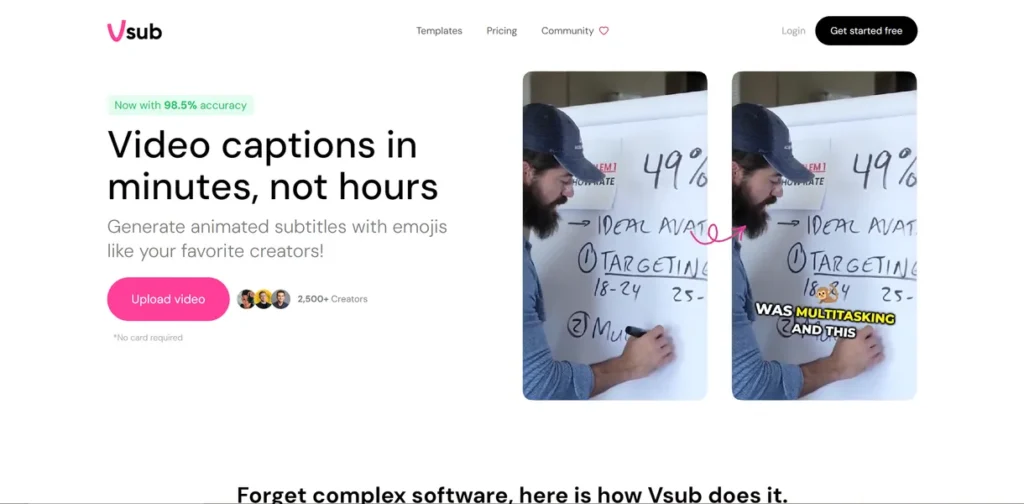
What is Vsub?
From a technical standpoint, Vsub is a specialized, cloud-based platform designed to automate a very specific video production pipeline: the creation of faceless, narrative-driven content. It functions as an integrated development environment (IDE) for story-based videos, targeting creators who need to scale production for social media platforms like TikTok, YouTube Shorts, and especially Reddit. Instead of a general-purpose NLE (non-linear editor), Vsub offers a streamlined, template-based workflow that ingests text and outputs a finished video, effectively abstracting away the complexities of traditional video editing. It’s engineered for high-volume output, prioritizing efficiency and speed for a niche but increasingly popular content format.
Key Features and How It Works
Vsub’s architecture is built around a core set of AI-driven modules that work in concert to assemble video content with minimal manual intervention. The process typically involves feeding the system a script or linking a source like a Reddit thread, after which the platform’s engine takes over.
- Auto Captioning with Animated Emojis: The system transcribes the audio narration and renders dynamic, synchronized captions. Crucially, it also contextually inserts animated emojis to heighten emotional impact and maintain viewer engagement. Think of this feature as a real-time linguistic and emotional interpreter; it not only translates spoken words into text but also adds the non-verbal cues (via emojis) that are essential for universal comprehension and connection in fast-paced social feeds.
- AI Voice Generation: At its core is a robust Text-to-Speech (TTS) engine with a library of voice models. Users can select a voice that aligns with their content’s tone, ensuring brand consistency across a series of videos without the overhead of recording and mastering human voiceovers. This allows for rapid iteration and A/B testing of narration styles.
- Cross-Platform Compatibility: The rendering engine is optimized to output video files with the correct aspect ratios, codecs, and compression levels for various social media platforms. This pre-configuration removes the guesswork and post-production transcoding steps, ensuring content is ready for immediate deployment.
- Automation Tools: This is the platform’s primary value proposition. It offers dedicated workflows for specific use cases, such as converting Reddit stories into videos. This involves programmatic data scraping, content parsing, and asset assembly, turning a multi-hour manual process into a task that can be executed in minutes.
Pros and Cons
From a software development perspective, Vsub presents a compelling but specialized toolchain. Its strengths lie in its focused design, but that same focus introduces limitations.
Pros
- Significant Efficiency Gains: The platform dramatically reduces the production cycle time, allowing for a 10x increase in content velocity by automating repetitive editing tasks.
- Scalable Production Model: The lifetime access plan provides a fixed-cost solution for potentially unlimited video rendering, making it a highly scalable option for content-heavy operations.
- Abstracted Complexity: The user-friendly interface lowers the technical barrier to entry, allowing individuals without a background in video engineering to produce polished content.
- Active Feedback Loop: The dedicated Discord server provides a direct channel to the development team, facilitating bug reporting, feature requests, and community-driven support.
Cons
- Specialized Toolchain: The platform is purpose-built for a specific content format. It lacks the flexibility of general-purpose video editors and is not suitable for projects outside its narrative-driven niche.
- Mastering Automation Workflows: While the basics are simple, leveraging the full suite of automation tools to their maximum potential requires an initial time investment to understand the system’s logic and capabilities.
- Constrained Customization: Advanced users may find the level of control over AI voice inflection, animation timing, and graphical elements to be limited compared to manual production workflows.
Who Should Consider Vsub?
Vsub is best suited for teams and individuals whose business model relies on the high-volume production of templated video content. Its architecture is optimized for specific roles:
- Digital Publishers: Content creators and media companies that monetize faceless narrative channels and require a predictable, scalable production system.
- Social Media Managers: Professionals tasked with maintaining high content velocity on short-form video platforms to drive engagement and audience growth.
- Video Marketers: Teams executing programmatic content marketing campaigns that use storytelling to engage potential customers or deliver educational material.
- Community Managers: Individuals managing brand communities or subreddits who need to quickly generate video content from user-generated text.
- Uncommon Use Cases: Educators could automate the creation of video-based learning modules from written lesson plans. Developers might use it to auto-generate simple explainer videos for software features from documentation.
Pricing and Plans
Vsub operates on a freemium model, offering a straightforward entry point for users to evaluate its core functionality. The structure includes a free tier that allows for testing the platform’s features with certain limitations. For users ready to scale production, the primary offering is a Pro plan, priced at $9 per month, which unlocks the full capabilities of the tool. Occasionally, a one-time purchase for lifetime access is made available, providing a cost-effective option for power users. For the most current and detailed pricing information, consulting the official Vsub website is recommended.
What makes Vsub great?
Struggling to scale your video output without a corresponding increase in production overhead? Vsub’s primary strength lies in its focused, vertical integration. Instead of forcing creators to stitch together separate tools for text-to-speech, captioning, asset sourcing, and editing, Vsub consolidates the entire workflow into a single, cohesive system. This design philosophy solves a critical bottleneck in modern content creation: the trade-off between quality, speed, and cost. By building an opinionated, automated pipeline specifically for narrative-driven social videos, Vsub provides a powerful solution for a very specific, high-demand market segment. It’s a classic example of engineering a tool to do one job exceptionally well, rather than many jobs passably.
Frequently Asked Questions
- How does Vsub process data from external sources like Reddit?
- Vsub likely uses a combination of official APIs (where available) and web scraping technologies to pull text content from specified URLs. The platform then parses this raw text, breaking it down into scenes or sentences that its AI engine uses to sequence narration, captions, and background visuals.
- Are the AI-generated voices customizable?
- Vsub provides a selection of pre-rendered AI voice models with different genders, accents, and tones. While you can choose the voice that best fits your content, fine-grained control over specific word inflection, pace, and emotional tone is generally limited, a common trade-off in current TTS technology for the sake of speed and simplicity.
- What level of technical skill is required to use Vsub?
- Basic operations in Vsub are designed to be intuitive, requiring no prior video editing experience. However, to leverage its full automation potential, a logical mindset and a willingness to learn the platform’s workflow-building tools will be beneficial. It’s easy to start, with a moderate ceiling for mastery.
- Can Vsub be integrated into a larger workflow via an API?
- While the current product is presented as a self-contained web application, its modular, automated nature suggests a backend architecture that could potentially support an API in the future. Currently, there is no public-facing API for direct integration, so it operates as a standalone tool in a content pipeline.