



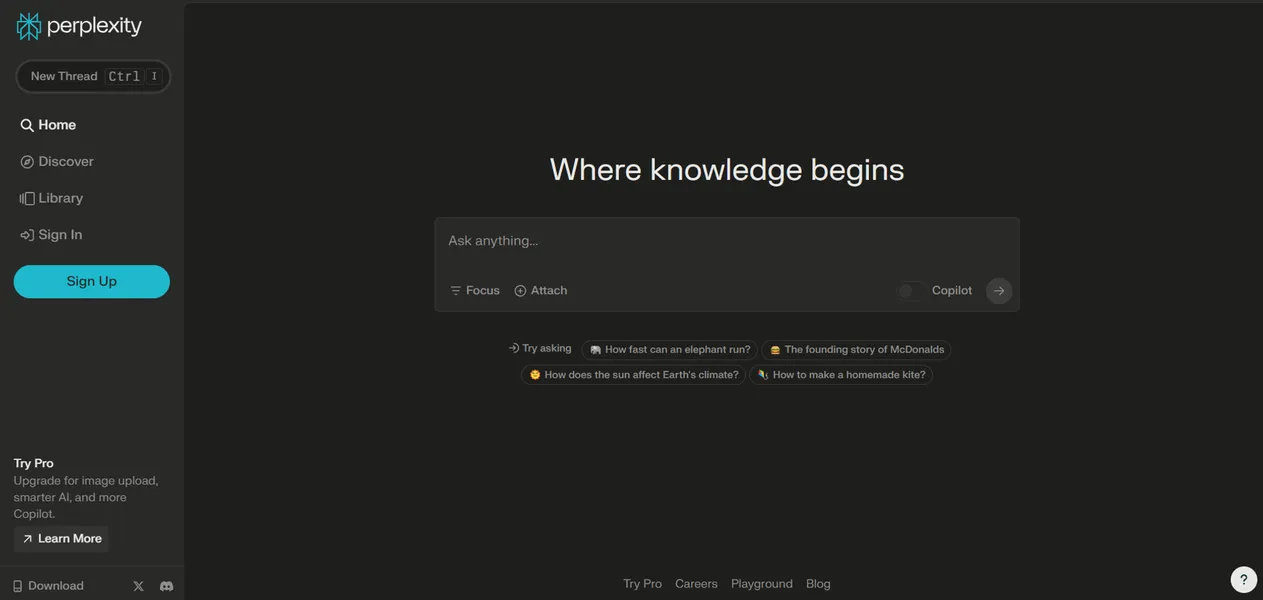
What is Perplexity?
Users expected AI search engines to replace Google. They got something different: a specific research assistant that prioritizes citations over broad discovery. Perplexity AI, Inc. built this conversational search engine to solve the hallucination problem plaguing early generative models. It pulls live web data and attaches footnote links to every claim.
The tool targets academics, analysts, and professionals who need verifiable facts fast. You type a question, and the engine reads multiple live web pages before drafting a response. This process stops users from clicking through ten different tabs.
- Primary Use Case: Conducting academic research with verifiable citations from peer-reviewed journals.
- Ideal For: Researchers and professionals seeking verified information without traditional search ads.
- Pricing: Starts at $17/mo (Freemium). Pro users get 600 advanced queries daily.
Key Features and How Perplexity Works
Search and Reasoning Models
- Pro Search: Executes multi-step reasoning for complex queries. Limited to 600 queries per day on the Pro plan.
- Model Selection: Lets users switch between GPT-4o, Claude 3.5 Sonnet, and Sonar Large. Available only to paid subscribers.
Document and Data Handling
- File Uploads: Reads and summarizes external documents. Supports PDF, CSV, and text files up to 25MB per file.
- Collections: Organizes specific threads into shared folders. Users must categorize these threads by hand.
Content Generation and Output
- Pages: Converts raw research threads into formatted, shareable web articles. Output length depends on the initial prompt complexity.
- Image Generation: Creates visual content using DALL-E 3 or Stable Diffusion XL. Restricted by the daily Pro Search query limit.
Developer and Integration Tools
- API Access: Allows developers to integrate search capabilities into external applications. Usage incurs separate API billing costs.
- Source Citations: Adds inline links to every source used to generate an answer. Depends on the availability of public web data.
Perplexity Pros and Cons
Pros
- Real-time web access ensures information is current compared to static LLM training data.
- Transparent sourcing allows users to verify facts by clicking direct links to original content.
- Multi-model flexibility lets Pro users switch between top-tier models like Claude and GPT-4o.
- The Pages feature transforms raw research into formatted articles with one click.
Cons
- The AI misinterprets the content of the cited sources at times, leading to subtle factual errors.
- The free tier is limited to basic search and lacks the advanced reasoning of Pro Search.
- High-volume users experience rate limits even on the Pro plan during peak times.
Who Should Use Perplexity?
- Academic Researchers: You need fast summaries of peer-reviewed papers with exact citations.
- Data Analysts: You compare product specifications and prices across multiple platforms.
- Casual Browsers: This is not a good fit for you. Standard search engines handle basic navigation queries much faster.
Perplexity Pricing and Plans
- Standard (Free): Includes basic search and help center access. This is a real free tier, not a trial.
- Pro ($17/mo): Adds advanced models, priority support, and file uploads. Users get 600 Pro Search queries daily.
- Max ($200/mo): Provides unlimited research queries, newest models, and an AI email assistant.
- Enterprise Pro ($40/user/mo): Adds team management, SOC 2 compliance, and data privacy controls.
- Enterprise Max ($325/user/mo): Unlocks unlimited research and labs for large organizations.
How Perplexity Compares to Alternatives
Similar to ChatGPT, Perplexity uses advanced language models to generate text. But ChatGPT focuses on creative writing and coding tasks. Perplexity forces the model to cite external sources for every factual claim. ChatGPT offers a broader plugin ecosystem, while Perplexity keeps the interface focused on search and retrieval.
Unlike Google Gemini, this tool does not integrate into a massive workspace suite like Google Workspace. Gemini pulls data from your Google Docs and Gmail accounts. Perplexity operates as a standalone research environment. Users who rely on Google Drive might find Gemini more convenient for internal document searches.
The Verdict for Fact-Driven Researchers
Perplexity delivers massive value to analysts who spend hours verifying claims. The $17 monthly Pro plan pays for itself if you synthesize complex topics. (I found the Claude 3.5 Sonnet integration accurate for technical summaries).
But casual users should skip the paid tiers.
If you need creative writing assistance, look elsewhere. ChatGPT remains the better choice for drafting original marketing copy or brainstorming fiction.
If you need hard facts and clickable footnotes, choose Perplexity.