



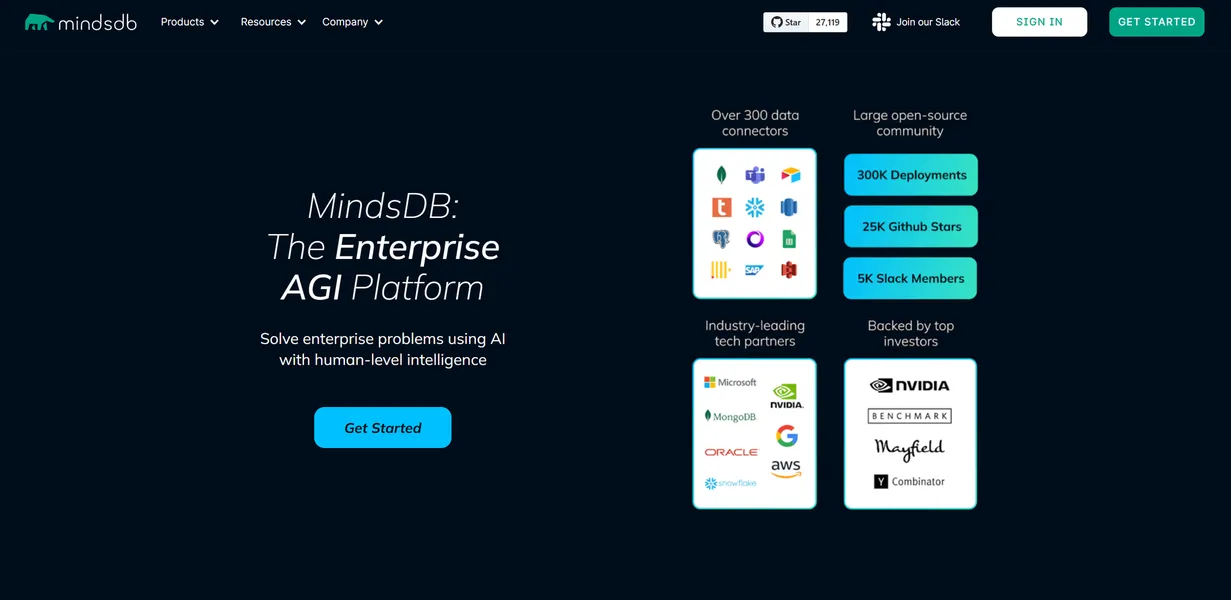
What is MindsDB?
MindsDB is an open-source middleware layer that lets you query machine learning models using standard SQL. You write a SQL statement, and the platform returns an AI-generated prediction or text response.
MindsDB Inc. built this platform to eliminate traditional data extraction pipelines. Data engineers and SQL developers use it to connect databases like PostgreSQL directly to models from OpenAI or Anthropic. You avoid moving data into separate Python environments.
- Primary Use Case: Querying machine learning models directly from existing SQL databases.
- Ideal For: SQL developers and data engineers building AI features.
- Pricing: Starts at $35/month (Pro Cloud) – The free cloud tier only allows 50 queries monthly.
Key Features and How MindsDB Works
Database and Model Integrations
- Connects to 100+ data sources including PostgreSQL, MongoDB, and Snowflake. Limit: Custom connectors require manual coding.
- Access to 50+ AI engines including OpenAI and Hugging Face. Limit: API costs for third-party models are billed separately by the provider.
SQL-Based AI Operations
- Deploy and query models using standard SQL syntax. Limit: Complex model debugging is harder than in native Python environments.
- Automated fine-tuning on private enterprise data. Limit: Requires properly formatted training data within the connected database.
Deployment and Security
- Available via managed cloud, Docker, or on-premise. Limit: Self-hosting requires significant infrastructure management.
- SOC2 Type II compliance with role-based access control. Limit: Advanced security features only exist on custom Enterprise plans.
MindsDB Pros and Cons
Pros
- Eliminates ETL pipelines by bringing AI models to the data source.
- Allows SQL developers to build AI features without learning Python.
- Open-source core permits extensive customization and private self-hosting.
- Connects to over 100 data sources, reducing custom connector code.
Cons
- The cloud free tier restricts users to just 50 queries per month.
- Debugging SQL-based model errors lacks the transparency of Python environments.
- Running heavy inference tasks on large datasets causes database performance overhead.
- Documentation is inconsistent, with some advanced features lacking detailed implementation guides.
Who Should Use MindsDB?
- SQL Developers: You can build AI applications using familiar database query languages.
- Data Engineering Teams: You save time by skipping complex data extraction and loading pipelines.
- Privacy-Conscious Organizations: You can self-host the open-source version to keep sensitive data internal.
- Not for Python Data Scientists: If you prefer Jupyter notebooks and custom Python scripts, this SQL-first approach feels restrictive.
MindsDB Pricing and Plans
MindsDB operates on a freemium model with open-source and managed cloud options.
- Community: Free. Open source under MIT and Elastic Licenses for container deployment.
- Free Cloud: $0/month. Includes a cloud instance but limits you to 50 queries per month (this acts more like a trial).
- Pro: $35/month. Provides a plug-and-play cloud instance billed monthly.
- Teams: Custom pricing. Annual subscription for customized deployment anywhere.
- Enterprise: Custom pricing. Organization-wide access with advanced security and support.
How MindsDB Compares to Alternatives
Similar to Mage.ai, MindsDB targets data engineers looking to integrate AI into existing workflows. Mage.ai focuses heavily on building and orchestrating data pipelines with AI assistance. MindsDB skips the pipeline entirely by bringing the model directly to the database.
Unlike Continual, which specializes in operational AI for modern data stacks, MindsDB offers broader model support. Continual focuses strictly on predictive machine learning models for platforms like Snowflake. MindsDB handles both predictive tasks and generative AI text generation.
The Verdict: Best for SQL-Heavy Data Teams
SQL developers get the most value from MindsDB. You can add sentiment analysis or predictive forecasting to your applications without learning new programming languages.
Python-native data scientists should look elsewhere. If you need complex custom model architectures, a tool like SageMaker fits better.
MindsDB will likely expand its autonomous AI agent capabilities over the next 12 months.