



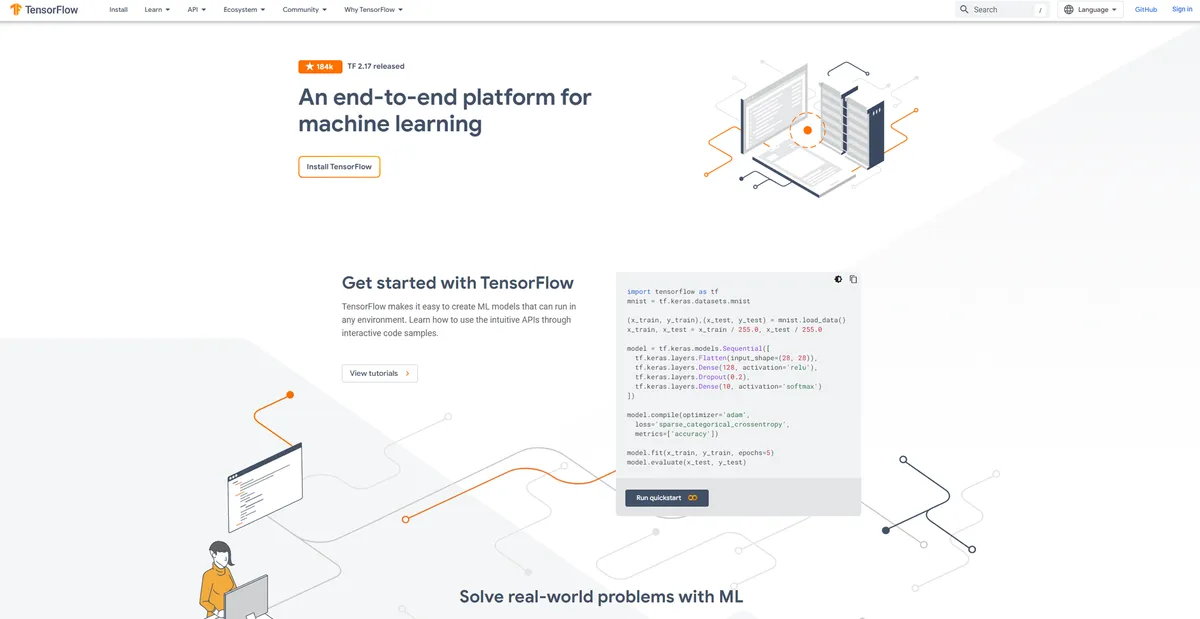
What is TensorFlow?
TensorFlow is an open-source machine learning library developed by Google that enables teams to build, train, and deploy sophisticated AI models. For a marketing manager, this isn’t just abstract technology; it’s a powerful engine for transforming raw data into a competitive advantage. With TensorFlow, your development or data science teams can construct predictive models that forecast customer behavior, segment audiences with unparalleled precision, and automate campaign optimizations. It provides the fundamental building blocks to move beyond standard analytics and create proprietary marketing intelligence tools that directly address your unique business challenges, from enhancing lead generation funnels to personalizing the customer journey at scale.
Key Features and How It Works
TensorFlow operates by allowing developers to create data flow graphs, where nodes represent mathematical operations and edges represent the data arrays (tensors) that flow between them. This structure is highly efficient for machine learning tasks. For marketing leaders, the key is understanding how its features translate to campaign impact.
- Comprehensive Ecosystem: TensorFlow is more than just a library; it’s a suite of tools. This includes TensorBoard, a visualization toolkit that allows your team to inspect model performance. For marketers, this means you can get clear, visual reports on how a predictive model is performing, making it easier to understand its logic and trust its outputs for campaign decisions.
- Flexible Architecture: The framework’s flexibility allows developers to deploy models across various platforms, including servers, mobile devices (iOS and Android), and web browsers. This enables your team to run predictive analytics directly where your customers are, such as powering real-time product recommendations in a mobile app or optimizing a web experience on the fly.
- Production-Ready Deployment: TensorFlow Serving is a dedicated system designed to deploy models into live, production environments. This ensures that a successful model built for analyzing customer churn can be quickly and reliably integrated into your CRM or marketing automation platform, accelerating the workflow from insight to action.
- Extensive API Support: With robust support for Python, one of the most common languages for data science, TensorFlow allows developers to build and iterate on models quickly. This means faster development cycles for custom marketing tools like lead scoring algorithms or media mix models.
Pros and Cons
Understanding TensorFlow’s strengths and weaknesses is critical for determining its fit within your marketing technology stack.
Pros
- Scalability: TensorFlow is engineered to handle massive datasets and can scale from a single machine to a distributed network of servers. This is ideal for analyzing large-scale customer data to inform global marketing campaigns.
- Customization: It offers deep flexibility to build highly tailored models that address specific marketing objectives, something pre-packaged analytics solutions cannot match.
- Strong Community Support: Backed by Google and a vast open-source community, your development team has access to extensive documentation, tutorials, and expert forums, which helps reduce development roadblocks and accelerate project timelines.
- Seamless Integration: It integrates tightly with the Google Cloud Platform, providing a streamlined workflow for teams already using Google’s ecosystem for data storage and computation.
Cons
- Steep Learning Curve: TensorFlow is not a user-friendly, out-of-the-box tool for marketers. It requires specialized knowledge in programming and machine learning, necessitating dedicated data science or engineering resources.
- Resource-Intensive: Training complex models requires significant computational power (often GPUs), which can lead to substantial cloud computing costs, impacting your marketing budget.
- Development Time: Building, training, and fine-tuning a custom model is a time-consuming process compared to implementing an off-the-shelf analytics tool.
Who Should Consider TensorFlow?
TensorFlow is best suited for marketing departments that are ready to invest in building proprietary, data-driven capabilities for a significant competitive edge. Consider this framework if your team fits one of these profiles:
- Data-Mature Organizations: Companies with established data science or ML engineering teams that can leverage its power to build custom solutions for lead scoring, customer lifetime value prediction, or dynamic content personalization.
- High-Growth Startups: Tech-forward startups that need to build scalable, data-centric marketing engines from the ground up without incurring high licensing fees for enterprise software.
- Marketing Teams with Unique Challenges: If your audience segmentation or campaign optimization needs go beyond the capabilities of standard marketing analytics platforms, TensorFlow provides the tools to build a perfectly tailored solution.
- Enterprises Managing Big Data: Large corporations that need to process and analyze massive volumes of customer data to uncover subtle trends and drive high-stakes marketing strategies.
Pricing and Plans
TensorFlow is an open-source library and is free to download and use. This makes it an incredibly cost-effective foundation for building powerful machine learning models. However, the total cost of ownership is not zero. Expenses will arise from the computational resources required for training and deploying models, such as cloud services from providers like Google Cloud, AWS, or Azure, as well as the cost of the specialized talent needed to work with the framework. For the most accurate and up-to-date pricing, please visit the official TensorFlow website.
What makes TensorFlow great?
TensorFlow’s most powerful feature is its profound scalability, allowing marketing operations to grow from initial pilot projects to enterprise-wide deployments without changing the underlying framework. This scalability means a model developed to analyze a small customer segment can be confidently deployed to manage millions of interactions across a global campaign. This capability, combined with its production-focused tools like TensorFlow Serving, ensures that your machine learning initiatives are not just research projects but robust, reliable components of your marketing workflow. It empowers your team to build and own proprietary models that deliver a sustainable competitive advantage by continuously refining customer targeting, improving lead quality, and maximizing campaign ROI in a way that generic tools cannot replicate.
Frequently Asked Questions
- Do I need a data scientist on my marketing team to use TensorFlow?
- Yes, almost certainly. TensorFlow is a low-level development library, not a user-facing application. Its effective use requires expertise in programming (primarily Python) and a solid understanding of machine learning principles. It is a tool for builders, not for direct use by most marketing campaign managers.
- How can TensorFlow specifically improve lead generation?
- TensorFlow can be used to build a predictive lead scoring model. By training a model on historical data of leads that converted, it can analyze incoming leads in real-time and assign a score based on their likelihood to become customers. This allows your sales team to prioritize their efforts on the most promising prospects, increasing conversion rates and efficiency.
- Is TensorFlow a replacement for our current marketing analytics platform?
- Not directly. TensorFlow is better viewed as a tool to augment your existing stack. While your analytics platform provides dashboards and reports on past performance, TensorFlow can build predictive models that forecast future outcomes. You can use it to create custom solutions that integrate with your CRM or analytics tools to provide forward-looking insights.
- What are the primary hidden costs of using TensorFlow?
- While the software itself is free, the two main costs are compute resources and talent. Training sophisticated models can be computationally expensive, often requiring powerful cloud-based GPUs which are billed by the hour. Additionally, hiring and retaining skilled machine learning engineers or data scientists represents a significant investment.