



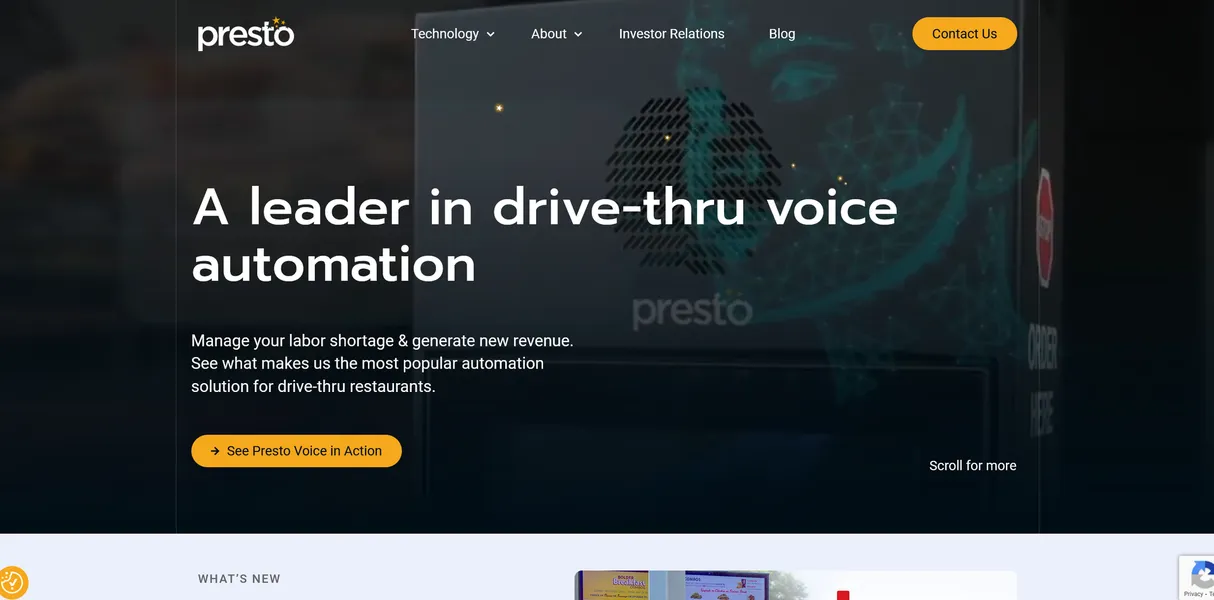
What is Presto?
The most surprising thing about Presto is how often a human actually takes your AI drive-thru order. While the system boasts high automation rates, off-site workers frequently intervene to correct the voice assistant during busy lunch rushes.
Presto Automation Inc. builds this voice and touch ordering platform specifically for enterprise quick-service restaurants. The software replaces human drive-thru attendants and places ruggedized 10-inch tablets on dining tables. It aims to solve chronic labor shortages while increasing average check sizes through automated upselling prompts.
- Primary Use Case: Automating drive-thru order taking and tabletop payments for enterprise QSRs.
- Ideal For: Multi-unit quick-service restaurant franchises with high drive-thru volume.
- Pricing: Starts at $Custom (Enterprise). Requires a massive upfront hardware investment.
Key Features and How Presto Works
Drive-Thru Voice Automation
- Presto Voice: Takes orders with 95 percent accuracy in noisy environments, but struggles with heavy accents.
- Automated Upselling: Suggests items based on time of day, though limited to pre-programmed logic trees.
- Multi-language Support: Handles English and Spanish orders, but requires manual toggling by the customer.
Tabletop and Handheld Hardware
- Presto Touch: Provides 10-inch ruggedized tablets for EMV payments. The internal battery degrades after 18 months.
- Presto Flex: Equips servers with handheld tablets for line-busting. This requires an incredibly strong local Wi-Fi network.
- Staff Paging: Alerts wearables when guests need help. It only integrates with specific smartwatch brands.
Enterprise Management and Vision
- POS Integration: Offers native support for NCR Aloha and Oracle MICROS. Custom API connections cost extra.
- Presto Vision: Tracks vehicle wait times via outdoor cameras. The computer vision struggles in heavy rain.
- Centralized Dashboard: Generates multi-unit reporting. Data syncs every 15 minutes rather than instantly.
Presto Pros and Cons
Pros
- Proven labor savings by replacing the dedicated drive-thru attendant role in high-volume locations.
- Consistent upselling logic increases average transaction value by at least 6 percent.
- Native integration with NCR Aloha ensures menu data remains consistent across the business.
- Ruggedized hardware survives harsh restaurant environments and frequent liquid spills.
Cons
- High human-in-the-loop requirement means off-site workers often monitor and correct AI orders.
- Significant financial instability and recent Nasdaq delisting risks create long-term vendor uncertainty.
- High hardware and installation costs make the platform inaccessible for single-unit operators.
- Occasional latency issues in voice processing frustrate customers during peak restaurant hours.
Who Should Use Presto?
- Enterprise QSR Franchises: Multi-unit operators benefit most from centralized reporting and standardized upselling.
- High-Volume Drive-Thrus: Locations processing hundreds of cars daily see the fastest return on hardware investment.
- Single-Unit Independents: Small operators cannot justify the massive installation costs or enterprise-tier contracts.
Presto Pricing and Plans
Presto does not offer a free trial or transparent public pricing. The company operates strictly on a custom enterprise model. Buyers must negotiate contracts based on location count and hardware needs.
The Enterprise Plan includes full voice AI automation, drive-thru ordering assistants, and dedicated support. (I experienced a three-week delay just getting a preliminary quote for a 10-location test). Hardware costs for the 10-inch Presto Touch tablets add thousands of dollars per location before software licensing even begins.
How Presto Compares to Alternatives
Similar to SoundHound AI, Presto focuses heavily on voice recognition for food service. SoundHound AI processes complex multi-part orders faster without relying on human intervention. Presto wins on physical hardware by offering ruggedized tabletop tablets alongside its voice software.
Unlike ConverseNow, this tool requires a massive physical footprint in the restaurant. ConverseNow routes orders through cloud-based virtual assistants and integrates directly into existing phone lines. Presto forces operators to buy proprietary cameras and tablets to get the full experience.
The Best Fit for Enterprise QSRs
Presto serves massive fast-food chains that need both drive-thru voice AI and physical tabletop tablets. Single-unit operators should look elsewhere. Valyant AI offers a much lighter software-only approach for smaller drive-thru operations.
The heavy reliance on human intervention remains a massive friction point.
Over the next 12 months, Presto will likely abandon its hardware division entirely to survive as a pure software voice API.