

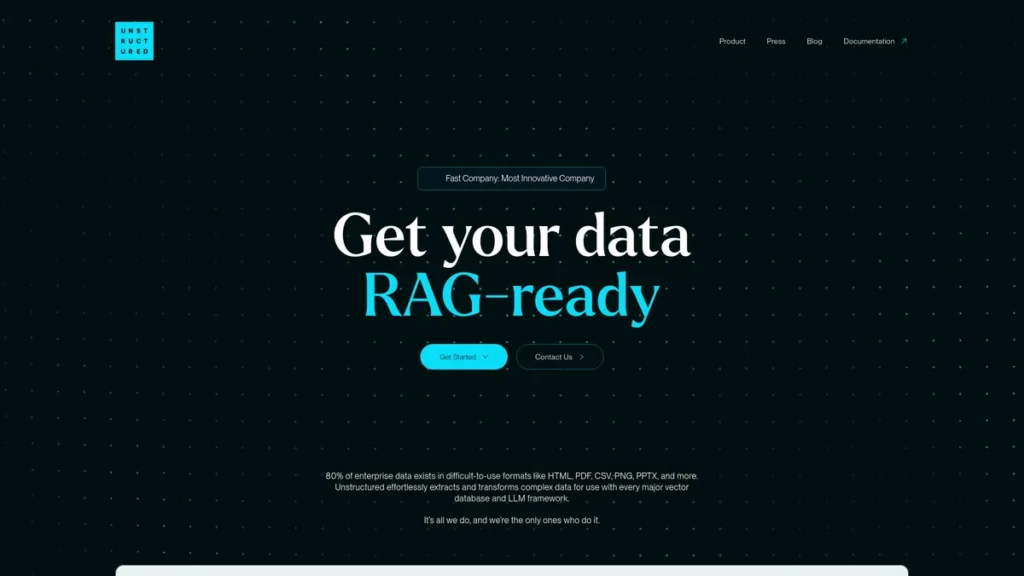
What is Unstructured Technologies?
For any business, valuable information is often trapped in documents, emails, PDFs, and images—so-called unstructured data. Extracting this information manually is time-consuming and prone to error. Unstructured Technologies is an innovative platform designed to solve this problem. It automates the process of extracting, transforming, and loading (ETL) this messy data so it can be used effectively by large language models (LLMs) and other AI applications. For a small business owner, this means turning your existing document archives into a source of actionable insights without dedicating countless hours to manual data entry. It’s a tool aimed at data scientists and AI researchers, but its core function is to make data preparation simpler and faster for AI-driven projects.
Key Features and How It Works
Unstructured Technologies operates by creating automated data pipelines. You define the source of your unstructured data and the format you need, and the platform handles the processing. Here’s a breakdown of its core features from a business perspective:
- Advanced Data Parsing: The system can intelligently pull specific information from a wide variety of file formats. This means it can extract customer names from emails, key clauses from legal PDFs, or product details from text documents, saving significant manual labor.
- Automated Workflows: You can create and schedule custom data pipelines. For example, you could set up a workflow to automatically process all new customer feedback emails that arrive in a specific inbox, preparing the text for sentiment analysis by an AI model. This “set it and forget it” approach ensures a constant flow of ready-to-use data.
- Scalability: While built for enterprise-scale tasks, this feature offers peace of mind for a growing business. It means the platform can efficiently handle an increasing volume of data as your company expands, without performance degradation.
- Integration with AI Models: This is a critical feature. The platform is built to connect directly with various AI and machine learning models. This seamless connection means you can feed your processed data straight into an AI for analysis, bypassing complex intermediate steps.
Pros and Cons
Evaluating any new tool requires a clear-eyed look at its benefits and drawbacks, especially when resources are tight.
Pros
- Time and Cost Savings: The primary ROI comes from automating manual data preparation. This directly reduces labor costs and frees up employee time for more valuable activities.
- Improved Data Accuracy: Automated extraction minimizes human error, leading to higher-quality data. When feeding this data into an AI, the resulting insights and predictions are more precise and reliable.
- User-Friendly Interface: Despite its powerful backend, the platform has an intuitive interface, which lowers the learning curve and makes it more accessible to users who may not have a deep technical background.
Cons
- Complex Initial Setup: While the interface is user-friendly, configuring the data pipelines for your specific needs can require some technical expertise. This isn’t a simple plug-and-play solution and may demand an initial time investment to optimize.
- Limited Customization: Some users may find the workflow customization options restrictive. If your business has a highly unique data processing requirement, you might find the platform’s standard options don’t fully accommodate it.
- Data Source Dependency: The old adage of “garbage in, garbage out” applies here. The tool’s effectiveness is directly tied to the quality of your source documents. Poorly scanned or formatted files can hinder performance.
Who Should Consider Unstructured Technologies?
This platform is most valuable for businesses that handle a significant volume of document-based information and want to leverage it for AI-powered insights. Small to medium-sized businesses in sectors like legal, healthcare, marketing, and real estate could see a substantial return on investment. For example, a small law firm could use it to rapidly process and categorize information from case files. A marketing agency could analyze thousands of customer reviews to identify trends. If you’re an entrepreneur looking to build an AI feature into your product but are concerned about the data preparation bottleneck, Unstructured Technologies provides a practical solution without the need to hire a dedicated data engineering team.
Pricing and Plans
Unstructured Technologies uses a freemium model, allowing businesses to test its capabilities before committing financially. This approach is ideal for small businesses needing to validate a tool’s ROI.
- Free Tier: This plan provides access to the platform’s core features, making it suitable for small-scale projects or for a thorough evaluation of its functionality.
- Pro Plan: Priced at $9 per month, this plan unlocks the full suite of features, offering greater processing capacity and more advanced capabilities for businesses ready to integrate the tool into their daily operations.
Disclaimer: For the most accurate and up-to-date pricing, please refer to the official Unstructured Technologies website.
What makes Unstructured Technologies great?
What makes Unstructured Technologies great is its direct, seamless integration with existing AI and machine learning models. This capability is its most powerful feature because it eliminates the need for intermediary software or complex custom scripts to connect your data to your AI. For a small business, this means a significantly shorter and less expensive path from raw data to valuable business intelligence. It streamlines the entire workflow, allowing you to focus on the insights generated by your AI rather than the technical challenges of feeding it clean, properly formatted data. This focus on end-to-end efficiency is what provides a tangible competitive advantage.
Frequently Asked Questions
- How much technical skill is really needed to set this up?
- While the day-to-day interface is user-friendly, the initial setup of data pipelines can be complex. A user should be comfortable with basic data concepts. Non-technical users can manage with the help of the provided tutorials, but some initial technical assistance might be needed to optimize workflows.
- Can Unstructured Technologies work with my existing cloud storage like Google Drive or AWS?
- Yes, the platform integrates with major cloud storage providers, including AWS, Google Cloud, and Azure. This allows for seamless data management and processing directly from where your files are already stored.
- What kind of security measures are in place for my sensitive business data?
- Unstructured Technologies employs robust data privacy and security protocols to protect your information during processing. However, it’s always recommended to review their specific security documentation to ensure it aligns with your company’s compliance requirements.
- Is the free plan actually useful, or is it just a limited demo?
- The free tier is designed to be functional for smaller projects and thorough evaluations. It allows you to test the core data parsing and workflow features to determine if the platform is a good fit for your business needs before upgrading to a paid plan.