


What is FiftyOne?
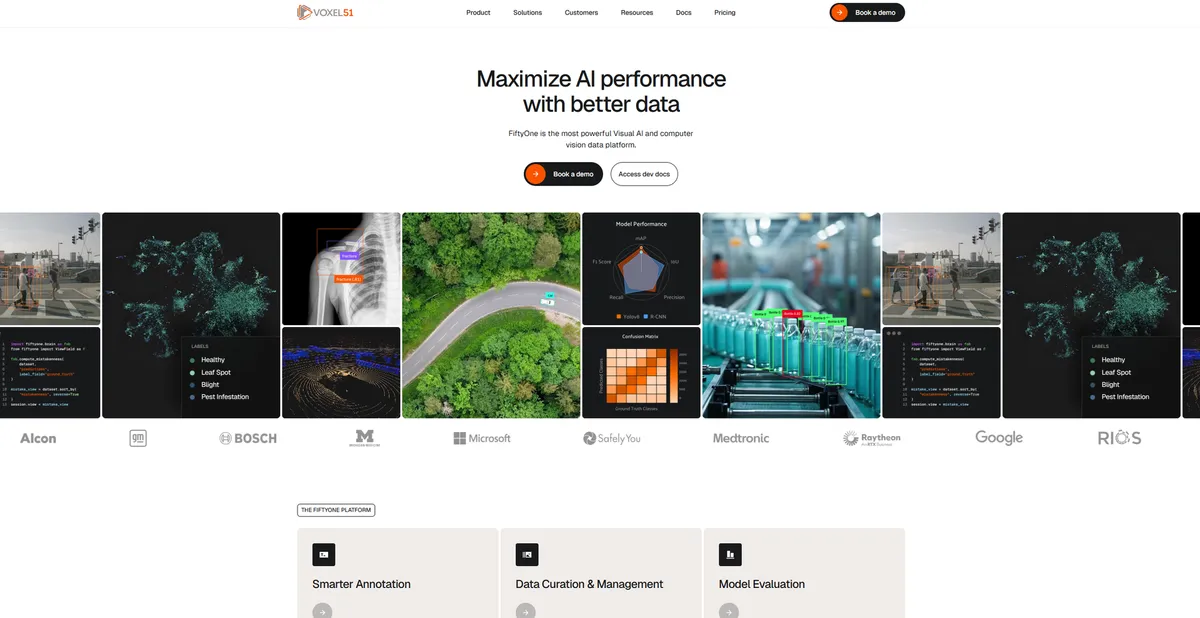
Computer vision engineers spend up to 80 percent of their time managing datasets instead of training models. Voxel51 built FiftyOne to solve this data bottleneck. The open-source tool helps machine learning engineers visualize, query, and manage image data. Users evaluate model performance by comparing ground truth labels against predictions side by side.
The platform targets Python-proficient machine learning engineers and computer vision researchers. Users can filter datasets to find edge cases or mislabeled samples using Python-based queries. The core version runs on local machines, keeping proprietary data secure during the curation process.
- Primary Use Case: Visualizing object detection bounding boxes and querying datasets for edge cases.
- Ideal For: Python-proficient machine learning engineers and computer vision researchers.
- Pricing: Starts at $0 (Freemium) – The open-source core provides local data management, while team collaboration requires a paid enterprise plan.
Key Features and How FiftyOne Works
Automated Data Curation
- FiftyOne Brain: Finds visual similarity and uniqueness across datasets. Limit: Users must generate embeddings first, consuming local compute resources.
- Similarity Search: Integrates with Pinecone and Milvus vector databases to find similar images. Limit: Users must configure external databases for large scale operations.
Programmatic Dataset Management
- Python SDK: Provides an API for dataset manipulation, filtering, and model evaluation. Limit: Non-programmers cannot use the interface without writing Python code.
- Dataset Zoo: Loads COCO, VOC, and Open Images datasets with one command. Limit: Downloading large public datasets requires large local storage drives.
Visual Evaluation and Annotation
- Annotation API: Integrates with Labelbox, CVAT, and Label Studio. Limit: FiftyOne lacks native annotation tools, requiring third-party accounts.
- Point Cloud Visualizer: Offers an interactive 3D viewer for LiDAR and multi-sensor fusion data. Limit: Rendering dense point clouds causes lag on machines without dedicated GPUs.
FiftyOne Pros and Cons
Pros
- Open-source core allows researchers to manage large datasets on local machines without data privacy concerns.
- Python-first approach enables integration into existing PyTorch or TensorFlow training loops.
- Advanced querying allows users to isolate specific edge cases in seconds using metadata filters.
- Built-in visualization of model predictions helps identify systematic errors that metrics miss.
Cons
- Requires Python proficiency, making it inaccessible for non-coding data annotators.
- Multi-user collaboration and centralized hosting features are restricted to the paid enterprise tiers.
- Large video datasets cause performance bottlenecks in the web-based visualizer on local hardware.
- Documentation for custom plugin development is limited compared to core features.
Who Should Use FiftyOne?
- Computer vision researchers: The open-source core allows local management of large datasets without privacy risks.
- Machine learning engineers: The Python SDK integrates into existing PyTorch or TensorFlow training pipelines.
- Non-coding data annotators: This tool is not a good fit. FiftyOne requires Python knowledge to filter datasets and configure views.
FiftyOne Pricing and Plans
FiftyOne offers a freemium pricing model. The free tier is a functional local tool, not a restricted trial.
- Open Source Core: Free. Includes community-driven local installs, core visualization, and data management features.
- Team: Contact Sales. Includes 8 user seats, 16 guest seats, 4 VPUs, 2,800 compute hours per month, and 1 production deployment.
- Growth: Contact Sales. Includes 25 user seats, 100 guest seats, 20 VPUs, 14,000 compute hours per month, and 3 production deployments.
- Custom: Contact Sales. Offers unlimited seats, unlimited VPUs, unlimited deployments, and professional services.
How FiftyOne Compares to Alternatives
Similar to DVC, FiftyOne helps machine learning teams manage data versions. DVC focuses on data version control using Git-like commands in the terminal. FiftyOne provides a visual interface for inspecting the actual images and bounding boxes. DVC works better for general machine learning data, while FiftyOne specializes in computer vision.
Unlike Labelbox, FiftyOne is not a dedicated data annotation platform. Labelbox provides a complete interface for human annotators to draw bounding boxes and masks. FiftyOne relies on integrations with tools like Labelbox for the actual labeling process. Teams use FiftyOne to curate the data before sending it to Labelbox.
Weights & Biases tracks machine learning experiments and model metrics across training runs. FiftyOne focuses on the dataset itself rather than the training process. Weights & Biases shows you that your model accuracy dropped. FiftyOne shows you which images caused the model to fail.
The Verdict for Computer Vision Engineers
FiftyOne delivers high value for Python-proficient machine learning engineers who need to debug computer vision datasets. The open-source version provides enough functionality for solo researchers to find edge cases and evaluate model predictions on local machines (the web interface runs locally on your machine).
The friction appears when teams try to collaborate.
Sharing datasets across a team requires upgrading to the expensive enterprise tiers (Voxel51 does not publish public pricing for these tiers). Non-technical users will struggle with the Python-heavy workflow.
Teams needing a platform for manual data labeling should look elsewhere.
Labelbox remains a better choice for organizations that employ non-coding data annotators.