


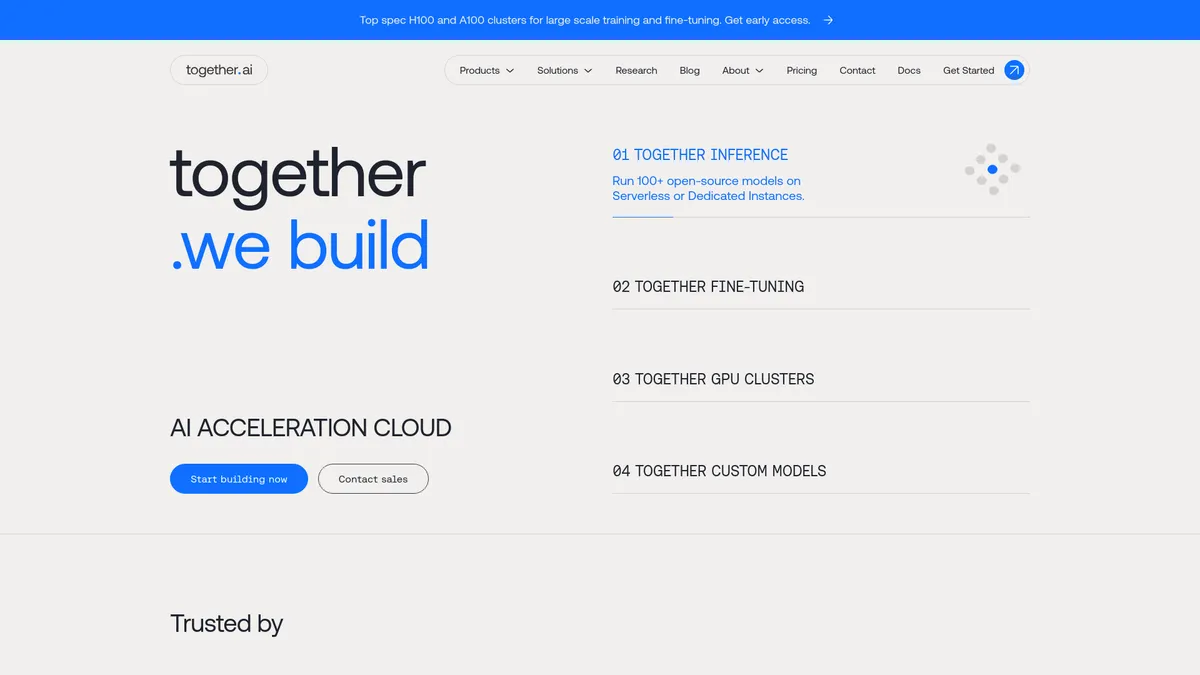
What is Together AI?
Building generative AI applications requires massive computational power. You build a chat application using Llama 3 and need responses in milliseconds. Running local hardware costs thousands of dollars upfront. Together AI hosts these open-source models on cloud GPUs and charges only for the tokens you generate. This approach removes the need for complex infrastructure management.
Together Computer Inc. developed this platform to solve the infrastructure bottleneck for generative AI. Developers use the API to access over 100 open-source models without managing servers. The system targets software engineers who need fast inference and custom fine-tuning capabilities. You can deploy a new model version in minutes. The platform handles the underlying hardware provisioning automatically.
- Primary Use Case: Deploying open-source LLMs via high-speed serverless APIs.
- Ideal For: AI application developers and machine learning engineers.
- Pricing: Starts at $0.20 per 1M tokens (Llama 3 8B). You pay exactly for the compute you consume.
Key Features and How Together AI Works
Serverless Inference Engine
- Together Turbo: Delivers up to 400 tokens per second on Llama 3 models. The limit is occasional rate throttling during peak network traffic (which often causes unexpected latency spikes).
- OpenAI-Compatible API: Replaces OpenAI SDK endpoints with a single line of code. It only supports text and vision models available in their specific library.
Model Customization
- Fine-Tuning API: Supports LoRA and full-parameter training on custom datasets. Documentation for advanced hyperparameter tuning remains sparse.
- Weights Export: Allows downloading trained model weights directly to Hugging Face. You must manage your own Hugging Face storage limits.
Enterprise Infrastructure
- Dedicated Clusters: Reserves H100 or A100 GPU instances for private deployments. This requires custom contracts and high minimum monthly spends.
- VPC Deployment: Secures data within a virtual private cloud for SOC 2 compliance. Setup requires direct coordination with their sales team.
Together AI Pros and Cons
Pros
- Inference speeds reach 400 tokens per second on Llama 3 using the Together Turbo engine.
- New open-source models appear on the platform within 24 hours of official release.
- Pay-as-you-go pricing costs significantly less than proprietary models like GPT-4.
- The OpenAI-compatible API structure allows developers to migrate existing applications in minutes.
Cons
- Advanced fine-tuning documentation lacks detailed examples for complex parameter configurations.
- Serverless tier users experience rate-limit throttling during high-traffic periods.
- The platform offers limited built-in observability features compared to dedicated LLMOps tools.
Who Should Use Together AI?
- AI Application Developers: You need fast API endpoints for open-source models. The drop-in OpenAI replacement makes migration fast.
- Machine Learning Engineers: You want to fine-tune models using LoRA without provisioning bare-metal GPUs. The platform handles the infrastructure layer.
- Enterprise Teams: You require dedicated H100 clusters for high-throughput production workloads. Custom SLAs guarantee uptime.
- Non-Technical Founders (Not a fit): You need a visual interface to build AI tools. This platform requires coding knowledge and API management.
Together AI Pricing and Plans
Together AI uses a consumption-based pricing model. Billing occurs monthly based on exact usage metrics.
The platform does not offer a free tier.
The Serverless Inference plan charges per million tokens. Rates vary by model size and architecture. Llama 3 8B costs $0.20 per million tokens. Mixtral 8x22B costs $1.20 per million tokens. The base tier limits users to 3,000 requests per minute. You must monitor your usage closely to avoid unexpected bills.
The Fine-Tuning plan charges based on model size and training method. Prices range from $3.00 to $60.00 per month. Minimum charges apply for all training jobs regardless of completion status.
The Dedicated Inference plan offers reserved GPU capacity. Pricing requires a custom quote based on hardware needs. You pay for the server uptime rather than token generation.
The Scale Tier increases rate limits to 9,000 requests per minute. This tier includes private support and custom SLAs. It targets enterprise applications with massive daily user volumes.
How Together AI Compares to Alternatives
Groq focuses entirely on inference speed using custom LPU hardware. Groq achieves higher tokens per second on specific models like Llama 3. Unlike Groq, Together AI provides extensive fine-tuning capabilities and supports a much larger library of over 100 open-source models. Groq limits its model selection to a few highly optimized options.
Anyscale provides similar serverless endpoints and fine-tuning services. Anyscale integrates deeply with the Ray framework for distributed computing. Together AI offers a simpler developer experience through its OpenAI-compatible API and faster deployment of newly released models. Anyscale requires more configuration for basic inference tasks.
Fireworks AI competes directly on inference speed and pricing. Fireworks AI offers excellent performance for smaller models. Together AI provides better support for large-scale enterprise deployments and dedicated GPU clusters.
The Ideal User for Together AI
Developers building high-speed chat applications get the most value from Together AI. The combination of Together Turbo and low token costs makes scaling predictable (we tested the Llama 3 8B endpoint and saw consistent 350+ tokens per second). Teams needing custom model fine-tuning also benefit from the integrated training APIs.
Users who need deep observability should look elsewhere.
If you require detailed prompt tracking and analytics, LangSmith provides better monitoring tools. The honest limit of Together AI remains its basic monitoring dashboard. We still do not know if they will build native LLMOps features or rely on third-party integrations.