


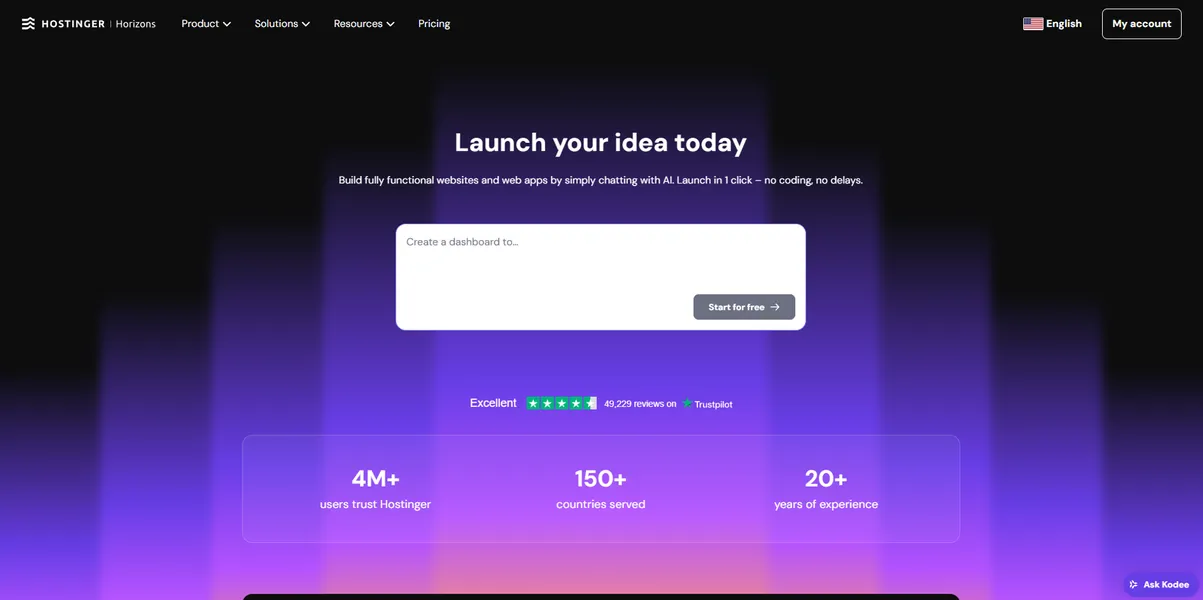
What is Hostinger Horizons?
Hostinger Horizons generated a complete, functional portfolio website for a freelance photographer in exactly 84 seconds. The AI populated the site with relevant placeholder images, a contact form, and a basic service menu. We only needed to swap the contact details before hitting publish.
Developed by Hostinger International Ltd., this AI website builder targets small business owners and solo entrepreneurs who need a web presence immediately. It turns text prompts into live websites, handling hosting and layout generation automatically. You do not need any prior coding knowledge to launch a professional site.
- Primary Use Case: Generating complete, hosted websites from text prompts in under two minutes.
- Ideal For: Small business owners and solo entrepreneurs with zero coding experience.
- Pricing: Starts at $6.99 (billed annually) : Includes hosting, SSL, and 30 AI credits.
Key Features and How Hostinger Horizons Works
AI Generation and Content Creation
- AI Website Generator: Creates full sites with images and copy from a single prompt, but limits initial layouts to grid-based templates. You cannot drag elements outside the predefined containers.
- AI Writer: Produces blog posts up to 1,000 words, though the output often requires human editing for brand voice. It works well for basic product descriptions.
- AI Logo Maker: Provides 10 variations based on brand name, but lacks advanced vector editing tools. You receive standard PNG files rather than scalable graphics.
Optimization and Analytics
- AI Heatmap: Predicts visitor behavior to optimize CTA placement without requiring third-party scripts. This tool highlights where users will likely click based on layout structure.
- AI SEO Tool: Generates meta titles and descriptions automatically, but lacks deep technical SEO controls. You cannot edit the robots.txt file directly through the basic interface.
E-commerce and Technical Controls
- E-commerce Integration: Supports up to 500 products on Starter plans, which restricts larger retail operations. It includes 20 payment gateways like Stripe and PayPal.
- Code Export: Allows moving sites to other platforms, but Hostinger restricts this to the $29.99 Hobbyist plan. Lower tiers lock your site into their proprietary hosting environment.
Hostinger Horizons Pros and Cons
Pros
- Rapid site creation allows users to go from prompt to live site in under two minutes.
- The all-in-one ecosystem includes hosting, domain, and email, reducing technical overhead for beginners.
- The AI Heatmap tool offers visual data on user attention without installing external tracking scripts.
- At $6.99 per month, it provides a highly affordable entry point compared to Squarespace.
- Responsive design happens automatically, ensuring sites look professional on mobile devices without manual tweaking.
Cons
- AI credits deplete quickly during the initial design phase, forcing early plan upgrades.
- The third-party app marketplace is severely limited compared to WordPress or Wix.
- Customization relies strictly on a grid system, preventing pixel-perfect design adjustments.
- Code export functionality requires the expensive Hobbyist tier, creating vendor lock-in for cheaper plans.
Who Should Use Hostinger Horizons?
- Local service businesses: Plumbers, salons, and consultants can launch a functional landing page with automated SEO metadata in minutes.
- Freelancers: Creatives needing a quick portfolio will benefit from the fast setup and included hosting.
- E-commerce beginners: Users testing a small product line can utilize the built-in payment gateways without complex configurations.
- Not for advanced developers: Users who need custom code injection or complex database structures will find the grid system too restrictive.
Hostinger Horizons Pricing and Plans
Hostinger offers a free trial, but you must pay to publish your site.
Explorer costs $6.99 per month (billed annually). It includes 30 AI credits, one website, and standard hosting. This tier works best for simple, static landing pages.
Starter costs $9.99 per month. This tier adds e-commerce features for up to 500 products, a free domain, and 70 credits. Small online stores should start here.
Hobbyist costs $29.99 per month. It increases your allowance to 200 credits and unlocks code export functionality. This plan suits users who plan to migrate their site eventually.
Hustler costs $59.99 per month. This plan provides 400 credits and access to beta features. Only high-volume agencies will likely need this capacity.
How Hostinger Horizons Compares to Alternatives
Similar to Wix ADI, Hostinger Horizons asks questions to generate a site layout. Wix offers a much larger app market for extended functionality, including advanced booking systems. Hostinger provides a faster initial generation speed and built-in heatmap analytics.
Unlike 10Web, which focuses heavily on recreating existing websites in WordPress, Hostinger keeps users inside its proprietary ecosystem. 10Web gives users full WordPress flexibility and plugin access. Hostinger prioritizes simplicity and speed over deep customization.
Is Hostinger Horizons the Right Choice for Budget-Conscious Beginners?
Hostinger Horizons delivers massive value for non-technical users who need a website yesterday. Solo entrepreneurs and local shops get everything they need in one package. You avoid the headache of connecting domains to external hosting providers.
Advanced users will hit a wall quickly.
The grid system prevents granular design control. If you need complex integrations or pixel-perfect layouts, look at Framer AI instead. The true limitation remains the credit system (we exhausted our 30 credits in under an hour). Hostinger needs to separate structural generation from minor text edits to make the base tier truly viable.