



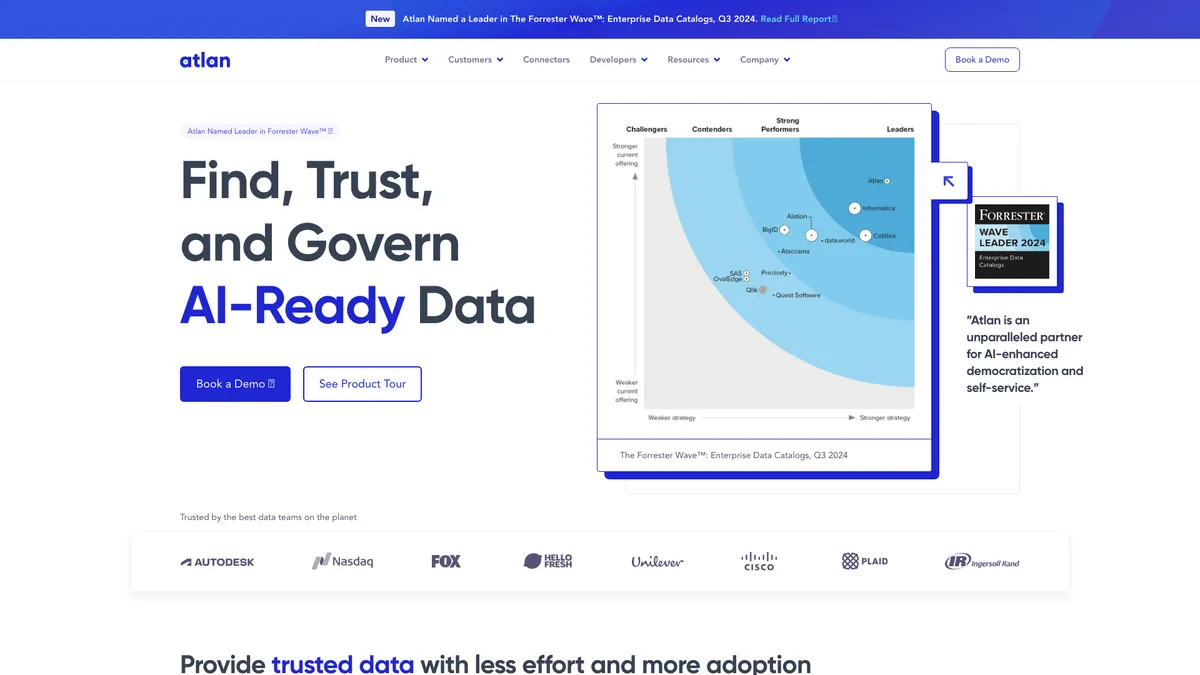
What is Atlan?
Data engineering teams spend up to 30 percent of their time manually tracing broken pipelines and documenting tables. Atlan Inc. built this active metadata management platform to solve that exact problem. It targets mid-market and enterprise data teams using modern cloud stacks like Snowflake and Databricks. The software acts as a central nervous system for your data infrastructure. It automatically crawls metadata, maps column-level lineage, and tags sensitive information.
The platform replaces static data catalogs with an active system that pushes context directly into the tools analysts already use.
- Primary Use Case: Automating end-to-end data lineage tracking and metadata management across cloud data stacks.
- Ideal For: Mid-sized to enterprise data teams using Snowflake, Databricks, and dbt.
- Pricing: Starts at $1666.67 per month (freemium). The high entry cost targets established companies rather than early-stage startups.
Key Features and How Atlan Works
Automated Lineage and Metadata Crawling
- Active Metadata Sync: Crawls and syncs metadata from over 50 sources including BigQuery and Redshift. It limits historical syncs based on your specific enterprise contract tier.
- Column-level Lineage: Visualizes data flow across dbt, Airflow, and BI tools. Complex custom SQL transformations sometimes require manual mapping adjustments.
AI-Assisted Documentation
- Atlan AI: Uses large language models to suggest descriptions for data assets. The AI occasionally produces hallucinations that require manual verification by data stewards.
- Automated Tagging: Identifies sensitive data using customizable regex and machine learning. Custom regex rules have a processing limit per hourly batch run.
Workflow Integration
- Chrome Extension: Provides a metadata overlay directly within BI tools like Power BI and Looker. It only works on Chromium-based browsers.
- Collaboration Suite: Includes Slack-like commenting directly on data assets. Message retention depends on your specific pricing plan.
Atlan Pros and Cons
Pros
- Deep integration with dbt and Snowflake allows near-instant setup of lineage without manual mapping.
- The browser extension increases user adoption by bringing data context into existing analyst workflows.
- Automated lineage mapping saves data engineering teams hundreds of hours of manual documentation work annually.
- Active metadata alerts push critical data health notifications to Slack before they impact executive reports.
Cons
- The $20,000 annual starting price makes it inaccessible for many small startups and boutique agencies.
- AI-generated column descriptions require careful manual review to catch inaccurate context.
- Initial configuration for legacy on-premise databases requires significantly more effort than cloud-native integrations.
Who Should Use Atlan?
- Enterprise Data Teams: Large organizations with complex Snowflake or Databricks environments gain immediate visibility into their data pipelines.
- Data Governance Officers: Compliance teams can automate PII tagging and data masking to ensure GDPR and HIPAA compliance.
- Budget-Constrained Startups: Small teams should avoid this tool. The high entry price and complex setup offer poor return on investment for simple data stacks.
Atlan Pricing and Plans
Atlan uses a freemium model with a steep jump to paid tiers. The Free Tier costs $0 per month and provides basic functionality for small teams. It acts more as a limited trial than a permanent solution for growing companies.
The Starter plan costs $1,666.67 per month, billed annually at $20,000. This tier includes data cataloging, standard connectors, and basic access control. The Premier plan requires custom pricing and adds advanced data governance, audit logs, and enhanced support. The Enterprise plan also uses custom pricing. It targets complex environments requiring sensitive data monitoring and custom security configurations.
How Atlan Compares to Alternatives
How does Atlan stack up against legacy governance platforms?
Similar to Alation, Atlan provides a central business glossary and data catalog. Unlike Alation, Atlan focuses heavily on active metadata and modern cloud data stacks. Alation offers better support for legacy on-premise databases. Atlan provides a much faster setup process for teams already using dbt and Snowflake. (I found Atlan’s Chrome extension much more intuitive for daily analyst use than Alation’s web interface).
Collibra represents another major competitor in the enterprise space. Collibra targets massive global enterprises with strict, top-down governance requirements. Atlan takes a bottom-up approach that appeals directly to data engineers and analysts. Collibra requires a massive implementation project that often takes months. Atlan connects to modern cloud warehouses and generates initial lineage graphs within days.
Final Verdict for Modern Data Teams
Atlan excels as a metadata management platform for mid-market and enterprise companies using modern cloud data stacks. If your team uses Snowflake, dbt, and Looker, Atlan will save your engineers hundreds of hours. The automated lineage and browser extension drive actual adoption among business users.
If you run a small startup or rely heavily on legacy on-premise SQL servers, look elsewhere. The $20,000 annual price tag makes little sense for simple environments. Small teams should evaluate CastorDoc instead. CastorDoc offers similar automated documentation features at a much lower price point.