



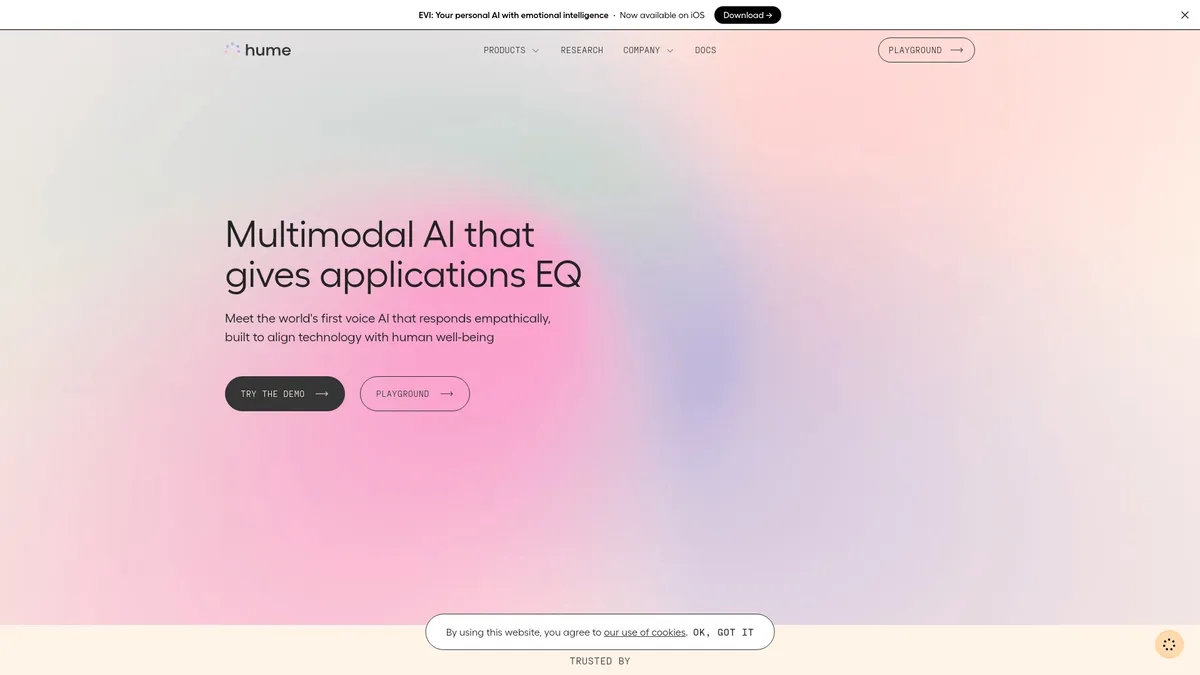
What is Hume AI?
Most voice assistants ignore how you speak and focus on what you say. Hume AI listens for the sigh before your sentence.
Hume AI, Inc. built this Empathic Voice Interface (EVI) and expression measurement API for developers and researchers. The platform detects over 50 distinct emotional dimensions in real time. Customer support teams use it to trigger human escalation when callers sound frustrated. Game developers use it to make NPCs react to a player’s actual emotional state.
- Primary Use Case: Detecting emotional nuances in voice and video streams for real-time application responses.
- Ideal For: Software developers building interactive voice agents or analyzing user sentiment.
- Pricing: Starts at $3 per month (Starter plan) for 30k characters and 40 EVI minutes.
Key Features and How Hume AI Works
Empathic Voice Interface and Prosody
- Empathic Voice Interface: Real-time voice-to-voice API with emotional prosody detection. Limit: Sub-200ms latency requires optimal network conditions.
- Vocal Prosody Model: Detects sarcasm, hesitation, and excitement in speech. Limit: Accuracy drops in noisy audio environments.
- WebSocket Support: Enables real-time streaming for live applications. Limit: Concurrent connections scale based on your plan tier.
Expression Measurement and Multi-modal Analysis
- Expression Measurement: Analyzes 50+ dimensions of emotion from video and audio streams. Limit: Processing high-resolution video increases API costs.
- Face Expression Model: Tracks facial muscle movements to identify complex emotional states. Limit: Misinterprets neutral facial expressions as negative states.
- Batch Processing: Allows analysis of large datasets of recorded media via REST API. Limit: Processing times vary based on server load.
Voice Cloning and Commercial Rights
- Custom Voice Cloning: Creates unique agent voices. Limit: Unlimited cloning requires the $14 per month Creator plan.
- Commercial License: Permits business use. Limit: Not included in the Free or Starter tiers.
Hume AI Pros and Cons
Pros
- Industry-leading emotional granularity measures over 50 distinct emotional dimensions.
- Sub-200ms real-time latency ensures empathic conversations feel natural and responsive.
- Detailed SDKs for Python and JavaScript simplify integration for software developers.
- Multi-modal capabilities cross-reference facial expressions with vocal tone for high accuracy.
- Accessible entry point with a $3 per month starter tier makes advanced emotion AI affordable.
Cons
- API costs escalate for high-volume real-time multi-modal analysis.
- The facial expression model misinterprets neutral resting faces as negative emotional states.
- Significant privacy concerns exist regarding the depth of emotional data tracked and stored.
- Free tier limits restrict meaningful testing of complex production workflows.
Who Should Use Hume AI?
- Software Developers: Python and JavaScript SDKs make integrating emotion detection into existing applications straightforward.
- Market Researchers: Batch processing allows teams to quantify emotional responses to video advertisements at scale.
- Customer Support Teams: Call centers can route angry callers to human agents based on vocal tone.
- Solo Hobbyists: The restrictive free tier makes this a poor fit for casual users without a budget.
Hume AI Pricing and Plans
The Free tier costs $0 per month. It includes 10,000 characters, 5 EVI minutes, and 1 concurrent connection.
This functions more as a limited trial than a usable free tier.
The Starter plan costs $3 per month. It provides 30,000 characters, 40 EVI minutes, and 5 concurrent connections.
The Creator plan costs $14 per month. It offers 140,000 characters, 200 EVI minutes, unlimited voice cloning, and a commercial license.
The Pro plan costs $70 per month. It includes 1 million characters, 1,200 EVI minutes, and 10 concurrent connections.
The Scale plan costs $200 per month. It provides 3.3 million characters, 5,000 EVI minutes, 20 concurrent connections, and 3 team seats.
The Business plan costs $500 per month. It offers 10 million characters, 12,500 EVI minutes, 30 concurrent connections, and 5 team seats.
Enterprise pricing requires contacting sales. It includes custom limits, unlimited seats, and SOC 2 and GDPR compliance.
How Hume AI Compares to Alternatives
Similar to OpenAI Realtime Voice, Hume AI offers low-latency conversational capabilities. OpenAI prioritizes general reasoning and knowledge retrieval. Hume AI prioritizes emotional intelligence and prosody detection. Developers building general-purpose assistants prefer OpenAI. Those building specialized empathic agents choose Hume AI.
Unlike ElevenLabs, Hume AI focuses on listening and reacting rather than just speaking. ElevenLabs produces realistic text-to-speech audio with exceptional voice cloning. Hume AI analyzes the user voice first and adjusts its own generated response to match the emotional context. ElevenLabs works better for audiobook narration and static content generation.
The Verdict: Best For Empathic Agent Developers
Hume AI delivers exceptional value for developers building interactive voice agents that require emotional awareness. The sub-200ms latency and 50-dimension emotional tracking create responsive applications. Customer support teams and game developers will see immediate benefits from the vocal prosody models.
Solo hobbyists and casual users should look elsewhere. The free tier limits restrict any serious experimentation. The API costs escalate if you process large volumes of multi-modal data.
If you need basic text-to-speech without emotional analysis, consider ElevenLabs instead. Choose Hume AI if your application must understand how a user feels, not just what they say.