

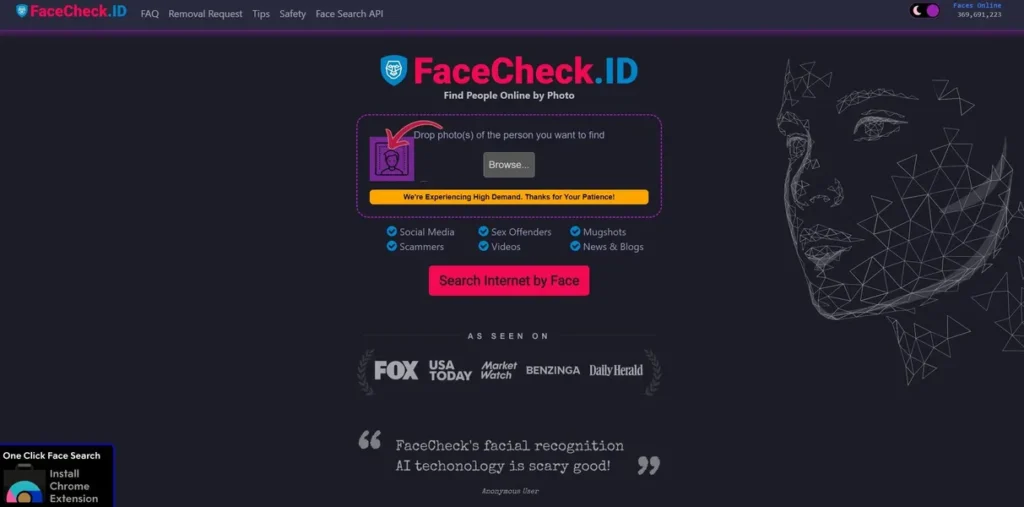
What is FaceCheck ID?
FaceCheck ID is a specialized facial recognition search engine architected to function as a powerful identity verification layer. From a technical standpoint, it operates by taking a single image input and querying a vast, indexed database of online images to find matches. This service is engineered for developers, security professionals, and organizations that require a programmatic way to cross-reference an individual’s face against their digital footprint. It effectively serves as a data retrieval tool, mapping a physical likeness to online presences across social media profiles, news publications, video platforms, and blogs. Its core utility is to provide a high-confidence signal for identity verification, risk assessment, and fraud prevention, streamlining what would otherwise be a complex and manual open-source intelligence (OSINT) gathering process.
Key Features and How It Works
FaceCheck ID is built upon a foundation of advanced AI and a meticulously curated data pipeline. Its functionality can be broken down into several key technical components:
- Advanced Facial Recognition Engine: At its core is a sophisticated machine learning model trained to detect and match facial features with high precision. The system provides a confidence score with each potential match, allowing developers to set their own thresholds for acceptable accuracy based on their application’s risk tolerance.
- Comprehensive Data Indexing: The platform’s backend continuously crawls and indexes a wide array of public web sources. This includes major social media networks, news outlets, video hosting sites, and blogs. The result is a comprehensive, cross-referenced view of a subject’s online presence derived from publicly available data.
- Safety-Centric Database Integration: A critical feature is its specialized integration with public safety databases. The engine specifically searches for matches within mugshot databases, sex offender registries, and news articles detailing criminal activity. This provides a crucial data point for risk mitigation and security screening applications.
- Privacy-Aware Architecture: The system is designed with privacy considerations in mind. According to its documentation, it does not permanently store personally identifiable information from user searches. Furthermore, its training data and indexing processes are configured to avoid cataloging images of children, a key safeguard for responsible deployment.
Pros and Cons
From a software development and integration perspective, FaceCheck ID presents a distinct set of advantages and potential challenges.
Pros
- High-Confidence Verification: The use of confidence scores provides a quantifiable metric for assessing match reliability, which is essential for building dependable automated workflows.
- Specialized Datasets: Direct access to indexed criminal and public safety records via a single query is a significant advantage over generic image search APIs, saving considerable development effort.
- Scalable Infrastructure: The service is designed to handle a high volume of search queries, making it a viable component for applications with large user bases, such as online dating platforms or marketplaces.
- Reduced OSINT Overhead: It automates the time-consuming process of manually searching for a person across dozens of online sources, abstracting that complexity into a single API call.
Cons
- Potential for API Limitations: The returned data, while providing matches, might lack rich contextual metadata. Developers may need to perform additional data enrichment to understand the full context of a matched image.
- Data Freshness Latency: As with any indexed database, there can be a delay between when content appears online and when it becomes searchable. This could be a limiting factor for real-time verification scenarios.
- Integration Complexity: While the service offers powerful capabilities, integrating it responsibly requires careful handling of sensitive data and clear communication with end-users about how their information is being processed.
- ‘Black Box’ Algorithm: The proprietary nature of the facial recognition model means developers have limited insight into potential biases or edge-case failure modes, which can be a concern for applications requiring high levels of transparency.
Who Should Consider FaceCheck ID?
FaceCheck ID is engineered for teams and professionals who require a scalable and efficient solution for identity verification and risk assessment. Key implementers include:
- Platform Trust & Safety Teams: Developers and product managers at social networks, dating apps, and online marketplaces can integrate FaceCheck ID to verify user identities, combat catfishing, and remove bad actors from their platforms.
- Corporate Security & HR Departments: Organizations can leverage the tool for enhanced background checks and due diligence, ensuring workplace safety by screening potential hires against public safety records.
- Financial & E-commerce Fraud Prevention Units: Teams working to prevent identity theft and fraudulent transactions can use facial verification as an additional security layer during onboarding or high-risk transactions.
- Journalists and OSINT Researchers: Professionals investigating subjects or verifying sources can use the tool to quickly establish an individual’s broader online presence and history from a single photograph.
Pricing and Plans
FaceCheck ID operates on a paid model, with plans structured to accommodate different levels of usage.
- Pricing Model: Paid
- Starting Price: $15/month
- Available Plans:
- Verifier: At $15 per month, this plan is designed for individuals or professionals with moderate search needs, offering a baseline number of queries for routine verification tasks.
- Pro: For $20 per month, this tier caters to frequent users and small teams requiring a higher volume of searches and potentially faster processing for more demanding workflows.
Disclaimer: Pricing information is subject to change. Please consult the official FaceCheck ID website for the most current and detailed plan information.
What makes FaceCheck ID great?
How do you programmatically verify a user’s identity beyond a simple email confirmation without building a complex, resource-intensive system from scratch? FaceCheck ID’s primary strength lies in its function as a specialized, pre-built verification layer. It solves the significant engineering challenge of aggregating and cross-referencing disparate public data sources. Instead of tasking a development team with building and maintaining scrapers for dozens of websites and public databases, FaceCheck ID provides a unified, queryable endpoint. Its unique value is not just in the facial recognition itself, but in the curated, safety-focused dataset it searches against, making it an incredibly efficient tool for any application where trust and safety are paramount.
Frequently Asked Questions
- Does FaceCheck ID offer an API for integration?
- While specific API access is typically detailed under enterprise or pro-level plans, the tool’s primary applications in corporate security and platform safety strongly suggest the availability of an API for programmatic integration into other software systems.
- What is the accuracy of the facial recognition search?
- The system provides a ‘confidence score’ with each match, indicating the model’s certainty. The absolute accuracy depends heavily on the quality, angle, and lighting of the uploaded photo. High-resolution, front-facing images yield the most reliable results.
- How does the platform handle data privacy?
- FaceCheck ID states that it does not store personally identifiable data from searches. For developers, this means that while the tool processes data to return a result, it is architected to minimize data retention. However, any organization integrating this tool should conduct its own privacy impact assessment.
- Is it possible to have my images removed from FaceCheck ID’s index?
- Like other search engines indexing public data, FaceCheck ID likely has a process for removal requests. Users should consult the official website’s privacy policy or support section for detailed instructions on how to submit a takedown request for their images.