

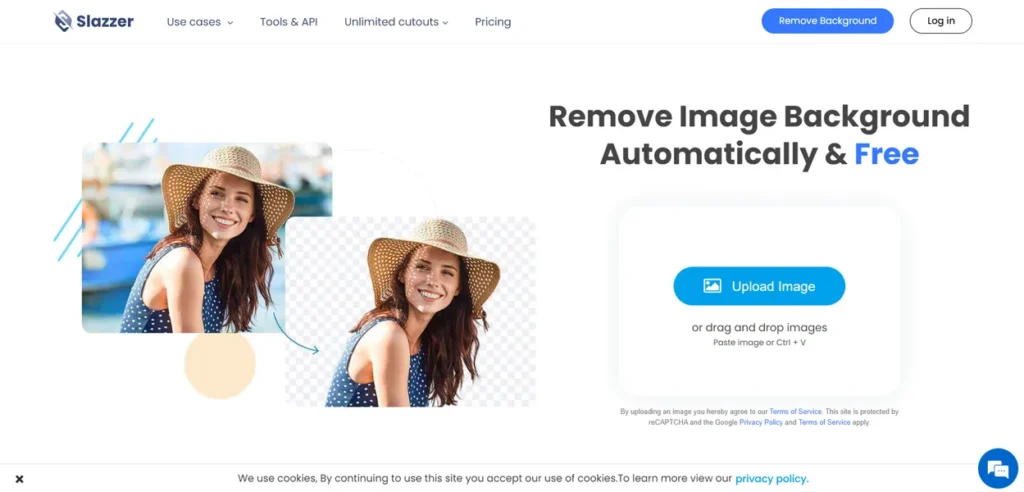
What is Slazzer?
Slazzer is an AI-powered image processing service designed for a single, computationally intensive task: automated background removal. From a technical perspective, it functions as a specialized microservice, accessible via a web interface or a REST API, that leverages advanced computer vision algorithms to accurately distinguish foreground subjects from their backgrounds. This allows for programmatic and bulk processing of images, making it an essential tool for developers building scalable solutions for e-commerce platforms, digital asset management systems, and other media-heavy applications where clean, consistent product or user imagery is a critical requirement.
Key Features and How It Works
Slazzer’s capabilities are built upon a foundation of machine learning models and thoughtful platform design. Understanding its core components is key to leveraging its full potential in a development workflow.
- AI-Powered Background Removal: At its core, Slazzer uses a trained neural network. This model analyzes an image pixel by pixel to create a precise alpha mask that isolates the primary subject. Its real value lies in its ability to handle complex edge cases—such as hair, fur, and semi-transparent objects—with a level of accuracy that traditionally required manual intervention with tools like Photoshop’s pen tool.
- High-Quality Cutouts: The output is a high-resolution image with a clean, transparent background. The algorithm is optimized to produce smooth, anti-aliased edges, ensuring the resulting assets can be seamlessly composed onto new backgrounds without jagged artifacts. This is critical for professional design and e-commerce applications.
- Desktop Application: For users who need to process large batches of images locally, Slazzer provides a desktop application for Windows, Mac, and Linux. This application acts as a client that interfaces with Slazzer’s processing backend, allowing users to queue thousands of images via a simple drag-and-drop interface. This is a practical solution for photographers or content managers handling significant offline image libraries.
- API and Integrations: For developers, the API is the most significant feature. It provides a programmatic endpoint for integrating Slazzer’s functionality directly into custom applications, scripts, or existing platforms. This enables fully automated workflows, such as processing user-uploaded profile pictures in real-time or standardizing entire product catalogs in an e-commerce backend. Pre-built integrations for platforms like Photoshop, Figma, and Shopify further reduce development overhead.
Pros and Cons
From a software development perspective, Slazzer presents a clear set of advantages and considerations.
Pros
- Scalable Automation: The API enables the creation of fully automated image processing pipelines capable of handling thousands of images without manual oversight, a level of scalability impossible to achieve with manual editing.
- High Algorithmic Accuracy: The AI model’s reliability in handling difficult edges reduces the need for manual quality assurance and correction, a common bottleneck in automated content workflows.
- Platform Flexibility: Offering a web UI, a desktop client, and a full-featured API provides multiple entry points for different use cases, from individual ad-hoc tasks to deeply integrated system processes.
- Reduced Development Overhead: It effectively outsources a complex computer vision problem, allowing development teams to focus on their core application logic rather than investing in building, training, and maintaining their own proprietary model.
Cons
- API Call Limitations: The free tier is primarily for evaluation and testing, as the limited credits are insufficient for any production-level workload. Scalable implementation requires a paid subscription.
- Cloud Dependency: As a cloud-based service, all processing relies on a stable internet connection to Slazzer’s servers. This introduces a potential point of failure that must be managed in any production system with error handling and retry logic.
- Potential API Latency: API response times are subject to network conditions and server load. For real-time applications, developers must architect their systems to handle this asynchronous process gracefully, potentially through webhooks or polling mechanisms.
Who Should Consider Slazzer?
Slazzer is not just for designers; it’s a powerful component for various technical roles and systems.
- E-commerce Developers: Professionals building or maintaining online retail platforms can use the API to programmatically create clean, uniform product images for catalogs, resulting in a consistent and professional user experience.
- Digital Asset Management (DAM) Architects: Integrating Slazzer into a DAM system can automate the creation of marketing-ready assets, such as generating transparent PNGs for use in different campaigns the moment a new image is uploaded.
- Application Developers: Engineers creating social media, profile management, or content creation apps can use Slazzer to provide users with a seamless background removal feature for their uploaded photos.
- MarTech & DevOps Teams: Teams responsible for automating marketing content pipelines can use Slazzer as a key processing step, for example, creating dynamic ad creatives by programmatically placing product cutouts on various backgrounds.
- Automotive Platform Developers: Teams building car dealership websites can use it to batch-process vehicle inventory photos, placing them on clean, uniform backgrounds for a professional online showroom.
Pricing and Plans
- Pricing Model: Paid
- Starting Price: $13/month
- Available Plans: The Pro plan begins at $13 per month. Slazzer primarily operates on a credit-based system, where credits are used per image processed. Plans vary based on the number of credits included.
Disclaimer: Please note that pricing information is subject to change. For the most accurate and current pricing details, including API call costs, refer to the official Slazzer website.
What makes Slazzer great?
Struggling to build a reliable, scalable image processing pipeline without investing heavily in in-house computer vision expertise? This is the exact problem Slazzer solves. Its primary strength lies in its positioning as a specialized, single-purpose tool that does one thing exceptionally well. For a developer, this is immensely valuable. Instead of allocating engineering resources to the complex, niche field of image segmentation, you can integrate a mature, reliable third-party API. Slazzer’s ability to handle fine details like hair and its consistent performance across millions of images represent a significant technical achievement. It abstracts away the complexity, allowing developers to treat background removal as a solved problem and focus their efforts on the unique logic of their own applications. It’s a classic build-versus-buy decision where ‘buy’ offers a clear advantage in speed, quality, and focus.
Frequently Asked Questions
- How robust is the Slazzer API for production use?
- The Slazzer API is a RESTful service designed for high-volume, programmatic access. With comprehensive documentation and official integrations, it is well-suited for production environments. Standard best practices, such as implementing error handling and managing API keys securely, should be followed.
- What image resolutions does the Slazzer API support?
- The API supports high-resolution images, which is essential for professional photography and print applications. Specific resolution limits and output size options are detailed in the official API documentation, but it can handle images up to 25 megapixels depending on the subscription plan.
- Can Slazzer be integrated into a serverless workflow?
- Absolutely. Its nature as a simple HTTP-based API makes it ideal for integration with serverless architectures like AWS Lambda or Google Cloud Functions. A typical pattern involves triggering a function upon an image upload to a storage bucket (e.g., S3), which then calls the Slazzer API to process the image and save the result.
- How does Slazzer handle data privacy for uploaded images?
- According to their policy, Slazzer’s systems are automated, and images are typically stored for a short period to allow for retrieval before being deleted. However, for any third-party service, it is critical for developers to review the official privacy policy and terms of service to ensure compliance with their own data handling requirements.
- What is the typical latency for an API call?
- API response time generally ranges from 1 to 10 seconds, depending on the image size, complexity, and current server load. For user-facing real-time applications, it is recommended to manage the user experience with loading indicators and process the images asynchronously to avoid blocking the UI.