



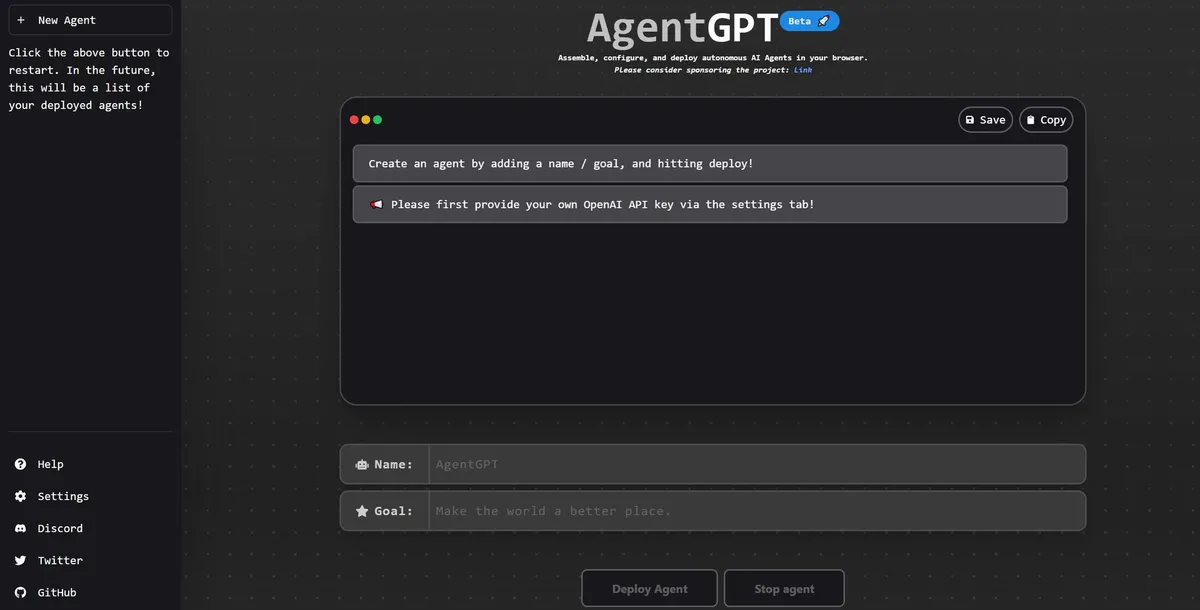
What is AgentGPT?
You need a competitive analysis of five different software pricing pages. Instead of copying text and prompting ChatGPT multiple times, you type one goal into a browser window. The AI creates a task list, visits the websites (which saves hours of copy-pasting), extracts the pricing tiers, and writes a final comparison report.
Reworkd AI built AgentGPT to solve the manual prompt engineering problem. The platform targets marketers, researchers, and developers who need to automate repetitive research tasks. It runs in your browser without requiring local installation. The system uses large language models to reason through problems. You give it a name and a goal. It then writes its own prompts to achieve that goal.
- Primary Use Case: Automating market research by scraping web data into structured reports.
- Ideal For: Non-technical users who want autonomous AI agents without using a command line interface.
- Pricing: Starts at $40/month (Pro). The free tier only allows five demo agents per day.
Key Features and How AgentGPT Works
Autonomous Task Execution
- Goal Breakdown: Agents split a main objective into smaller steps. Limit: Agents can get stuck in infinite loops if the goal lacks specific parameters.
- Loop Limits: The system runs tasks continuously. Limit: Pro users get a maximum of 25 loops per agent run to prevent runaway token usage.
- Custom Agent Naming: Users define specific roles for their agents. Limit: Names do not fundamentally change the underlying model logic.
Live Web Integration
- Web Search: Agents browse the internet to find current information. Limit: Free tier users face strict restrictions on search volume and depth.
- Data Export: Users can save completed research. Limit: Exports are restricted to PDF, Word, or JSON formats.
- Multi-Language Support: The platform executes tasks in dozens of languages. Limit: Translation accuracy depends on the underlying OpenAI model.
Model and API Access
- GPT-4 Access: Pro users get higher reasoning capabilities. Limit: High token consumption can cause unexpected costs if you connect your own OpenAI API key.
- Open Source Core: Developers can inspect the GitHub repository. Limit: Self-hosting requires technical knowledge and local hardware resources.
AgentGPT Pros and Cons
Pros
- Browser-based interface removes the need for command line installation.
- Web browsing integration pulls current data instead of relying on outdated training sets.
- Open-source code allows developers to self-host the application for better privacy.
- Autonomous task generation reduces the time spent writing manual prompts.
Cons
- Agents often lose context during complex tasks and require human intervention.
- The free tier acts as a restricted trial with only five daily demo agents.
- Users risk high API costs if they connect personal OpenAI keys without setting hard limits.
Who Should Use AgentGPT?
- Market Researchers: You can automate competitor analysis and data scraping across multiple websites.
- Content Creators: You can generate social media calendars based on current viral trends.
- Software Developers: You can write and debug code across multiple files for software development projects.
- Budget-Conscious Solo Users: This tool is a bad fit for you. The $40 monthly price is high compared to standard ChatGPT Plus subscriptions.
AgentGPT Pricing and Plans
The Free plan costs $0 per month. It functions as a restricted trial. Users get five demo agents per day using the GPT-3.5-Turbo model. Web search and plugin access are restricted.
The free tier is essentially a trial.
The Pro plan costs $40 per month. It includes 30 agents per day and unlocks GPT-4 access. Each agent can run up to 25 loops. Users also get unlimited web search and priority support. You must monitor your usage on the Pro plan. The 30 agents per day limit resets every 24 hours. The 25 loops per agent ensure tasks do not run forever (I found this crucial for avoiding runaway API costs).
The Enterprise plan requires custom pricing. It includes everything in Pro plus SAML SSO. Buyers also receive a dedicated account manager and custom feature development.
How AgentGPT Compares to Alternatives
Similar to AutoGPT, AgentGPT breaks down large goals into smaller tasks. AutoGPT requires local installation via a command line interface. AgentGPT runs in your web browser. AutoGPT gives developers more control over local file systems. AgentGPT appeals to non-technical users who want immediate access.
Unlike Godmode.space, AgentGPT offers an open-source core for self-hosting. Both tools provide browser-based access to autonomous agents. Godmode.space focuses on a visual user interface for task approval. AgentGPT provides better export options like JSON and Word formats.
Similar to BabyAGI, AgentGPT creates a task list based on a primary objective. BabyAGI focuses on task prioritization and execution in a continuous loop. AgentGPT provides a more accessible web interface for immediate use. BabyAGI requires Python knowledge to set up and run.
The Verdict: Best for Non-Technical Researchers
AgentGPT delivers high value to researchers who need automated web scraping without writing code. Solo users on a tight budget should look elsewhere due to the expensive Pro tier. If you want a free local alternative, AutoGPT remains the better choice for technical users.