



What is LlamaIndex?
The most impressive aspect of LlamaIndex is its ability to extract structured tables from messy PDFs. Developers struggle to feed complex documents into large language models. LlamaIndex solves this specific ingestion problem.
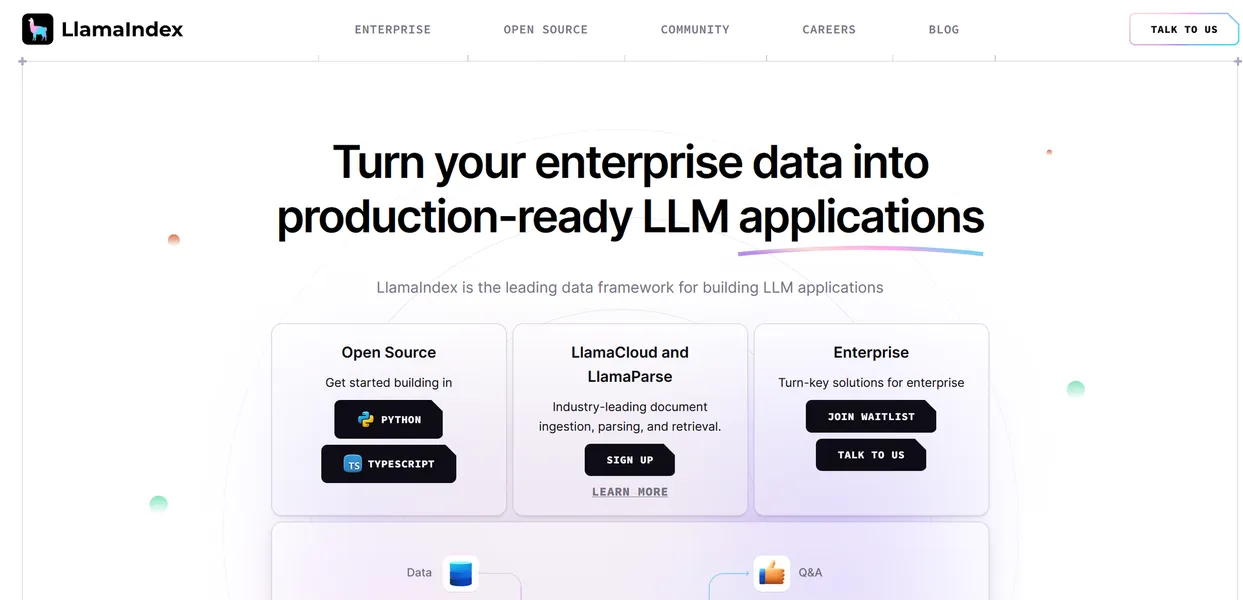
LlamaIndex, Inc. built this data framework to connect custom data sources to AI models. It enables retrieval-augmented generation for developers building context-aware applications. The open-source library targets software engineers who need to query internal documents using models like GPT-4.
- Primary Use Case: Building RAG pipelines to query internal PDF documents using GPT-4.
- Ideal For: Software developers building context-aware AI applications.
- Pricing: Starts at $50 (freemium) – The Starter tier supports 5 users and 50,000 credits per month.
Key Features and How LlamaIndex Works
Data Ingestion and Connectors
- LlamaHub: Provides 160 data connectors for platforms like Slack and Notion. The free tier restricts users to local file uploads.
- LlamaParse: Extracts tables and multi-column layouts from complex PDFs. Processing speed drops when handling documents over 100 pages.
Indexing and Storage
- VectorStoreIndex: Supports diverse data structures for retrieval. Debugging nested indices requires external observability tools like LangSmith.
- Vector Database Support: Integrates natively with 20 databases including Pinecone and Milvus. Users must host and manage these databases separately.
Orchestration and Evaluation
- Agentic RAG: Supports ReAct agents for complex query routing. Function calling capabilities depend on the chosen language model.
- RagEvaluator: Measures faithfulness and relevancy of generated answers. Evaluation metrics consume additional tokens and increase API costs.
LlamaIndex Pros and Cons
Pros
- LlamaHub offers over 100 pre-built loaders for rapid data ingestion.
- LlamaParse handles complex document structures like tables with high accuracy.
- Developers can swap language models and embedding models with one code line.
- The open-source community provides weekly updates for Python and TypeScript libraries.
Cons
- Beginners face a steep learning curve due to high levels of abstraction.
- Official documentation lags behind the fast release cycle of the core library.
- Debugging complex nested indices proves difficult without third-party observability tools.
Who Should Use LlamaIndex?
- Enterprise developers: Teams building complex RAG pipelines benefit from the managed LlamaCloud platform.
- Data engineers: Professionals connecting Slack and Notion data to chatbots find the 160 connectors useful.
- Non-technical users: This tool is a poor fit for people without Python or TypeScript coding experience.
LlamaIndex Pricing and Plans
The open-source library is free for commercial use. LlamaCloud offers a freemium managed service. The free tier acts as a restricted trial.
- Open Source / Free: $0 per month. Includes 10,000 credits per month for one user. Restricted to file uploads only.
- Starter: $50 per month. Provides 50,000 credits for five users. Supports five external data sources.
- Pro: $500 per month. Includes 500,000 credits for 10 users. Supports 25 data sources.
- Enterprise: Custom pricing. Offers unlimited credits, VPC deployment, and dedicated support.
How LlamaIndex Compares to Alternatives
Similar to LangChain but LlamaIndex focuses on data ingestion and indexing. LangChain offers a broader set of tools for general agent orchestration. Developers combine both libraries in complex applications.
Unlike Haystack, LlamaIndex provides a proprietary document parsing service called LlamaParse. Haystack relies on open-source components for document processing. Haystack offers a visual pipeline builder for enterprise teams.
Final Verdict for AI Developers
Software engineers building RAG applications get the most value from LlamaIndex. The extensive connector ecosystem saves weeks of custom integration work. (I spent three days building a Notion connector before discovering LlamaHub had one ready).
The heavy abstraction hides underlying errors.
This creates friction during the debugging process.
If you need to extract tables from PDFs, choose LlamaIndex. If you want to build general AI agents without heavy data ingestion, look at LangChain instead.