



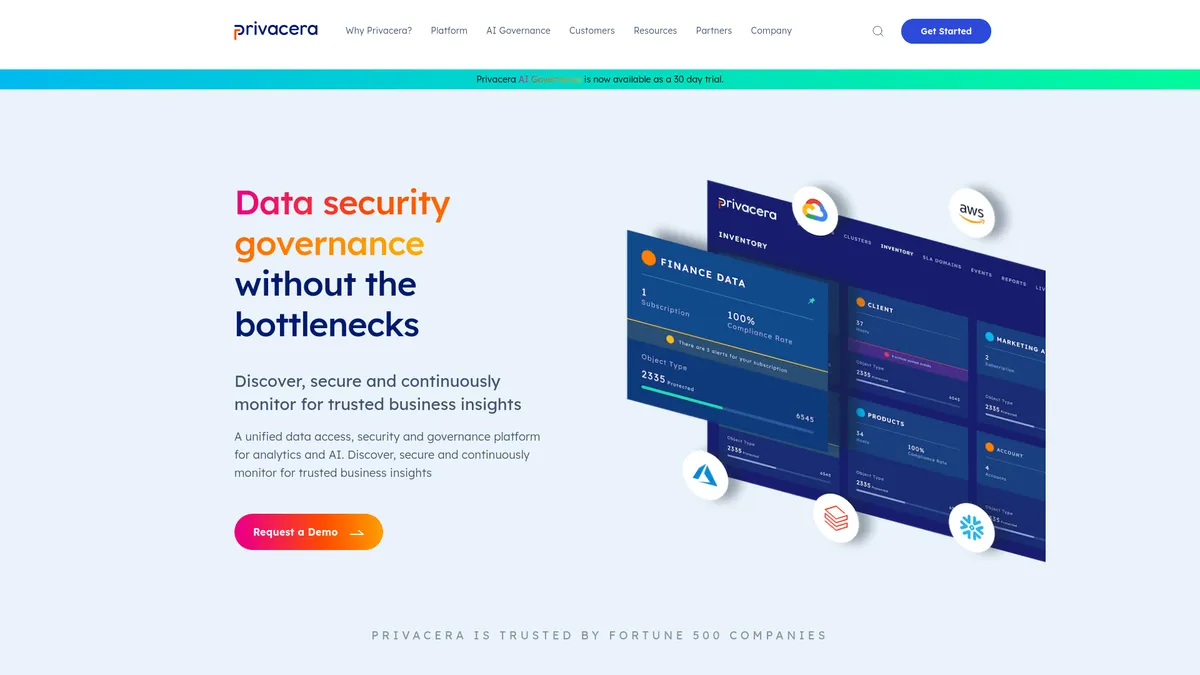
What is Privacera?
The most frustrating part of testing Privacera is the mandatory $1,470.40 setup fee just to get started. Once configured, the platform applies row and column access controls across 100 different data sources.
Privacera, Inc. built this data security and governance platform to solve multi-cloud compliance. It targets data-driven enterprises running workloads on AWS S3, Snowflake, and Databricks. The software automates sensitive data discovery and enforces privacy rules without manual SQL coding.
- Primary Use Case: Automating fine-grained access control across multi-cloud data lakes.
- Ideal For: Enterprise data engineering teams managing petabyte-scale environments.
- Pricing: Starts at $30 (per user per month) : Requires a $1,470.40 setup fee.
Key Features and How Privacera Works
Automated Data Discovery and Tagging
- Multi-Cloud Scanning: Scans AWS, Snowflake, and Databricks to locate PII. Scanning large clusters requires heavy compute resources.
- Machine Learning Tagging: Applies PCI and PHI tags without manual input. Custom tag creation requires manual regex configuration.
Access Control and Masking
- Fine-Grained Security: Enforces row and column restrictions for Spark and Trino queries. Policy updates take up to five minutes to propagate.
- Dynamic Data Masking: Obfuscates sensitive fields during real-time query execution. High concurrency queries experience slight latency increases.
AI and Compliance Governance
- Privacera AI Governance: Filters sensitive data from LLM training sets and prompts. This module only supports specific commercial LLM APIs.
- Unified Audit Reporting: Generates centralized logs for GDPR and HIPAA compliance. Exporting reports larger than 50MB requires API pagination.
Privacera Pros and Cons
Pros
- Enforces identical security policies across AWS, Azure, and GCP from one dashboard.
- Built by Apache Ranger creators, ensuring native integration for distributed policy enforcement.
- Handles petabyte-scale data environments without crashing the primary query engine.
- Includes specific modules for filtering Generative AI prompts.
Cons
- Initial policy configuration requires heavy technical expertise and weeks of planning.
- The $1,470.40 setup fee blocks smaller teams from adopting the platform.
- Advanced configuration documentation remains sparse and references deprecated features (a common issue with legacy Hadoop tools).
- Running discovery agents consumes massive compute resources in large Hadoop clusters.
Who Should Use Privacera?
- Enterprise Data Teams: Large organizations managing data across Snowflake and Databricks need centralized policy management. Privacera prevents duplicate work across these platforms.
- Compliance Officers: Teams facing strict HIPAA or GDPR audits benefit from the unified reporting dashboard. The automated tagging catches PII that manual reviews miss.
- Small Startups: Solo developers or small teams will find the pricing and setup complexity overwhelming. A native database feature works better for simple use cases.
Privacera Pricing and Plans
Privacera hides its true cost behind a complex pricing structure.
The free trial offers time-limited access without a credit card. This tier restricts core integrations (we tested the Snowflake integration) and limits scanning capabilities.
The Standard Plan costs $30 per user per month. You must pay a mandatory $1,470.40 one-time setup fee before using the software.
The Enterprise Plan charges a $598 monthly base fee. Custom pricing exists for massive deployments requiring tailored quotes from the sales team.
How Privacera Compares to Alternatives
Similar to Immuta, Privacera provides dynamic data masking and fine-grained access control. Immuta focuses on attribute-based access control and offers a smoother initial onboarding experience. Privacera relies on its Apache Ranger heritage, making it a better fit for legacy Hadoop environments transitioning to the cloud.
Unlike BigID, this tool prioritizes access enforcement over pure data cataloging. BigID excels at mapping complex data relationships and privacy risk assessments. Privacera blocks unauthorized queries at the engine level across Spark and Trino.
Final Verdict for Enterprise Data Architects
Enterprise data architects managing petabyte-scale hybrid clouds get the most value here. The platform unifies security rules across AWS, Snowflake, and Databricks.
Small teams should look elsewhere.
The $1,470.40 setup fee makes no sense for a five-person analytics department. Immuta serves as a better alternative for mid-market companies needing faster deployment.
Privacera will likely shift its entire focus toward AI governance within 12 months, leaving traditional database security as a secondary feature.