
Ada is an enterprise AI customer service agent platform built around a proprietary dual-model Reasoning Engine. Founded in Toronto in 2016 and valued at $1.2B, it automates support across chat, voice, and email for brands like Square, Pinterest, and Wealthsimple.
Ada is an enterprise AI customer service agent platform built and headquartered in Toronto, Canada. Founded in 2016 by Mike Murchison and David Hariri, Ada raised a $130M Series C at a $1.2B valuation before pivoting its entire product strategy from no-code chatbot builder to a full agentic AI platform. The company now positions itself under a category it coined: ACX, or Agentic Customer Experience. The core premise is that a single AI agent, trained on a company's knowledge base and connected to its business systems, should resolve the majority of customer inquiries without any human intervention.
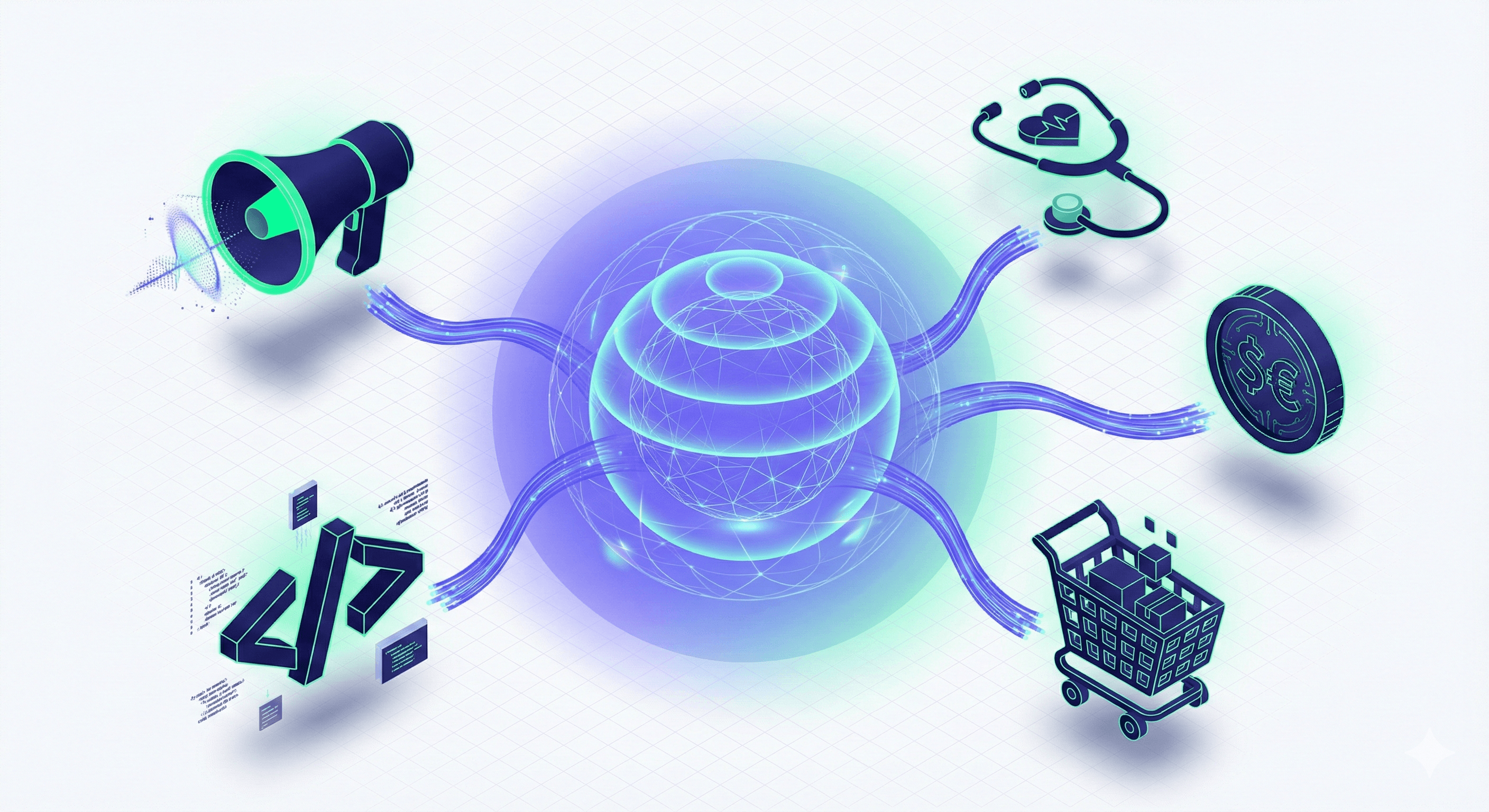
The platform operates across three channels: messaging, voice, and email. Its centerpiece is the Ada Reasoning Engine, a dual-model architecture that combines a "Thinker" model for multi-step reasoning and a "Talker" model for natural conversation, orchestrating multiple LLMs from OpenAI, Anthropic, Microsoft Azure, and Amazon Bedrock behind a unified interface. Alongside the Reasoning Engine, Ada offers Playbooks for building multi-step automated workflows, Actions for connecting to business systems (refunds, account lookups, policy enforcement), Coaching tools for iterative agent improvement, and a Performance Center for analytics. It carries HIPAA, SOC2, GDPR, and AIUC-1 certifications, which matters for regulated industries like fintech, healthcare, and travel. Ada serves 350+ enterprise customers across 85+ countries, including Square, Pinterest, Monday.com, Wealthsimple, Cebu Pacific, and Barnes and Noble.
What Ada actually is in May 2026
Ada no longer describes itself as a chatbot company. The product is an AI agent platform, and the distinction is intentional. Traditional chatbots rely on decision trees or intent-matching: a user says something, the system picks a pre-written response branch. Ada's agent reasons through problems. For each customer inquiry, the Reasoning Engine breaks the question into components, retrieves relevant knowledge, decides whether it needs to take an action (like issuing a refund or updating an address), and then generates a resolution path. The Reasoning Log gives operators visibility into how the agent reached each decision, which is important for audit trails in regulated environments.
The February 18, 2026 launch of the Unified Reasoning Engine was the most significant product update in Ada's recent history. Previously, voice, messaging, and email channels each required separate instruction sets, separate Playbook logic, and separate optimization cycles. The Unified Reasoning Engine introduced patent-pending technology that applies a single intelligence layer across all channels simultaneously. A Playbook written once now runs across voice, chat, and email without modification, and the same context, guardrails, and brand logic apply regardless of channel. Mike Gozzo, Ada's Chief Product and Technology Officer, described the intent: "Customer service doesn't happen in silos, and AI agents shouldn't either.. one brain behind every AI agent, applying the same context, logic, and safeguards."
Ada also integrates with 14+ helpdesk platforms including Zendesk, Salesforce, Freshworks, Gorgias, Help Scout, and Twilio Flex, though reviewers consistently note that the full feature set is optimized for Zendesk and Salesforce customers. Companies on other stacks encounter gaps in functionality that require workarounds or custom API work.
Where Ada sits versus Decagon and Sierra
The enterprise AI agent space has three credible players at scale: Ada, Decagon, and Sierra. They address the same core problem but differ mechanically in ways that matter for procurement decisions.
Decagon uses Agent Operating Procedures (AOPs), rules written in plain English that compile into deterministic agent logic. This approach gives non-technical CX teams direct control over agent behavior without engineering involvement, and Decagon's setup typically takes days rather than Ada's 8-16 weeks. Decagon supports broader helpdesk integration natively, without the Zendesk/Salesforce preference Ada carries. However, Decagon's voice capabilities are less mature. Ada's Unified Reasoning Engine, launched February 2026, enables voice Playbooks with the same logic that runs on chat and email, a capability Decagon has not yet matched at the same level of omnichannel unification.
Sierra takes a developer-first approach. It builds persistent customer memory across sessions, enabling agents that recall past interactions, preferences, and open issues without the user repeating themselves. For consumer brands where relationship continuity matters (financial services, subscription retail), Sierra's memory architecture produces measurably better perceived experience. The tradeoff is setup complexity and cost: Sierra requires engineering resources to configure and maintain, and pricing typically exceeds both Ada and Decagon. Sierra also lacks Ada's out-of-the-box compliance certifications, which makes it a harder sell in healthcare or regulated fintech. Ada sits between these two: more technically sophisticated than Decagon's AOP model but more accessible than Sierra's developer-first architecture. When omnichannel compliance is the priority, Ada has an edge. When speed-to-deploy or cross-session memory matters more, Decagon and Sierra respectively are worth evaluating in parallel.
For broader comparisons in the conversational AI and agent space, see also Intercom Fin, Cresta, and Echowin depending on your channel mix and existing helpdesk stack.
How the Reasoning Engine actually works inside Ada
Ada's Reasoning Engine is not a single model. It is an orchestration layer that coordinates multiple LLMs depending on the task. The "Thinker" model handles multi-step reasoning: parsing a customer's intent, identifying what actions or lookups are needed, retrieving knowledge from connected sources, and determining the resolution path. The "Talker" model handles conversational generation: producing the response in the right tone, brand voice, and language. These two models operate in parallel rather than sequentially, which reduces latency for complex queries that would otherwise require multiple round trips.
The Playbooks layer sits on top of this. Playbooks are multi-step workflows that an agent follows for specific scenarios: processing a return, escalating a complaint, verifying identity before a sensitive action. They are built in Ada's no-code interface, though building complex Playbooks at scale is one of the recurring friction points in operator reviews. The Actions layer connects the agent to external systems via API. An agent can look up an order, initiate a refund, change an account setting, or retrieve account balance data, all within a conversation. The Coaching interface allows operators to review transcripts, flag incorrect resolutions, and update the agent's behavior without retraining from scratch. This iterative feedback loop is how Ada frames the "coachable AI" positioning it introduced in November 2023.
Ada claims an 80%+ autonomous resolution rate across its customer base, though this varies significantly by industry and implementation quality. Ipsy reported a 943% ROI in four months with $2.7M in estimated annual savings. Cebu Pacific saw a 34%+ higher resolution rate compared to its prior declarative chatbot. Monday.com reported a 42% reduction in agent handle time. These are operator-reported figures from Ada's case study library, not independently audited.
"Our AI Agent brings us closer to our customers, reducing operational burden and increasing our automated resolution." - Paul Teshima, Chief Client Experience Officer, Wealthsimple, November 2023
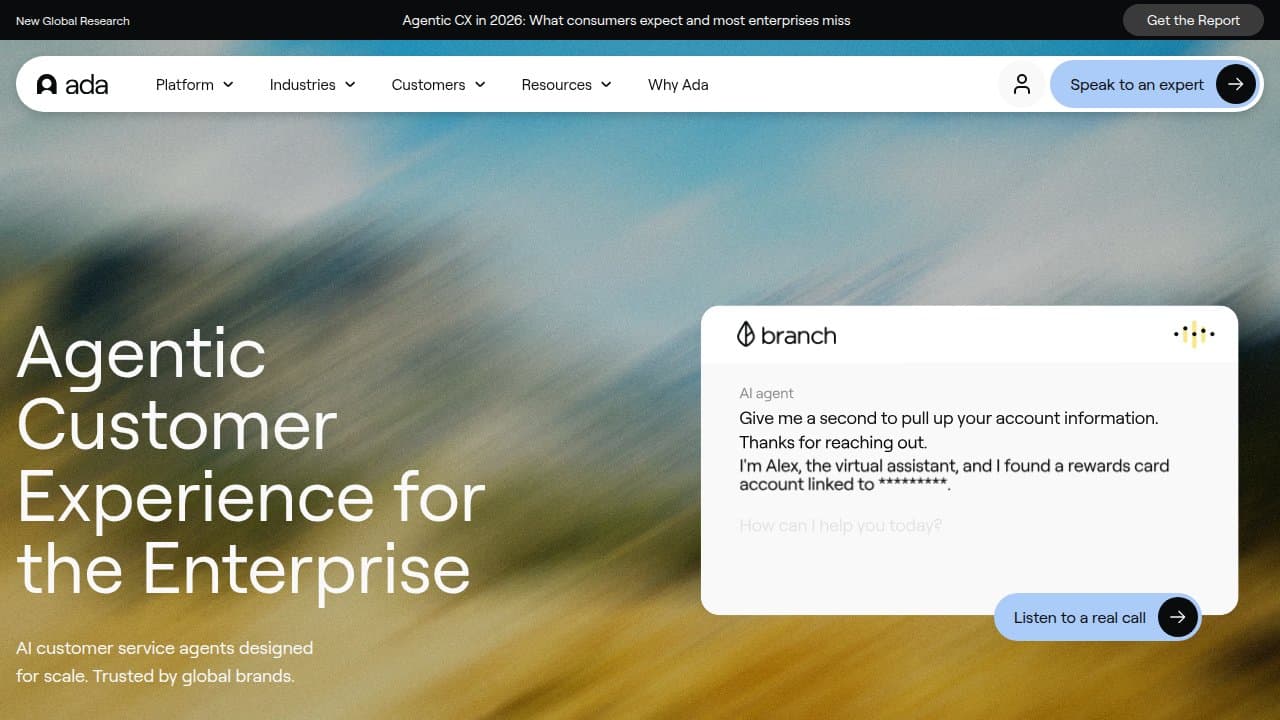
"Voice has always been the hardest channel to transform.. our AI agents can now reason through complex, high-stakes voice conversations." - Brian Gilman, VP of Customer Support at Branch, February 2026
The friction and reliability patterns users keep raising
Ada has a notable rating gap between its administrator-facing G2 score (4.6/5) and its end-user Trustpilot score (1.9/5). This gap tells a specific story: the platform is well-designed for the CX operator building and managing it, but customer-facing interactions frequently fail in ways that frustrate the actual end user. The most consistent complaint from Trustpilot reviewers is the "endless loop" pattern, where the chatbot cannot resolve a query, does not offer a clear escalation path to a human, and cycles the user through the same unhelpful responses repeatedly.
Implementation complexity is the second major friction point. G2 reviewers who rate Ada positively still describe it as "a huge, time-consuming project" that is "not something you can just sign up for and get running by yourself in an afternoon." The standard 8-16 week implementation timeline requires Ada's professional services team (the ACX Practice or ACX Experts tiers), which adds to the total cost of deployment and delays time-to-value.
The Zendesk/Salesforce dependency surfaces regularly in reviews from enterprise teams on other stacks. One G2 reviewer noted: "After building out our instance we found out that Ada does not support all of the feature sets that it advertised just because we do not use Salesforce or Zendesk." Playbook complexity also compounds over time as the number of flows grows. Multiple reviewers report that Playbooks work well for the first 10-20 flows but become difficult to maintain and audit at scale, with users getting "stuck" mid-flow when edge cases aren't handled.
Pricing opacity is a structural issue for procurement teams. Ada publishes no public pricing. Third-party benchmarks suggest a $30K/year floor and a median enterprise contract around $70K/year. One Reddit commenter reported their company paid over $300K/year for roughly 150,000 monthly tickets, noting they would "stick with Zendesk messaging and answer bot" instead. These estimates vary widely based on volume, channels, and add-on services.
Who Ada is for
Ada fits best for enterprise customer support teams with 50,000 or more monthly tickets who are already on Zendesk or Salesforce and need HIPAA, SOC2, or GDPR compliance as a baseline requirement. Airlines, subscription commerce brands, and financial services companies show the strongest reported ROI in Ada's case library. The investment in a 8-16 week implementation makes sense when the deflection math works: at $1-$3.50 per resolution and a starting ticket volume that justifies the platform fee, the savings from eliminating human-handled tickets can return the contract cost within months. Ipsy's 943% ROI in four months is an outlier, but the underlying economics are real for high-volume support organizations.
Ada is not a fit for teams under 10,000 monthly tickets, where the cost-per-resolution math rarely closes. It is also not a good choice for teams not on Zendesk or Salesforce: the feature gaps are real and well-documented across independent reviews. Companies that need same-day deployment, self-serve onboarding, or transparent per-seat pricing before internal approval should evaluate Decagon or Intercom Fin first. Teams prioritizing end-user CSAT above deflection rate should treat the 1.9/5 Trustpilot score as a genuine risk signal, not a statistical anomaly, and pressure Ada for customer-facing resolution quality metrics before signing.
User Reviews
No reviews yet. Be the first to share your experience!
Sign in to write a review.
Related articles
Guides and articles related to Ada.
AI Agents for Business: What They Actually Are and 12 Things You Can Automate Today
AI Customer Support Automation: Cut Ticket Volume 50% Without Hurting CX
AI Customer Support Triage That Routes 70% of Tickets Without a Human (2026)
Turn Any AI Agent Into a Superagent: The 12-Integration Stack (2026)
How to Sell AI Chatbots to Local Businesses ($1K-$5K Retainers, 2026)