



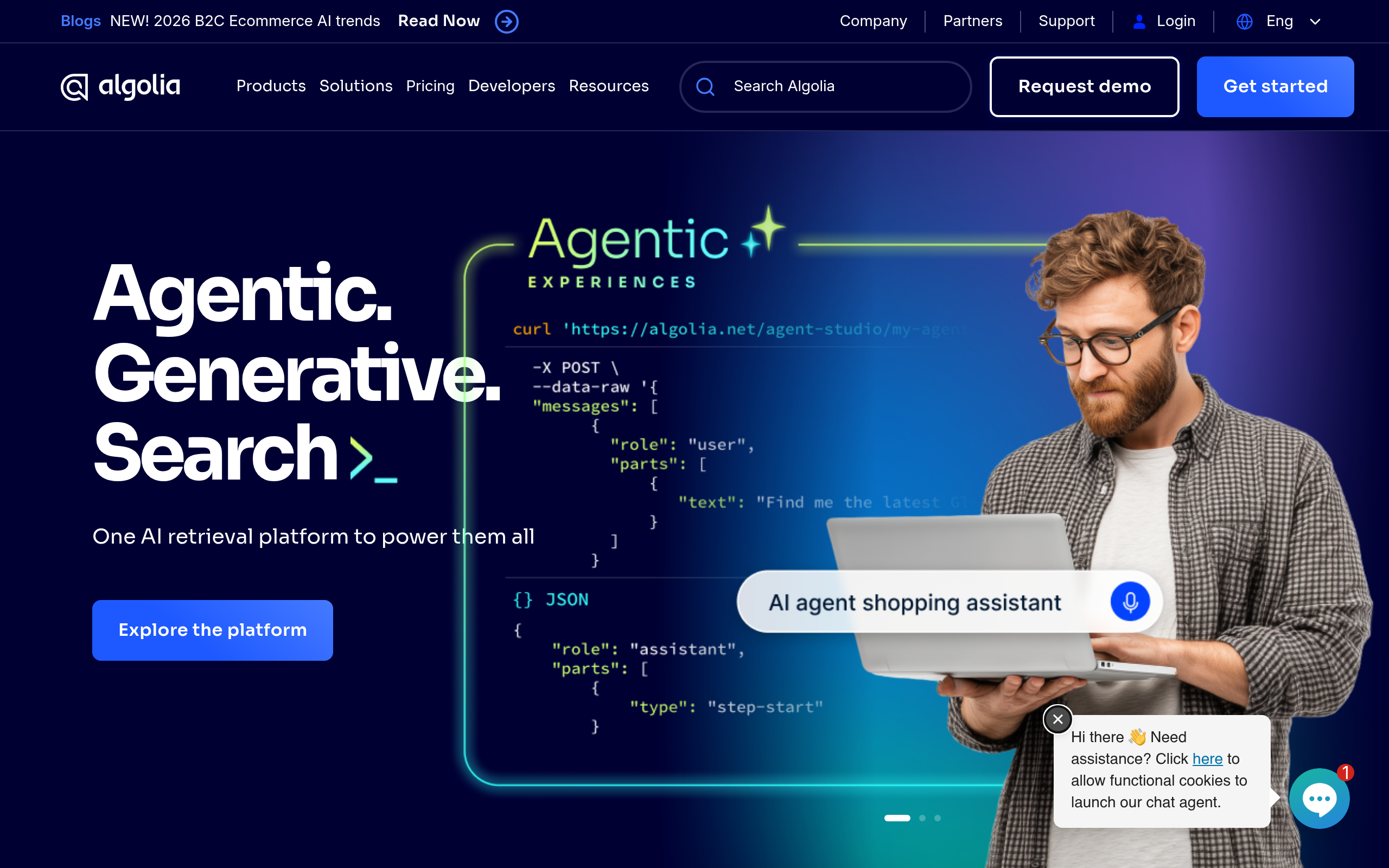
What is Algolia?
Algolia is an API-first search engine that delivers sub-50ms query responses for e-commerce stores and content catalogs. It replaces native database queries with a globally distributed search network. Developers use its pre-built UI libraries to add typo-tolerant autocomplete bars to websites.
Built by Algolia, Inc., this platform solves the problem of slow product discovery. It targets engineering teams and merchandising managers who need fast keyword and AI neural search. Similar to Elasticsearch but fully managed, it removes the burden of hosting infrastructure.
- Primary Use Case: Implementing real-time autocomplete search bars for e-commerce stores.
- Ideal For: Engineering teams and merchandising managers.
- Pricing: Starts at $0.50 (Pay-as-you-go). You pay per 1,000 searches after the initial free allowance.
Key Features and How Algolia Works
Search and Relevance Engine
- NeuralSearch: Combines keyword and vector search in a single API call. Requires complex initial data mapping.
- Typo Tolerance: Handles spelling errors across 68 supported languages. Limited to predefined alphabet configurations.
- Synonyms Management: Defines one-way or multi-way synonyms. Limited to manual entry or basic API updates.
Merchandising and Analytics
- Rules Engine: Pins, hides, or boosts specific results. Limited to 1,000 rules per index on standard plans.
- A/B Testing: Tests search configurations to measure conversion impact. Limited to testing exactly 2 configurations simultaneously.
- Analytics Dashboard: Tracks click-through rates and search volume in real time. Data retention depends on the pricing tier.
Developer Tools and Integration
- InstantSearch Libraries: Pre-built UI components for React, Vue, and Angular. Requires custom CSS for brand matching.
- Algolia Crawler: Scrapes and indexes content from web domains. Limited by target site rate limits and structure.
- Record Indexing: Stores JSON objects for search. Strictly limited to 10KB per object.
Algolia Pros and Cons
Pros
- Delivers sub-50ms search latency globally via a Distributed Search Network.
- Provides extensive documentation and SDKs for 10 programming languages.
- Allows non-technical staff to manage merchandising rules through a visual dashboard.
- Scales to handle millions of records and thousands of queries per second.
Cons
- Costs escalate rapidly for high-traffic sites due to the $0.50 per 1,000 searches pricing model.
- Restricts record size to 10KB per object (which breaks text-heavy documentation indexing).
- Requires complex initial configuration for advanced AI features like NeuralSearch.
Who Should Use Algolia?
- E-commerce Merchandisers: You need visual tools to pin products and boost specific brands without writing code.
- Frontend Developers: You want pre-built React components to deploy an autocomplete bar in an afternoon.
- Enterprise Content Managers: You manage massive catalogs and need sub-50ms faceted navigation.
- Budget-Constrained Solo Founders (Not Recommended): You will hit the pay-as-you-go limits quickly if your site gets scraped or experiences a traffic spike.
Algolia Pricing and Plans
The Build plan is free but strictly limited to development environments. It includes 10,000 searches per month and 1,000,000 records. It lacks production-grade performance features.
The Grow plan costs $0.50 per 1,000 searches. It operates on a pay-as-you-go model. You get 10,000 free searches per month and 100,000 records. Overage costs $0.40 per 1,000 records.
The Grow Plus plan requires custom pricing. It adds enhanced AI capabilities and higher usage limits.
The Elevate plan requires an annual custom contract. It grants access to NeuralSearch, the full AI suite, and premium support.
How Algolia Compares to Alternatives
Unlike Elasticsearch, Algolia is a fully managed service. Elasticsearch requires you to provision servers, manage clusters, and tune relevance manually. Algolia handles infrastructure and provides a visual dashboard for non-technical users. But Elasticsearch offers unlimited queries for a flat server cost.
Similar to Meilisearch but much more expensive at scale. Meilisearch is open-source and allows self-hosting. You can run Meilisearch on a $20 monthly server for millions of queries. Yet Algolia provides superior global latency through its edge network and better out-of-the-box merchandising tools.
The Best Search Engine for E-commerce Teams
Algolia delivers massive value to e-commerce teams who need fast product discovery. Merchandisers get the visual control they need. Developers get the APIs they want.
Solo developers building text-heavy applications should look elsewhere. The 10KB record limit creates constant friction.
If you want a cheaper alternative, try Typesense.
Algolia will likely shift entirely toward AI-generated answers over traditional keyword matching within 12 months.