



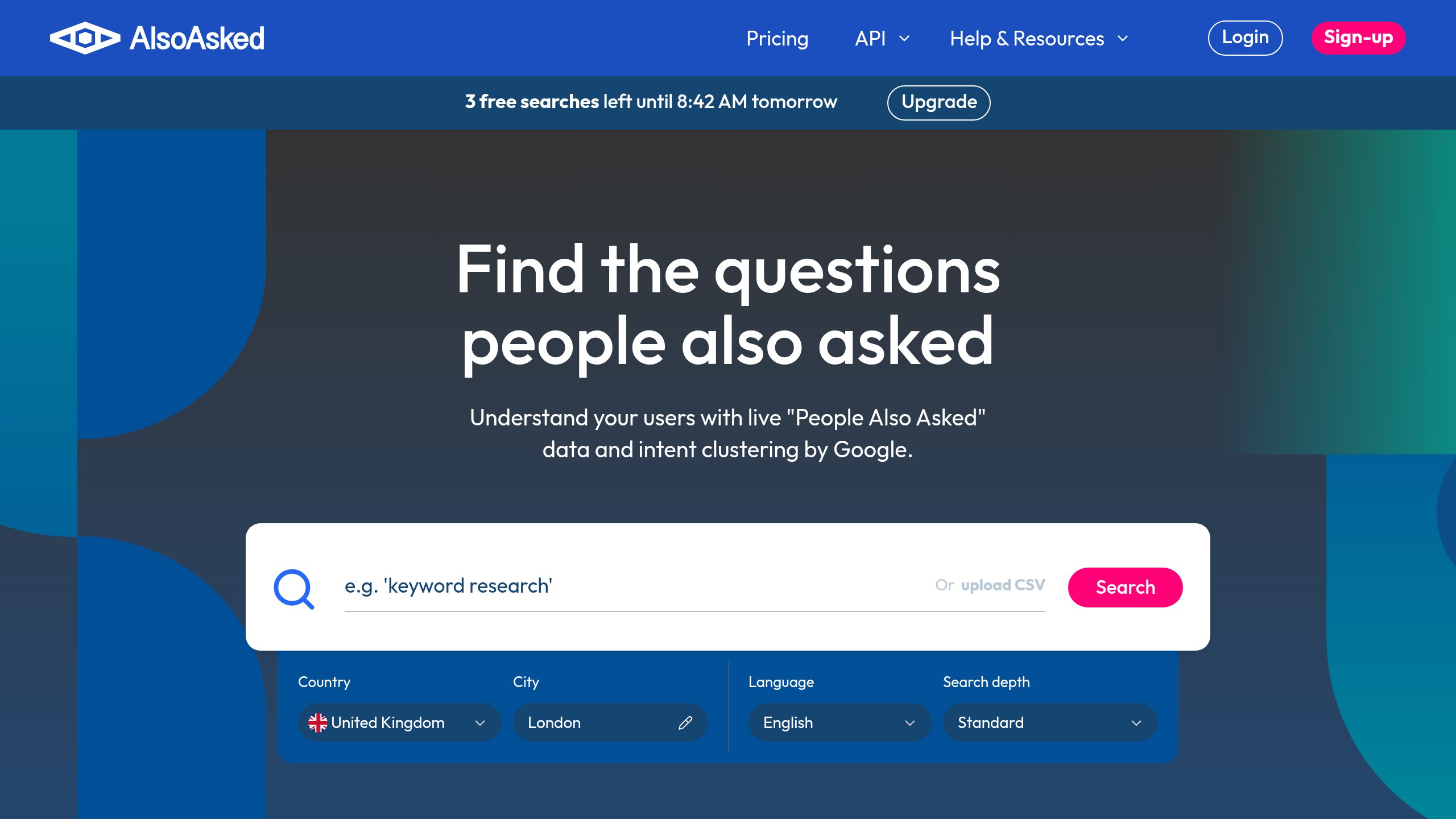
What is AlsoAsked?
You need to map out a topical cluster for a new product launch by Friday, but staring at a flat list of keywords gives you zero clue how buyers actually frame their questions. AlsoAsked solves this specific bottleneck. Developed by AlsoAsked Ltd., this SEO and content research tool extracts live ‘People Also Ask’ data from Google. It formats those questions into a visual branching tree. Marketing managers use it to accelerate campaign output and hit target publication dates faster.
Building an authoritative article without mapped search intent is like trying to bake a soufflé without measuring your ingredients.
AlsoAsked hands you the exact measurements.
It pulls real-time data directly from search results to show you how one user query leads to the next. The short version: you get a ready-made structure for your blog posts and FAQ sections.
- Primary Use Case: Discovering long-tail questions to structure blog posts and build topical authority clusters.
- Ideal For: SEO professionals and marketing managers who need to outline multiple articles quickly.
- Pricing: Starts at $12/month (Basic plan) a highly affordable entry point for solo users.
Key Features and How AlsoAsked Works
Visual Search Intent Mapping
- Branching Diagrams: The tool takes Google PAA boxes and maps them into interactive visual trees (a lifesaver when trying to explain topic clusters to impatient executives). This shows exactly how user intent progresses from a broad topic to specific concerns.
- Live Data Extraction: It pulls queries directly from live search results. You always see current user behavior rather than relying on a static database.
- Deep Search: Users can instruct the tool to search one level deeper. This action returns an average of 100 follow-up questions for complete coverage.
High-Volume Campaign Tools
- Bulk Upload: Marketing teams can upload hundreds of keywords simultaneously. This feature processes massive editorial calendars in minutes.
- Asynchronous API: Enterprise users can interact with the data programmatically. Webhook support allows teams to pipe question data directly into custom marketing dashboards.
- Geo-Specific Filtering: You can target searches by specific countries and languages. This ensures localized campaigns hit the right regional intent.
Client and Data Exports
- PNG Export: You can download an entire visual map as a high-resolution image. I found this visual output highly effective for justifying content strategies to clients.
- CSV Export: Users can save collected text into CSV files. This lets you move the raw data into a spreadsheet for further sorting.
AlsoAsked Pros and Cons
Strengths
- Pulls live data directly from Google PAA boxes to ensure content matches current search trends.
- Visual mind map format makes explaining search intent progression to non-technical stakeholders very easy.
- The $12 per month starting price makes it highly accessible for solo freelancers and small agencies.
- API access with webhook support gives larger teams a way to automate their research workflows.
- Exporting question trees as PNG images takes seconds and provides an immediate asset for presentations.
Limitations
- The tool provides zero search volume or cost-per-click metrics.
- Basic plan users lose access to their search history after 24 hours.
- Searches return no results if the target keyword does not trigger a PAA box on Google.
- It functions strictly as a data extraction utility and lacks any AI writing capabilities.
Who Should Use AlsoAsked?
- Marketing Managers: Ideal for leaders who need to generate article outlines and delegate briefs to writers quickly.
- Agency SEO Strategists: The PNG export feature provides clear visual proof of search intent for client pitch decks.
- Programmatic SEO Builders: The API and bulk upload tools fit perfectly into automated site-building workflows.
- Data-Driven Media Buyers: This tool is NOT a good fit for you. It offers no search volume, CPC, or competitor metrics to guide ad spend.
AlsoAsked Pricing and Plans
The platform keeps its pricing structure simple. The Basic plan costs $12 per month and includes 100 searches per month. The real issue: this cheapest tier restricts search history access to just 24 hours. This tight window is a noticeable friction point for teams managing ongoing editorial projects. You have to export your data immediately.
The Lite plan costs $29 per month. It increases the limit to 300 searches and expands history access to one year. The Pro plan costs $59 per month. It provides 1,000 searches, CSV exports, bulk uploading, and API access. There is no free tier available.
You either pay for a plan or pay for individual API credits.
How AlsoAsked Compares to Alternatives
AnswerThePublic focuses on keyword modifiers and autocomplete data. It uses prepositions to show what users might search for around a topic. Compare that to AlsoAsked. This tool specifically targets the PAA boxes to show related queries based on intent rather than alphabetical autocomplete results. AnswerThePublic provides a broader list of ideas, but AlsoAsked provides a clearer hierarchy of specific questions.
Semrush Topic Research is a massive feature inside a very expensive software suite. It groups content ideas into cards and provides actual search volume metrics alongside the ideas. The difference here: AlsoAsked maps out the direct follow-up questions users ask after their initial query. Semrush tells you how many people search for a topic. AlsoAsked tells you exactly what they want to know about it.
The Right Pick for High-Volume Content Teams
AlsoAsked speeds up the most tedious part of campaign planning. It tells you exactly what questions an audience needs answered. Marketing managers, content editors, and agency owners get an immediate return on investment by accelerating outline creation. Solo founders and small teams benefit from the cheap entry price.
Even so, the total lack of search volume data means it cannot function as your only research tool. If you need a single platform to handle both question discovery and traffic metrics, you should look elsewhere. Ahrefs Keywords Explorer provides PAA data alongside strict search volume numbers to guide content decisions.