

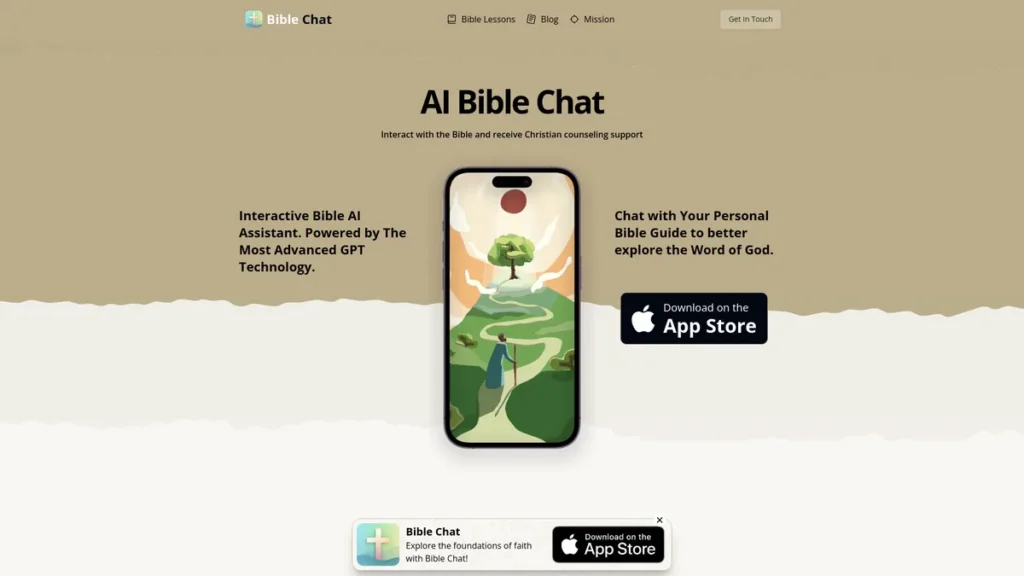
What is Bible Chat?
Bible Chat is an AI-powered application designed to function as a specialized conversational interface for biblical texts. At its core, it leverages a sophisticated large language model (LLM), noted to be based on GPT architecture, to process user queries and generate contextually relevant responses. The platform is engineered to serve a niche vertical: interactive religious study and spiritual guidance. Its primary function is to parse and interpret the complex dataset of the Bible, allowing users to perform tasks ranging from theological inquiry and verse retrieval to engaging in structured, AI-guided study sessions. From a technical standpoint, it represents a purpose-built implementation of generative AI aimed at making a dense and historically significant text corpus more accessible and interactive for a broad user base.
Key Features and How It Works
Bible Chat’s functionality is built upon several core components that work in tandem to deliver its user experience. Understanding these from a system design perspective reveals a well-thought-out application of AI technology.
- Interactive Bible AI Assistant: This is the central processing unit of the application. It utilizes a fine-tuned GPT model to manage conversational flow and maintain context during theological discussions. The system processes natural language input, queries its knowledge base, and generates human-like text responses in real time, simulating a conversation with a knowledgeable theological expert.
- Verse Finder: More than a simple keyword search, this feature likely employs semantic search algorithms. It allows the system to understand the user’s intent and retrieve relevant scriptures based on abstract concepts, topics, or themes rather than exact phrasing. This requires a robust data indexing and retrieval mechanism capable of mapping conceptual queries to specific text passages.
- Bible Trivia Games: This feature represents a gamified front-end that leverages the core AI’s knowledge base. It programmatically generates questions, validates user answers, and adjusts difficulty, serving as an effective mechanism for user engagement and knowledge reinforcement.
- Personalized Prayers: A practical application of the AI’s generative text capabilities. The system is designed to take unstructured user input—such as personal reflections or concerns—and synthesize it with scriptural data to produce a structured, coherent output in the form of a prayer.
Pros and Cons
From a software development and systems architecture perspective, Bible Chat presents a compelling but limited package.
Pros:
- Robust LLM Implementation: The integration of deep learning delivers impressively context-aware responses to complex biblical inquiries. This suggests a well-tuned model that effectively handles the nuances of theological language.
- Clean Mobile UI/UX: The interface is designed for accessibility, ensuring that the complex back-end technology is usable by a non-technical audience. A streamlined user experience is critical for application adoption and retention.
- Multilingual Support: The inclusion of multiple languages indicates a scalable internationalization (i18n) framework. This is a significant technical advantage for achieving global market penetration.
- Integrated Engagement Hooks: Features for community interaction and Christian counseling are built directly into the platform, fostering a dedicated user base and providing valuable data for iterative feature development.
Cons:
- Lack of Cross-Platform Support: Being a mobile-only application is a significant technical limitation. It precludes desktop use and, more importantly, restricts opportunities for integration via a web app or external tools.
- No Public API: The absence of a developer API is a major missed opportunity. An API would allow third-party developers to integrate Bible Chat’s verse-finding or query-answering capabilities into other faith-based applications, creating a B2B revenue stream.
- Potential for Interpretive Inaccuracy: Like all current-generation LLMs, the AI is susceptible to ‘hallucinations’ or generating responses that lack the nuanced interpretation of a trained human theologian. This makes it unsuitable for rigorous academic or scholarly research where interpretive precision is paramount.
Who Should Consider Bible Chat?
Bible Chat is a valuable tool for a specific set of users, though its technical limitations define its ideal audience.
- Individual Believers: Users seeking a modern, interactive method for personal study, prayer, and scriptural exploration will find the tool highly effective.
- Church and Study Groups: The app can serve as a supplementary resource for facilitating discussions, though the mobile-only format may be challenging for group presentations.
- Spiritual Counselors: As an assistive tool, it can help find relevant scriptures or frame discussions, provided there is consistent human oversight.
- Developers and Tech Entrepreneurs: This app serves as an excellent case study in vertical AI implementation. It demonstrates the market potential for fine-tuning powerful LLMs for specific knowledge domains. The platform’s limitations also highlight market gaps, such as the need for a ‘Bible as a Service’ API.
Pricing and Plans
Bible Chat operates on a subscription model, offering a trial period for users to evaluate its capabilities. A 7-day free trial is available for all new users to access the full suite of features. Following the trial, users can choose from several subscription tiers to maintain access. The plans are structured as follows:
- Weekly Subscription: $4.99 per week
- Monthly Subscription: $12.99 per month
- Annual Subscription: $59.99 per year
For the most current pricing information, consulting the official app store listing is recommended.
What makes Bible Chat great?
Bible Chat’s single most powerful feature is its interactive AI assistant, built on a sophisticated GPT framework. This core technology elevates the application beyond a digital concordance or simple search engine into a dynamic, conversational partner for scriptural exploration. The technical achievement lies in successfully fine-tuning a general-purpose language model for the highly specialized and nuanced domain of theology. This allows the AI to handle ambiguity, interpret abstract queries, and maintain conversational context, providing users with insightful, relevant, and personalized interactions. This focused application of advanced AI to a specific knowledge base is what makes it a standout tool in the digital faith technology space.
Frequently Asked Questions
- What AI model does Bible Chat use?
- The documentation indicates that Bible Chat is built on advanced GPT technology. This implies it uses a variant of the Generative Pre-trained Transformer architecture, which has been specifically fine-tuned on a large corpus of biblical and theological texts to optimize for performance in this domain.
- Is there an API for developers to integrate Bible Chat’s features?
- Currently, Bible Chat is a closed-ecosystem, mobile-only application. There is no publicly available API for third-party developers to access its verse-finding, query-answering, or text-generation capabilities for integration into other software or services.
- How does the AI handle different biblical translations and interpretations?
- The system’s ability to provide context-aware responses suggests it is trained primarily on one or more popular translations (e.g., NIV, KJV, ESV). While it can parse queries effectively, its interpretive depth is limited by its training data. For rigorous theological or academic work that requires comparing source texts and historical contexts, the AI should be used as a preliminary research tool, not an authoritative source.
- What are the primary data privacy and security considerations?
- Users may input sensitive personal information, especially when using the personalized prayer feature. The platform’s high security rating (4.8/5) suggests the implementation of strong end-to-end encryption and robust data handling policies. However, it is always recommended for users to review the application’s specific privacy policy to understand how their data is stored, processed, and protected.