



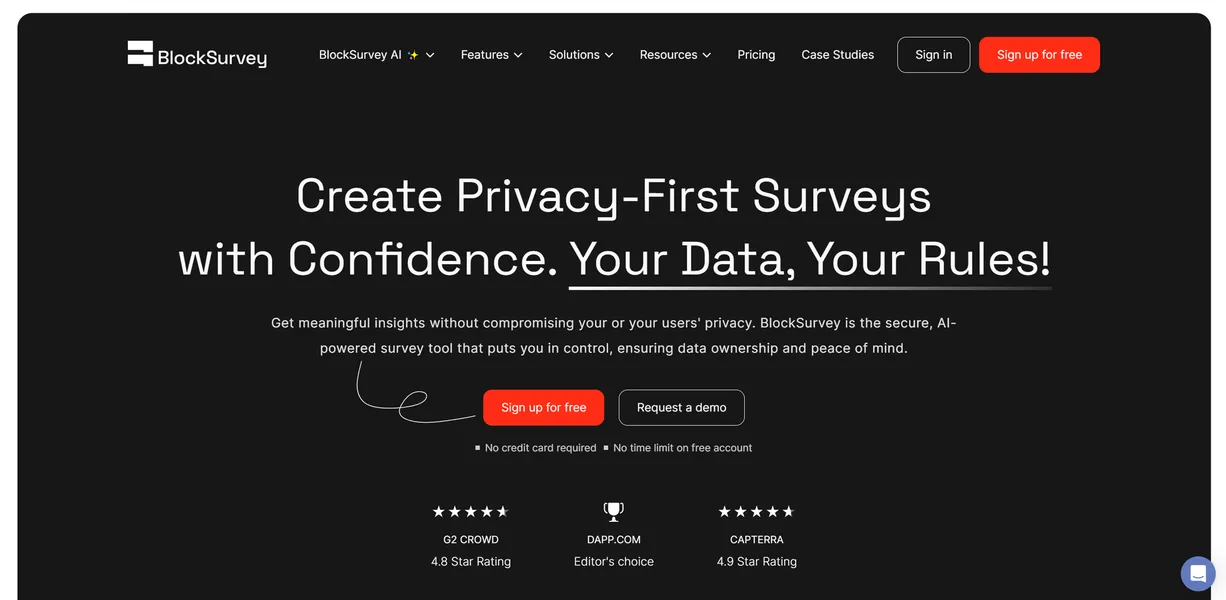
What is BlockSurvey?
The most unusual thing about BlockSurvey is that the company hosting your data cannot read it.
BlockSurvey Inc. built this privacy-focused survey platform to solve a massive data security problem. It uses blockchain technology to provide end-to-end encryption and decentralized data ownership. HR professionals and medical researchers use it to collect sensitive information without risking a data breach. The platform generates surveys in seconds using AI, though its free plan restricts users to a mere 10 responses per month.
- Primary Use Case: Collecting sensitive patient health data and anonymous employee feedback.
- Ideal For: Medical researchers and HR teams requiring strict data privacy.
- Pricing: Starts at $25 (freemium) – The entry price exceeds basic survey tools but includes essential encryption.
Key Features and How BlockSurvey Works
AI Survey Generation
- AI Builder: Generates 10 or more questions from a text prompt or URL. Limit: AI processing limits apply based on your subscription tier.
- Sentiment Analysis: Categorizes text responses as positive, negative, or neutral. Limit: Available only on higher paid plans.
Privacy and Security Architecture
- End-to-End Encryption: Uses AES-256 encryption to secure all collected data. Limit: Requires users to safely store their own secret keys (I lost my test key once and had to start over).
- Decentralized Storage: Stores data on Gaia hubs instead of centralized servers. Limit: Users must manage their own storage provider choices.
Form Customization and Logic
- Logic and Branching: Creates complex paths with conditional jumps. Limit: Unlimited jumps require a paid subscription.
- White Labeling: Removes platform branding and adds custom CSS. Limit: Requires the $50 per month Plus plan.
BlockSurvey Pros and Cons
Pros
- Blockchain architecture ensures developers cannot access your survey data.
- The AI assistant drafts industry-specific surveys in under 60 seconds.
- Users maintain full ownership of identity through Stacks blockchain integration.
- Zero tracking cookies ensure total respondent anonymity and fast load times.
Cons
- The free plan limits users to just 10 responses per month.
- Managing decentralized identity keys confuses non-technical users.
- The $25 monthly starting price exceeds basic tiers of traditional tools.
- Structural layout options lack the visual variety found in Typeform.
Who Should Use BlockSurvey?
- Medical Researchers: You need strict HIPAA compliance and secure data collection for patient studies.
- HR Professionals: You want to guarantee true anonymity for internal employee feedback surveys.
- Casual Users: You should avoid this tool. The 10-response free limit makes it useless for basic event planning or simple polls.
BlockSurvey Pricing and Plans
BlockSurvey offers a freemium model, but the free tier acts more like a restricted trial.
- Free: $0/mo – 1 user, 10 questions, 10 responses per month.
- Basic: $25/mo (billed annually) – 1 user, 100 responses per month.
- Plus: $50/mo (billed annually) – 3 users, 1,000 responses per month, custom branding.
- Business: $83/mo (billed annually) – 5 users, 10,000 responses per month, advanced logic, multi-language.
- Enterprise: Custom pricing – Tailored features, security, and compliance.
How BlockSurvey Compares to Alternatives
Similar to Typeform, BlockSurvey offers logic branching and custom branding. Unlike Typeform, BlockSurvey prioritizes data sovereignty over flashy visual design. Typeform gives you interactive layouts, while BlockSurvey gives you AES-256 encryption.
Tally provides a generous free tier with unlimited forms and responses. BlockSurvey restricts free users to 10 monthly responses. Tally works best for budget-conscious creators, but BlockSurvey wins for enterprise teams handling sensitive medical data.
The Best Survey Tool for Data Privacy
BlockSurvey delivers unmatched security for organizations handling sensitive information.
Medical researchers and HR teams get the most value from its decentralized architecture. Solo creators needing simple forms should look at Tally instead.