



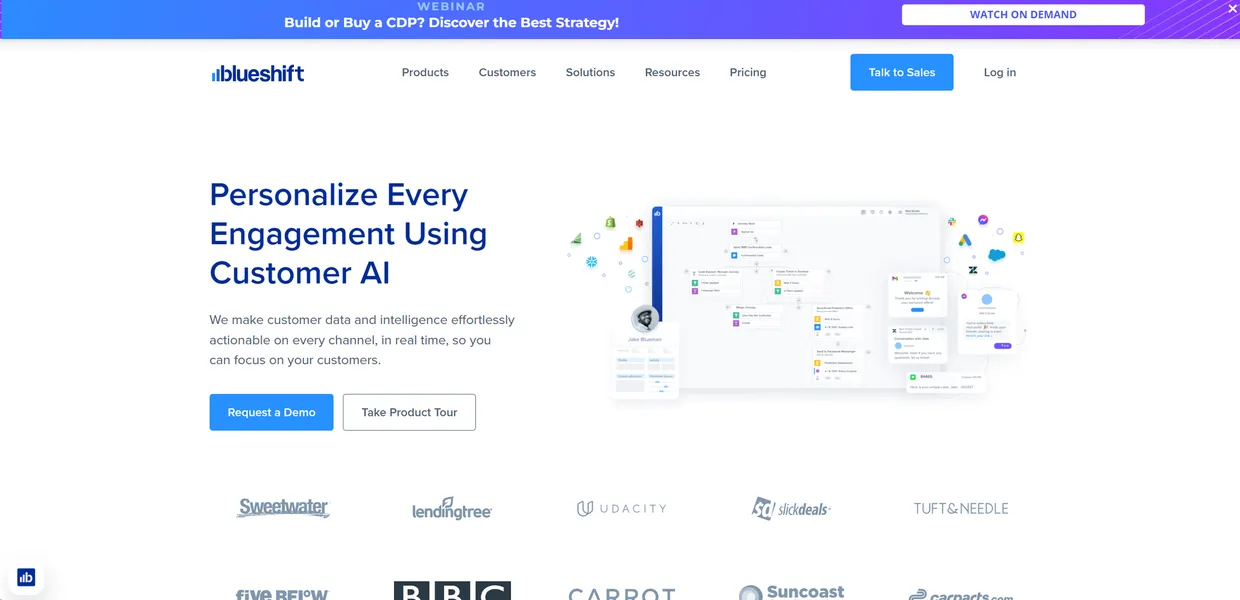
What is Blueshift?
Enterprise marketers often expect a customer data platform to just store profiles, but they get a fragmented system requiring separate email tools. Blueshift changes this equation. It combines data aggregation with campaign execution in one interface. Users build segments based on real-time behavior and immediately trigger messages across email, SMS, and mobile push.
Developed by Blueshift Labs, Inc., this platform targets enterprise B2C brands struggling with data latency. It solves the delay between a customer abandoning a cart and receiving a relevant offer. The system processes behavioral triggers in under one second.
- Primary Use Case: Triggering automated cross-channel campaigns based on real-time predictive scoring.
- Ideal For: Enterprise B2C marketing teams with high event volumes.
- Pricing: Starts at Custom Pricing (Annual Contract) – Requires speaking to sales for exact volume-based tiers.
Key Features and How Blueshift Works
Unified Data Architecture
- Single Customer View: Consolidates data from Segment, Shopify, and Salesforce into unified profiles. Limit: Initial data mapping takes several months for complex setups.
- Flexible Schema: Accepts custom event attributes without rigid database constraints. Limit: Querying very large datasets in the reporting interface causes sluggish performance.
Predictive Intelligence Engine
- Churn Prediction: Built-in models score users on churn risk and purchase intent. Limit: Requires sufficient historical data volume to generate accurate scores.
- Send Time Optimization: Delivers messages when individual users are most likely to engage. Limit: Only works effectively after tracking user behavior over multiple campaigns.
Cross-Channel Orchestration
- Real-time Event Processing: Triggers actions like cart abandonment emails in under one second. Limit: Requires proper API configuration to achieve sub-second latency.
- Dynamic Content: Uses Liquid templating for personalizing HTML emails with real-time product catalogs. Limit: Documentation for advanced Liquid templating lacks complex real-world examples.
Blueshift Pros and Cons
Pros
- Unified data architecture eliminates the need for separate CDP and ESP tools, reducing data latency.
- Predictive modeling is accessible to marketers without requiring a dedicated data science team or coding.
- Real-time triggers allow for immediate response to user actions like page views or clicks.
- Highly scalable infrastructure handles billions of events for large enterprise retailers.
Cons
- Steep learning curve for the visual journey builder compared to simpler tools like Mailchimp.
- Implementation and initial data mapping take several months for complex enterprise setups.
- Reporting interface becomes sluggish when querying very large datasets or long time ranges.
- Documentation for advanced Liquid templating lacks complex real-world examples.
Who Should Use Blueshift?
- Enterprise B2C Retailers: Brands with massive product catalogs use the predictive recommendations to personalize emails at scale.
- Data-Driven Marketing Teams: Teams wanting to trigger campaigns based on propensity scores without waiting on data engineers.
- Small Businesses: Solo founders or small shops will find the implementation timeline too long and the custom pricing too high.
Blueshift Pricing and Plans
Blueshift hides its exact pricing behind a sales wall.
The company offers a Free Trial (which functions more like a guided sandbox), but this is just a limited-time test of core platform features. The Growth plan requires an annual contract and custom pricing based on event volumes and campaign execution limits. The Enterprise plan adds advanced AI controls and governance features, also at a custom annual rate.
How Blueshift Compares to Alternatives
Similar to Braze, Blueshift focuses heavily on cross-channel orchestration and mobile push notifications. Braze offers a slightly more intuitive visual journey builder for mobile-first brands. Blueshift counters with stronger native predictive modeling for churn and purchase intent without requiring external data science tools.
Unlike Iterable (which excels at flexible workflow building for growth marketers), Blueshift leans harder into its unified customer data platform roots. Iterable requires a separate CDP like Segment to function at its peak. Blueshift handles both the data aggregation and the campaign execution natively.
The Verdict for Enterprise B2C Marketers
Large retail brands with high data volumes get the most value from Blueshift. It connects fragmented data sources and turns them into immediate marketing actions. Small teams looking for quick email automation should look elsewhere. A tool like Mailchimp makes much more sense for basic newsletters and simple triggers.
The honest limit remains the setup time.
We still do not know if Blueshift plans to simplify its initial data mapping process for faster onboarding.