



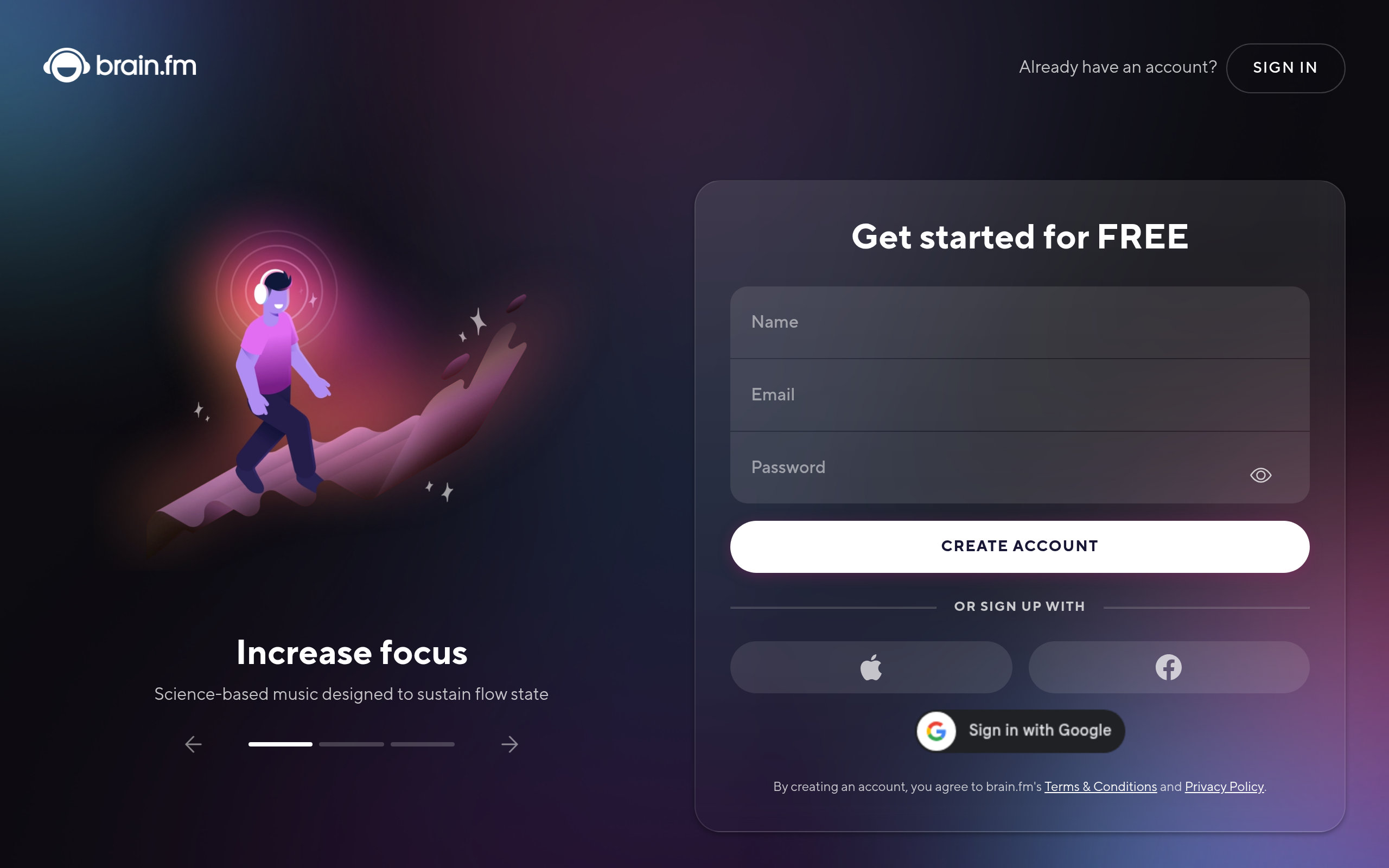
What is Brain.fm?
Brain.fm is a functional audio application that uses rhythmic pulses to alter brainwave activity, offering a built-in Pomodoro timer adjustable up to 24 hours. Developer Brain.fm, Inc. built this tool for software developers and students who struggle with auditory distractions. The core technology relies on patented neural phase locking to synchronize brainwaves across 10 different music genres.
The application replaces traditional playlists with continuous algorithmic soundscapes. Users select a mental state, and the audio engine generates tracks designed to induce that specific cognitive condition within 15 minutes.
- Primary Use Case: Deep work sessions requiring sustained concentration.
- Ideal For: Software developers and students with ADHD.
- Pricing: Starts at $14.99 (paid): High cost but offers scientifically validated focus tracks.
Key Features and How Brain.fm Works
Neural Phase Locking and Audio Engine
- Neural Phase Locking: Aligns brainwaves to rhythmic pulses, though high intensity settings cause auditory fatigue for some users.
- Spatial Audio: Uses 3D soundscapes to minimize looming effects, requiring stereo headphones for full immersion.
- Intensity Control: Adjusts the neural effect from low to high, but lacks granular EQ controls.
Focus and Sleep Modes
- Focus Modes: Provides Deep Work, Creative Flow, and Study options, restricted to pre-set algorithmic tracks.
- Sleep and Nap Modes: Includes specific tracks for 20-minute naps or 8-hour sleep cycles, requiring comfortable sleep hardware.
- Timer Function: Built-in Pomodoro timer adjusts from 5 minutes to 24 hours, but does not integrate with external calendar apps.
Platform Access and Offline Use
- Offline Mode: Mobile app allows downloading tracks for offline use, limited by your device storage capacity.
- Cross-Platform Sync: Syncs progress across Web, iOS, and Android, though the desktop web version occasionally buffers on slow connections.
Brain.fm Pros and Cons
Pros
- Scientifically validated through peer-reviewed research and EEG testing to improve focus within 15 minutes.
- Zero-distraction audio avoids lyrics or sudden melodic shifts that break concentration during study blocks.
- Mobile app interface allows one-tap focus sessions without complex configuration.
- Continuous updates add new music tracks weekly to prevent listener fatigue over long subscription periods.
Cons
- The $14.99 monthly subscription is expensive compared to free white noise alternatives on YouTube.
- High-intensity tracks cause auditory fatigue or mild headaches for some users after prolonged listening.
- Users cannot mix their own soundscapes or add external white noise to the generated tracks.
- Desktop web version occasionally suffers from buffering issues on slower internet connections.
Who Should Use Brain.fm?
- Software Developers: The zero-distraction audio blocks out open-office noise during long coding sprints.
- Students with ADHD: The high-intensity focus modes provide necessary stimulation to maintain attention on reading materials.
- Budget-Conscious Casual Listeners: This tool is not a good fit. The $14.99 monthly fee is too high if you only need occasional background noise.
Brain.fm Pricing and Plans
Brain.fm operates entirely on a paid subscription model.
The Monthly Subscription costs $14.99 per month. This tier provides full access to all focus, sleep, and relaxation music. Users get offline downloads and cross-platform syncing across all devices.
The Enterprise plan uses custom pricing. It provides volume licensing for corporate teams who want to offer focus tools to employees.
Paying $14.99 monthly is expensive compared to standard music streaming apps. The service does not offer a free trial, forcing users to pay upfront to test the neural phase locking technology.
How Brain.fm Compares to Alternatives
Similar to Focus@Will, Brain.fm targets productivity through neuroscience-backed audio. Focus@Will relies heavily on human-curated channels and personality typing to select music. Brain.fm uses an AI engine to generate continuous tracks with embedded rhythmic pulses. Focus@Will costs less annually, but Brain.fm offers superior mobile app stability and offline download capabilities.
Unlike Endel, this tool focuses on intense work sessions rather than ambient background noise. Endel uses real-time inputs like weather and heart rate to generate soundscapes. Brain.fm ignores external data (a distinct friction point if you want reactive audio) to maintain strict neural phase locking. Endel works better for general relaxation, while Brain.fm excels at forcing deep concentration.
The Final Verdict for Deep Work Audio
Brain.fm delivers highly effective focus music for professionals who need to block out noisy environments. Software developers and neurodivergent users get the most value from the patented rhythmic pulses. Casual listeners should look elsewhere. If the $14.99 monthly price is too high, Endel provides a cheaper alternative for ambient soundscapes.