



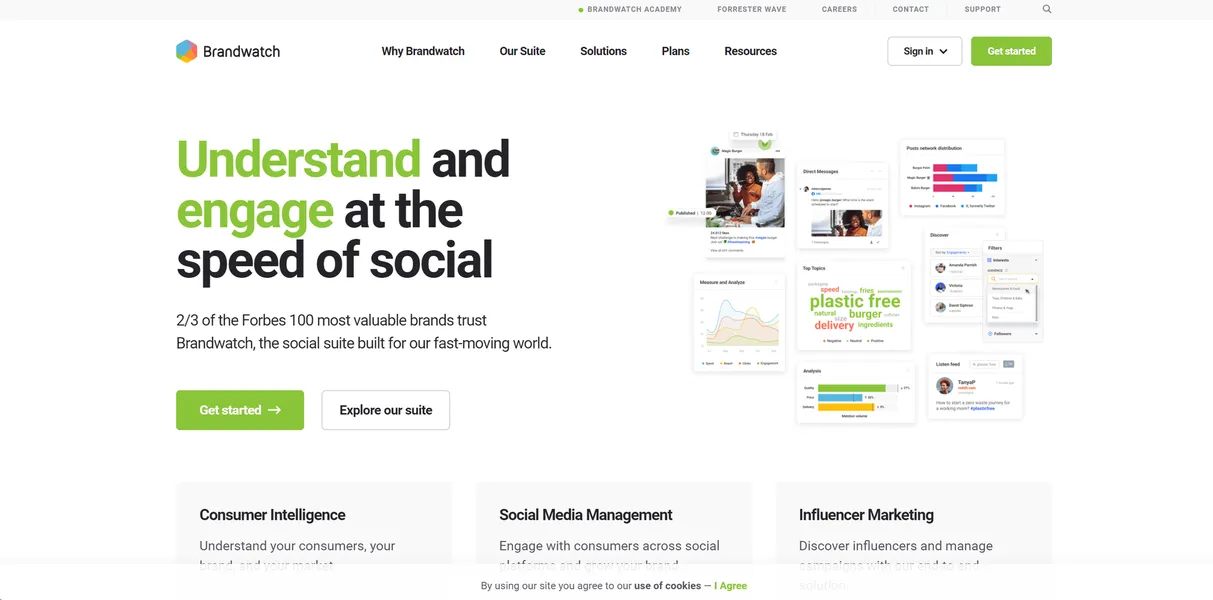
What is Brandwatch?
Over 1.4 trillion historical conversations sit inside the Brandwatch database. This massive archive dates back to 2008.
Developed by Cision, Brandwatch operates as an enterprise social intelligence platform. It helps large marketing teams monitor brand mentions across 100 million online sources. These sources include Reddit, X, Tumblr, and thousands of independent blogs. Users track sentiment, manage social media publishing, and identify influencers within a single interface. The platform targets global brands needing deep consumer research. It replaces fragmented marketing stacks with one centralized data hub.
- Primary Use Case: Enterprise social listening and historical consumer research.
- Ideal For: Global marketing teams and enterprise PR agencies.
- Pricing: Starts at $800 (Custom Quote) with high entry costs restricting access to large budgets.
Key Features and How Brandwatch Works
Consumer Research and Listening
- Historical Data: Access conversations back to 2008. Standard plans limit this access to 12 months.
- Boolean Search: Build complex queries with unlimited operators. Complex queries require significant training to master.
- Sentiment Analysis: Score mentions in over 40 languages. Accuracy drops on sarcastic posts.
- Custom Classifiers: Train machine learning models to categorize data based on specific brand needs. Training these models requires large initial data sets.
Visualizations and Reporting
- Vizia Dashboards: Create real-time data displays for office screens. This requires a separate $500 monthly add-on.
- AI Analyst (Iris): Detect sudden spikes in brand mentions. Alerts trigger late during high-volume global events.
- Image Insights: Identify brand logos in social media images. Object detection struggles with obscured logos.
- API Access: Export data into external business intelligence tools like Tableau or Power BI. API rate limits restrict massive daily data pulls.
Social Management and Influencer Discovery
- Unified Inbox: Manage comments across Facebook, Instagram, and X. API limits delay real-time message syncing.
- Influence Database: Search over 30 million creators. Full demographic breakdowns require the premium influencer add-on.
Brandwatch Pros and Cons
Pros
- Access to 15 years of historical data provides unmatched long-term trend analysis.
- Customizable Vizia dashboards allow granular reporting for different executive stakeholders.
- Advanced Boolean search offers superior precision compared to mid-market competitors like Sprout Social.
- Cision integration gives PR teams a unified view of earned media and social chatter.
- The Iris AI analyst identifies emerging crises before they hit mainstream news outlets.
Cons
- Pricing starts near $800 per month, locking out small businesses and solo consultants.
- The interface requires extensive training to build accurate Boolean queries.
- Users report data latency when processing massive real-time events.
- Customer support response times lag for users on standard service tiers.
Who Should Use Brandwatch?
- Enterprise PR Teams: Agencies managing global brands need the 15-year historical data archive to track long-term sentiment shifts.
- Corporate Crisis Managers: The Iris AI analyst helps teams spot emerging negative trends before they hit mainstream news.
- Market Researchers: Analysts use custom classifiers to segment audience conversations by specific product features.
- Small Business Owners: This platform is a poor fit for local businesses due to the high monthly cost and complex setup.
Brandwatch Pricing and Plans
Brandwatch does not offer a free trial.
The company uses a custom pricing model based on data volume and feature access.
Base access costs $800 to $1,000 per month billed annually. This Custom Quote tier includes standard social listening and 12 months of historical data.
How much does full access cost?
Pulling data older than one year requires a custom premium upgrade. Adding specialized Vizia visualizations costs an estimated $500 per month. Accessing the full 30 million creator database adds $200 to $500 to the monthly bill. These add-ons push the total cost well above the base price.
How Brandwatch Compares to Alternatives
Similar to Meltwater, Brandwatch targets enterprise users with massive data requirements. Meltwater focuses on traditional PR and news media monitoring (print and digital broadcasts). Brandwatch provides deeper historical social media data and more advanced Boolean search operators. Meltwater wins on traditional media coverage, while Brandwatch dominates social listening.
Unlike Sprout Social, Brandwatch prioritizes complex consumer research over daily social media publishing. Sprout Social offers a simpler interface and transparent pricing for mid-market teams. Brandwatch wins on data depth but loses on user-friendliness. Sprout Social fits social media managers better, while Brandwatch serves data analysts.
The Best Choice for Enterprise Data Analysts
Brandwatch delivers massive value to data analysts and enterprise PR teams. The 1.4 trillion post archive gives researchers the exact data they need to map long-term consumer behavior.
Small teams and solo marketers should look elsewhere. The steep learning curve and $800 starting price create unnecessary friction for basic social listening (a common complaint among new users). Sprout Social remains a better recommendation for teams needing simple publishing and basic reporting.
Over the next 12 months, Brandwatch will integrate generative AI directly into its Vizia dashboards to automate executive summary creation.