

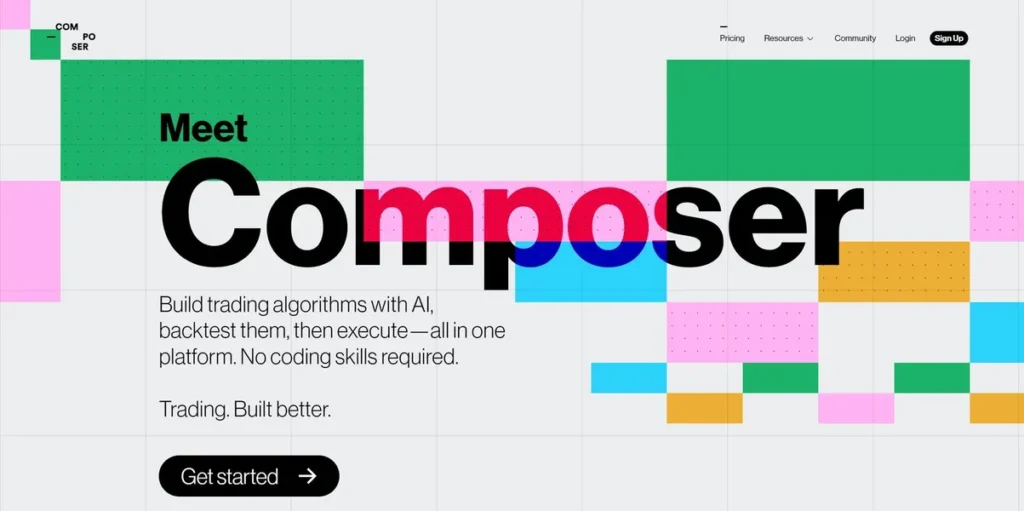
What is Composer?
Composer is an integrated development environment (IDE) for investment strategies, abstracting the complexities of quantitative trading into a streamlined, no-code platform. From a technical standpoint, it provides a high-level interface that allows users to define, test, and deploy trading algorithms without writing a single line of Python or C++. By leveraging a natural language processing (NLP) interface and a visual editor, Composer effectively translates user intent into executable trading logic. The platform manages the entire lifecycle, from data ingestion and backtesting against historical market data to automated order execution through brokerage APIs. This democratizes access to algorithmic trading, a domain traditionally reserved for those with deep expertise in both finance and software engineering.
Key Features and How It Works
Composer’s architecture is built around a core set of features designed to provide an end-to-end solution for automated investing. Its functionality can be broken down into several key components:
- AI-powered Strategy Creation: This feature functions as an NLP front-end. Users input their investment objectives and logic in plain English, which the system parses and converts into a formal strategy structure. This significantly lowers the barrier to entry for strategy definition.
- No-code Visual Editor: For users who require more granular control, the visual editor serves as a graphical user interface for a domain-specific language (DSL) tailored to finance. It allows for the construction of complex conditional logic and rule-based systems through drag-and-drop components, which are then compiled into an executable strategy.
- Comprehensive Backtesting: A critical component for any trading system, Composer’s backtesting engine allows strategies to be simulated against historical market data. The platform’s claim of over 5 million backtests suggests a robust, distributed computing backend capable of handling significant computational loads, enabling users to validate their logic’s historical performance before deployment.
- Automated Trading Execution: Once a strategy is finalized and backtested, Composer’s execution engine takes over. This backend service manages portfolio state, calculates necessary trades based on the strategy’s logic, and executes orders via integrated brokerage accounts. It handles tasks like periodic rebalancing automatically.
- Community Insights: This feature functions as a shared repository or version control system for trading strategies. Users can publish their strategies, allowing others to inspect, ‘fork’ (remix), or invest in them directly, fostering a collaborative development environment.
Pros and Cons
Pros
- Rapid Prototyping: The high-level abstraction enables incredibly fast iteration on investment ideas without the overhead of writing and debugging code or managing infrastructure.
- Managed Infrastructure: Composer handles the complexities of market data feeds, secure brokerage connections, and order execution, allowing users to focus exclusively on strategy logic.
- Scalable Backend: The platform’s ability to run millions of backtests indicates a well-architected system designed for performance and reliability.
- Systematic Approach: It enforces a disciplined, rule-based approach to investing, removing emotion and manual error from the trading process.
Cons
- Abstraction Limitations: For advanced quantitative developers, the no-code interface may lack the granularity needed for highly specialized strategies, such as those requiring microsecond-level latency optimizations or custom, proprietary data sources.
- Technical Learning Curve: While no coding is required, users must still learn the platform’s specific logic and financial primitives, which can present a learning curve for those unfamiliar with systematic trading concepts.
- API and Integration Constraints: The platform’s current focus on U.S. users suggests limitations in its available brokerage API integrations and support for international markets.
Who Should Consider Composer?
Composer is engineered for a distinct set of users who operate at the intersection of finance and technology. Individuals with strong investment theses who lack the software development skills to implement them will find the platform invaluable. It serves as an excellent rapid prototyping tool for financial analysts and portfolio managers who need to test hypotheses without commissioning development resources. For software developers new to the quantitative finance space, Composer acts as a structured sandbox for learning strategy development principles. Even seasoned quantitative traders may find it useful for managing simpler, less latency-sensitive components of their overall portfolio, prioritizing speed of deployment over granular execution control.
Pricing and Plans
Specific pricing information was not available in the source data provided for this review. The platform is understood to operate on a subscription model, offering a flat monthly fee for access to its full suite of features, including unlimited automated trading. A free trial period is also available for new users to evaluate the system’s capabilities. For the most accurate and up-to-date pricing, please visit the official Composer website.
What makes Composer great?
Struggling to bridge the gap between investment ideas and executable, backtested code? Composer’s primary technical achievement is its seamless integration of the entire trading algorithm development lifecycle. It successfully combines ideation (via NLP), development (via a visual DSL), robust testing (via a scalable backtesting engine), and deployment (via an automated execution system) into a single, cohesive platform. This end-to-end, fully managed environment eliminates the significant friction and infrastructure overhead typically associated with algorithmic trading. By abstracting away the low-level complexities, it allows developers and investors alike to focus on the signal rather than the noise, concentrating their efforts on strategy logic and performance.
Frequently Asked Questions
- What level of technical control do I have over the trading algorithms?
- Composer provides a high-level visual and natural language interface for defining strategy logic. While this allows for significant complexity, it does not offer low-level control over the execution code, server infrastructure, or order routing. The platform is designed to prioritize accessibility and ease of use over granular, low-level optimization.
- How reliable is the backtesting engine?
- Having processed over 5 million backtests, Composer’s engine is demonstrably robust. It utilizes historical market data to simulate how a strategy would have performed. However, developers should remain aware of common pitfalls like lookahead bias and overfitting. As with any backtest, past performance is not a guarantee of future results.
- Can I integrate my own custom data sources or APIs?
- Composer operates as a self-contained ecosystem. It supports a wide range of assets, including stocks and ETFs, within its environment but does not appear to offer a public API for integrating external, custom data feeds or third-party services.
- What security measures are in place?
- As an SEC-registered platform, Composer is required to adhere to stringent security and compliance standards. This typically includes robust data encryption, secure authentication protocols, and rigorous operational controls to protect user data and financial assets.