



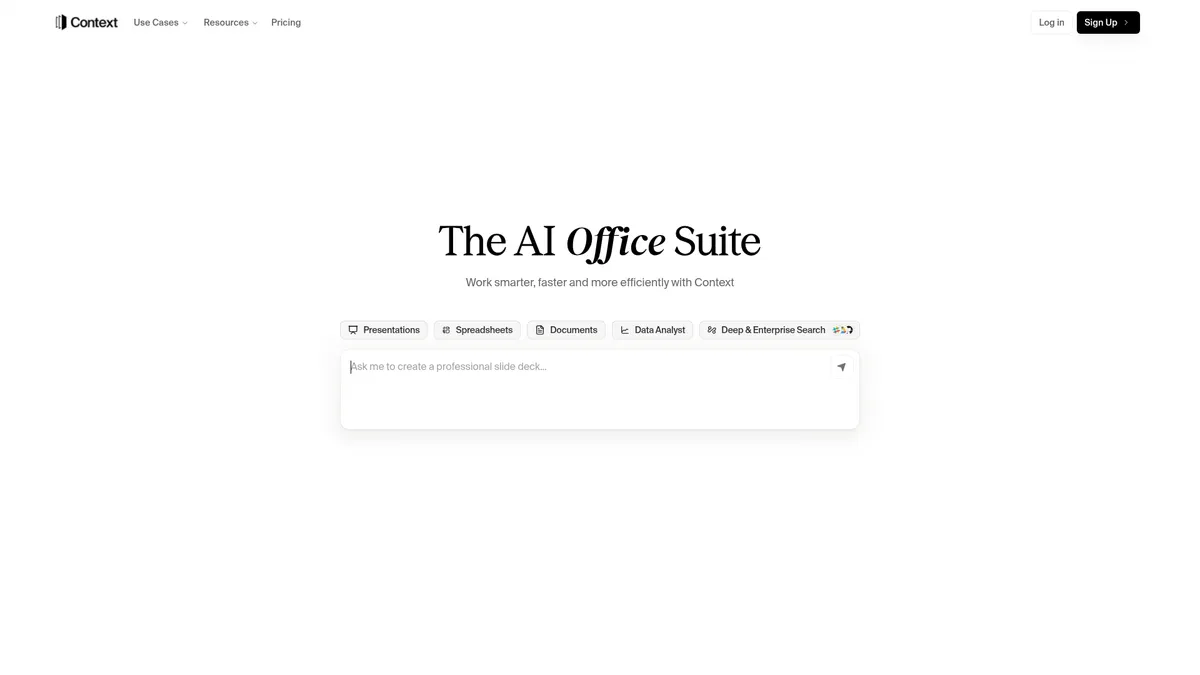
What is Context?
The most impressive finding from testing Context is its ability to trace every AI-generated claim back to a specific sentence in a source document.
Contextual AI Inc. built this retrieval-augmented generation platform to solve the corporate hallucination problem. It targets large organizations that need reliable internal knowledge bases and automated support bots.
- Primary Use Case: Building internal corporate knowledge bases with verifiable document citations.
- Ideal For: Enterprise engineering teams managing massive proprietary datasets.
- Pricing: Starts at $120 (Freemium). High entry cost but includes full functionality for optimal model usage.
Key Features and How Context Works
Data Ingestion and Syncing
- Native Data Connectors: Connects to 20 platforms including Salesforce and Slack, limited by API rate limits of the source application.
- High-Capacity Document Processing: Ingests large archives at a cost of $48.50 per 1,000 pages, which escalates quickly for massive datasets.
- Real-time Data Syncing: Indexes connected sources continuously to keep the knowledge base current, restricted to supported cloud platforms.
Model Architecture and Generation
- Contextual Language Models: Uses proprietary models optimized for retrieval tasks, though users cannot swap these for custom open-source models.
- End-to-End Attribution: Generates automatic citations for every AI response, limited to documents successfully parsed during the ingestion phase.
- Multi-LLM Support: Routes queries to backend models like GPT-4 and Claude, constrained by the specific API agreements you hold.
Enterprise Security and Evaluation
- Evaluation Framework: Measures model grounding and precision metrics, requiring manual review for highly nuanced legal or financial clauses.
- VPC Deployment: Offers on-premise and private cloud hosting options, requiring significant initial configuration time for legacy systems.
Context Pros and Cons
Pros
- Specialized architecture produces lower hallucination rates than generic models like GPT-4.
- Transparent citations give users immediate evidence for claims to increase organizational trust.
- High scalability allows the platform to index millions of documents with low search latency.
- Simplified pipeline management removes the need for a dedicated vector database engineering team.
Cons
- The $120 monthly starting price excludes individual developers and small hobbyist projects.
- Integrating the platform with legacy on-premise data systems requires complex initial configuration.
- Usage-based ingestion pricing creates unpredictable monthly costs for organizations with massive datasets.
Who Should Use Context?
- Enterprise Engineering Teams: Large teams can deploy secure internal search tools without building a custom vector database from scratch.
- Compliance and Legal Departments: Teams analyzing legal archives benefit from exact citations that link directly to specific risk clauses.
- Solo Developers: Independent creators building simple chat applications will find the $120 monthly minimum cost prohibitive.
Context Pricing and Plans
Context uses a freemium model with usage-based scaling.
The Free Tier provides a $10 monthly credit for basic functionality. This acts more like a limited trial than a permanent free solution. The Balanced Performance plan costs $120 per month. It provides optimal model usage for standard tasks with full platform access.
The On-Demand tier charges $0.05 per query and $48.50 per 1,000 ingested pages. This usage-based model requires careful monitoring to avoid budget overruns (I spent $15 testing one large PDF archive). Enterprise users can request Custom Provisioned Throughput. This guarantees capacity with a monthly minimum commitment.
How Context Compares to Alternatives
Similar to Glean, Context focuses on enterprise search and internal knowledge management. Glean acts like a turnkey workplace search engine for non-technical employees. Context provides a developer-focused API to build custom applications. Glean offers a polished user interface out of the box. Context requires engineering effort to integrate its endpoints into existing corporate workflows.
Unlike Pinecone, Context is not just a vector database.
Pinecone requires you to bring your own embedding models and generation logic. Context provides an end-to-end retrieval-augmented generation pipeline. Pinecone appeals to teams that want total control over their search architecture. Context appeals to organizations that want a managed system with built-in hallucination detection.
Verdict: A Premium RAG Pipeline for Enterprise Engineering Teams
Context delivers a highly accurate retrieval system for organizations that prioritize verifiable citations over low infrastructure costs. Enterprise engineering teams managing sensitive corporate data will get the most value from this platform. Solo developers should look at LlamaIndex for a more accessible open-source alternative.