



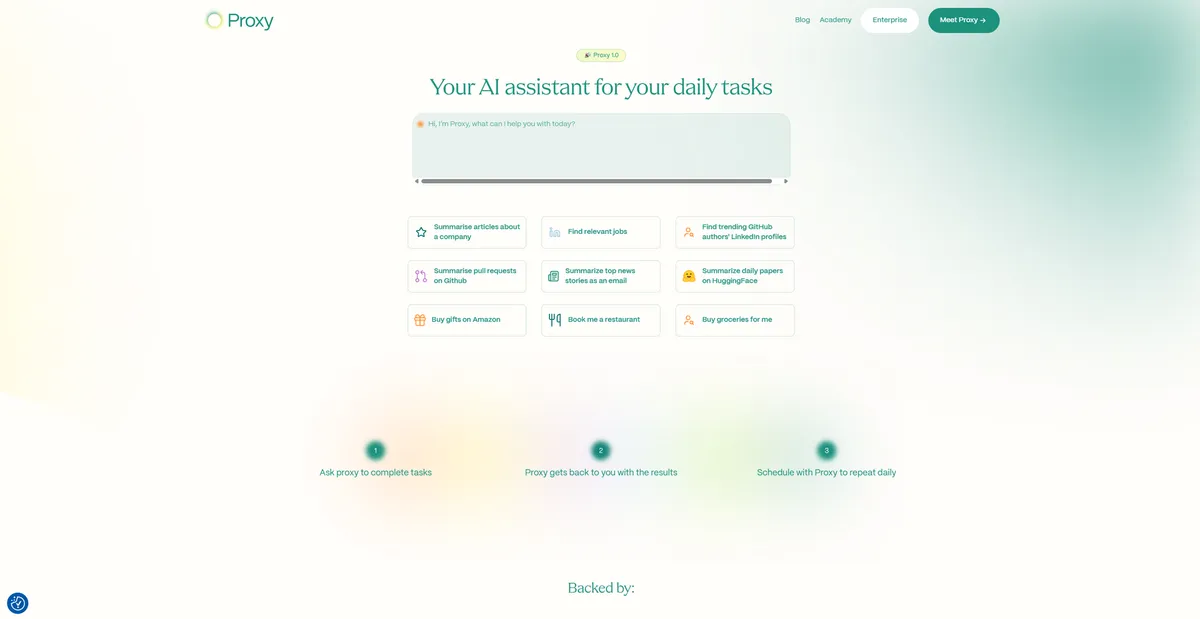
What is Convergence?
Convergence Proxy is an autonomous AI agent that clicks, types, and reads software interfaces like a human operator. You give it a high-level goal, and it executes the required sequence of actions across multiple applications.
Developed by Convergence AI Inc., this tool solves the integration problem for legacy systems lacking official APIs. Operations managers and researchers use it to automate repetitive data entry, coordinate schedules, and process e-commerce orders.
- Primary Use Case: Automating multi-step data entry across legacy web platforms without APIs.
- Ideal For: Operations managers handling high-volume repetitive digital tasks.
- Pricing: Starts at $20/mo (Freemium) – Expensive at the high end, but basic plans offer accessible entry points.
Key Features and How Convergence Works
Autonomous Interface Operation
- Cross-application operation: Operates across 1,000 web-based tools and desktop interfaces.
- Real-time screen perception: Processes UI updates at 10 frames per second to track visual changes.
- Error recovery: Identifies and retries tasks if a page fails to load.
Memory and Reasoning
- Long-term memory: Stores up to 50GB of user-specific workflow context and preferences.
- Proprietary Large Action Model: Sequences sub-tasks using advanced logic trained by ex-DeepMind researchers.
- Multi-modal input: Accepts instructions via text, voice, and uploaded screenshots.
Security and Control
- Human-in-the-loop: Requires mandatory manual approval for any financial transaction or high-stakes action.
- SOC2 Type II compliance: Secures data handling with local processing options available.
Convergence Pros and Cons
Pros
- Completes entire workflows like booking flights without manual intervention.
- Allows no-code training by recording a 2-minute screen demonstration.
- Operates on any website regardless of whether an official API exists.
- Utilizes advanced reasoning for complex logic, built by ex-DeepMind researchers.
- Runs multiple Proxies at the same time to handle high-volume data tasks.
Cons
- Operating user interfaces is slower than performing direct API calls.
- Minor changes in a website layout break the agent execution path.
- The $200 per month Max plan is an expensive option for small businesses.
- Users report session timeouts during long-running autonomous tasks.
Who Should Use Convergence?
- Operations Managers: Teams handling repetitive data entry across legacy platforms save hours of manual clicking.
- Market Researchers: Analysts can set the agent to browse multiple sources and synthesize data into reports.
- API-Dependent Developers: Software engineers looking for fast data transfers should avoid this tool and stick to traditional API integrations.
Convergence Pricing and Plans
Convergence uses a freemium model with several paid tiers.
- Free Tier: $0 per month for basic access and essential features.
- Claude Pro: $20 per month for higher usage limits tailored to individual users.
- Claude Team (Std): $25 per user per month for business features, requiring a minimum of 5 seats.
- Claude Max: $200 per month for 20x the usage limits of the Pro plan.
- Claude Team (Premium): $150 per user per month, which includes Claude Code for selected users.
The free tier functions for testing basic agent capabilities.
How Convergence Compares to Alternatives
Similar to MultiOn, Convergence uses a browser extension to interact with web elements. MultiOn focuses on consumer web browsing and quick tasks. Convergence targets complex enterprise workflows with its 50GB memory capacity and SOC2 compliance.
Unlike Adept, which integrates into enterprise software suites, Convergence relies on visual screen perception at 10 frames per second. Adept feels faster for specific supported applications. Convergence offers broader compatibility across undocumented legacy web platforms.
The Verdict for Operations Teams
Convergence Proxy provides high value for teams stuck managing data across disconnected, older web portals. If your daily work involves copying information between three different browser tabs, this agent saves time.
The visual interface approach introduces noticeable latency.
(Watching an AI click through a form tests your patience).
Users needing instant data synchronization should look elsewhere.
Adept remains a better choice for users operating within major enterprise software ecosystems.
Within 12 months, visual AI agents will execute UI tasks at speeds beyond human perception.