


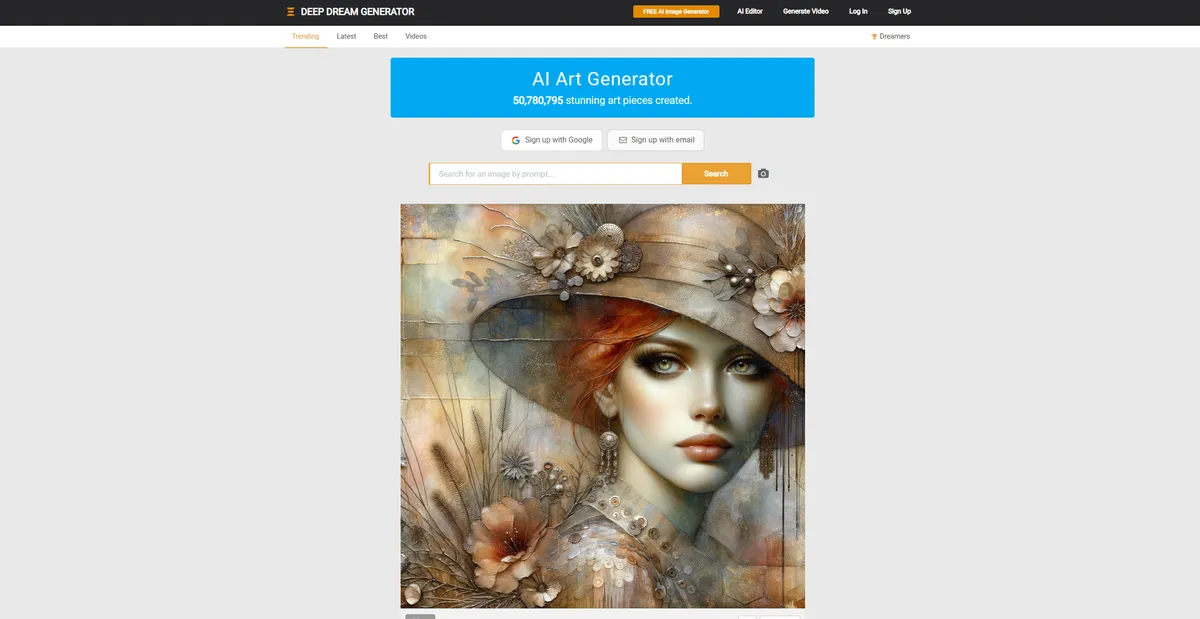
What is Deep Dream Generator?
You have a standard landscape photo and want it to look like a Van Gogh painting. Deep Dream Generator applies specific artistic style transfer techniques to make that exact visual change. Aetoma Ltd developed this AI image generation platform to help digital artists and hobbyists create surreal visuals from text prompts or existing images. The software analyzes your base image and maps the visual characteristics of your chosen style onto it.
The tool runs in your browser (even on older laptops) and requires no local GPU resources.
- Primary Use Case: Transforming personal photographs into classical paintings using style transfer.
- Ideal For: Digital artists and hobbyists exploring abstract patterns.
- Pricing: Starts at $19/mo (Freemium). The free tier limits daily usage through an energy point system.
Key Features and How Deep Dream Generator Works
Text and Image Generation Models
- Text-to-Dream: Generates images from text prompts using stable diffusion models. Limits depend on your available energy points.
- Deep Dream: Creates psychedelic abstract patterns inspired by original Google research. Output resolution caps at your plan limit.
- Iterative Generation: Evolves an existing dream into new variations with modified parameters. Each iteration costs additional energy points.
Style Transfer Tools
- Deep Style: Transfers the artistic style of one image onto another using neural networks. Processing takes longer than standard generation.
- Thin Style: Applies a simplified style transfer for rapid artistic iterations. Quality is lower than Deep Style.
- Aspect Ratio Selection: Choose between square, landscape, or portrait orientations. Custom aspect ratios are not available.
Platform Controls and Storage
- Resolution Scaling: Supports output resolutions from Full HD up to 5K. The 5K option requires the $99/mo Ultra plan.
- Cloud Storage: Saves generated assets in a dedicated gallery. Storage ranges from 20GB to 200GB based on your subscription.
- Privacy Controls: Keeps generated images private or shares them in the community feed. Free users cannot make all images private.
Deep Dream Generator Pros and Cons
Pros
- The community feed lets users discover exact text prompts and style settings from other creators.
- The energy recharge system gives free users a daily allowance without a hard account lockout.
- High resolution 5K output capability suits professional print production.
- Granular control over style weight allows precise adjustments to the final image.
Cons
- The energy system restricts heavy users who need unlimited generation.
- The user interface feels dated compared to modern AI tools like Leonardo.ai.
- Style transfer results often produce unwanted visual artifacts on complex images.
- The platform lacks advanced editing features like in-painting or out-painting.
Who Should Use Deep Dream Generator?
- Hobbyist digital artists: You want to experiment with abstract patterns and style transfers without buying a high end graphics card.
- Print designers: You need 5K resolution outputs for physical media production.
- Commercial illustrators: This tool is not a good fit. You need precise control over character poses and in-painting edits.
Deep Dream Generator Pricing and Plans
The platform uses a freemium model based on an energy point system. Users spend energy to generate images, and the system recharges these points over time.
The free tier is a real free plan, but it limits your daily generation capacity.
- Free: $0/mo. Includes limited daily usage and slow energy recharge.
- Advanced: $19/mo. Provides 120 Energy units, 20GB storage, and Full HD resolution.
- Professional: $39/mo. Provides 250 Energy units, 50GB storage, and Quad HD resolution.
- Ultra: $99/mo. Provides 750 Energy units, 200GB storage, and 5K resolution.
How Deep Dream Generator Compares to Alternatives
Similar to NightCafe, Deep Dream Generator focuses on artistic style transfer and community sharing. NightCafe offers more generation models and a more modern interface. Deep Dream Generator provides higher maximum resolution outputs for premium users. Both tools use a credit system, but NightCafe offers more ways to earn free credits through daily challenges.
Unlike Midjourney, this tool relies on a standard web interface rather than Discord. Midjourney produces more realistic photographic results (like human faces) and handles complex text prompts better. Deep Dream Generator wins on specific image to image style transfer tasks. Midjourney requires a paid subscription, while Deep Dream Generator offers a free entry point.
Final Verdict for Digital Artists
Deep Dream Generator excels at turning standard photos into stylized digital paintings. Hobbyists and print designers get the most value from its high resolution outputs and style transfer tools. Commercial illustrators who need precise image editing should look at Midjourney instead.