

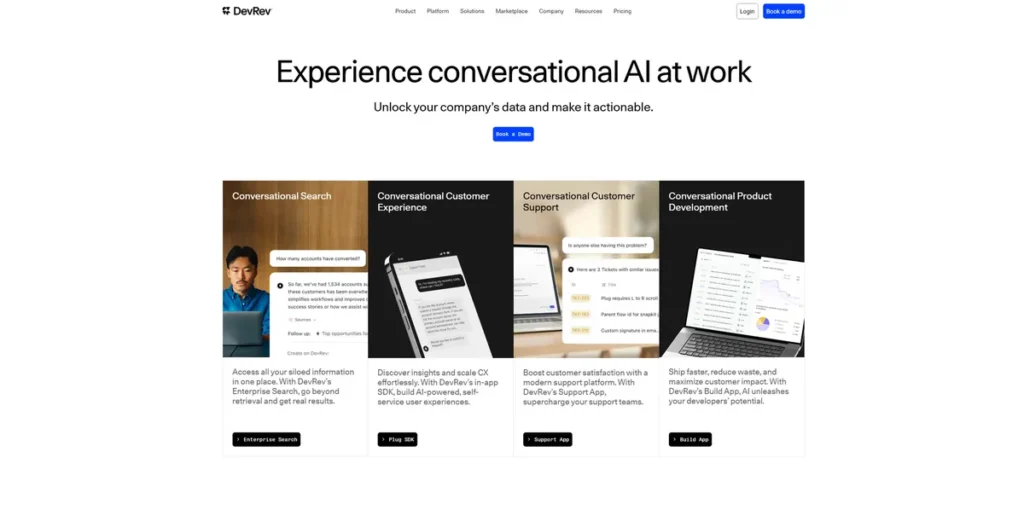
What is DevRev?
For a business owner, managing separate tools for customer support and product development is often a source of inefficiency and added cost. DevRev addresses this by merging these two functions into a single, cohesive platform. In practical terms, it creates a direct line from a customer complaint or feature request to the development team’s workflow. Instead of a support agent manually copying information from a helpdesk ticket into a project management tool like Jira, DevRev treats the customer issue and the developer task as parts of the same whole. This is designed to reduce manual data entry, minimize communication errors, and speed up the entire cycle from customer feedback to product improvement, ultimately impacting your bottom line by saving time and resources.
Key Features and How It Works
DevRev’s features are built to provide tangible benefits for a business focused on operational efficiency and return on investment. Here’s a breakdown of how its core components work to achieve that:
- AI-Driven Analytics: The platform analyzes incoming support tickets and customer interactions to identify trends. For a business owner, this means you get clear data on the most frequent bugs or most requested features, allowing you to allocate your limited development resources to tasks that will have the greatest positive impact on customer satisfaction and retention.
- Omni-Channel Communication: This feature consolidates all customer conversations from various channels (like email, chat, and social media) into a single inbox. This prevents your team from having to constantly switch between different applications, leading to faster response times and a more organized support process.
- Integrated Roadmapping and Sprint Tracking: DevRev connects your product roadmap directly to real-time customer feedback. When a customer reports a critical issue, it can be prioritized and moved directly into a development sprint. This ensures your team is always working on what matters most to your users, rather than building features in a vacuum.
- Self-Service Tools: You can create a customer-facing portal or knowledge base powered by generative AI. This allows customers to find answers to common questions on their own, reducing the number of routine support tickets. For your business, this translates directly to lower support overhead.
- Session Replays and Analytics: This feature allows your support and development teams to watch a recording of a user’s session leading up to an error. It eliminates the time-consuming back-and-forth of trying to reproduce a bug, allowing developers to see the exact problem and fix it faster.
Pros and Cons
Evaluating any new tool requires a clear-eyed look at its potential benefits versus its costs and challenges.
Pros
- Tool Consolidation: By combining the functions of a helpdesk, project manager, and analytics tool, DevRev can potentially lower your monthly software subscription costs.
- Operational Efficiency: The direct link between support issues and development tasks eliminates manual steps, reduces the chance of human error, and accelerates bug fixes and feature releases.
- Data-Informed Product Strategy: Your development priorities are based on quantitative data from actual customer interactions, not guesswork. This reduces the risk of wasting resources on unwanted features.
- Improved Customer Retention: Faster issue resolution and effective self-service options contribute to a better customer experience, which is key for loyalty and retention.
Cons
- Initial Setup Complexity: Migrating from established tools like Zendesk or Jira requires a significant time investment. For a small team, this implementation phase can divert resources from other critical tasks.
- Learning Curve: An all-in-one platform has many features, and it will take time for your team to become proficient. This training period is an indirect cost that must be considered.
- Limited Third-Party Integrations: DevRev’s ecosystem is still developing. If your workflow depends on a specific third-party application that doesn’t integrate with DevRev, it could be a non-starter or require inefficient manual workarounds.
Who Should Consider DevRev?
DevRev is built for businesses where the product itself is a core part of the operation, particularly small to medium-sized tech startups and SaaS companies. If the feedback loop between your customers and your developers is currently slow, broken, or managed with a patchwork of disconnected tools, DevRev offers a compelling solution. E-commerce businesses with in-house development teams can also benefit by directly linking customer support interactions with improvements to their platform. However, if your company doesn’t develop its own software or your support and development teams are already working efficiently, the cost and effort of switching may not be justified. It is a powerful tool, but one that solves a specific set of operational challenges centered on product development.
Pricing and Plans
At the time of this review, detailed pricing information for DevRev’s plans was not publicly available on their website. The platform appears to offer different tiers, likely including a free or trial version to allow businesses to test the service. For the most accurate and up-to-date pricing, please visit the official DevRev website.
What makes DevRev great?
The single most powerful feature of DevRev is its unification of customer support tickets and development work items into a single, cohesive entity. This isn’t just about putting two lists in the same window; it fundamentally changes the workflow by eliminating the artificial barrier between the team that talks to customers and the team that builds the product. For a small business, the impact is direct: when a bug is reported, it doesn’t need to be translated, re-entered, and prioritized in a separate system. It flows directly to the development backlog with all the original context, including customer conversations and session replays. This dramatically reduces the time to resolution, cuts down on administrative overhead, and ensures that development efforts are perfectly aligned with real-world customer needs, maximizing the ROI of every engineering hour.
Frequently Asked Questions
- Is DevRev a replacement for tools like Jira and Zendesk?
- Yes, for many businesses, DevRev is designed to replace both by integrating their core functionalities. The goal is to provide a single platform for customer support and product development, which can help reduce your overall software subscription costs and simplify your tech stack.
- How much technical effort is required to implement DevRev?
- The initial setup and data migration can be complex and may require technical expertise. While day-to-day use can be managed by non-technical staff, a successful implementation often requires a dedicated person or team to handle the configuration and integration with your existing systems to realize the platform’s full potential.
- Can a small team with limited resources benefit from DevRev?
- It’s a definite possibility. If your primary challenge is the communication gap between support and development, DevRev can deliver significant value by streamlining that process. However, you must weigh the upfront time investment required for setup and training against the long-term efficiency gains. Using a free tier, if available, would be a low-risk method to evaluate if it’s the right fit for your team.
- What happens if DevRev doesn’t integrate with another critical tool our business uses?
- This is a critical factor to verify before committing. DevRev’s list of third-party integrations is still growing. If an essential tool in your workflow is not supported, you may need to rely on manual processes to bridge the gap, which could negate some of the platform’s efficiency benefits. Always check their current integration capabilities first.