



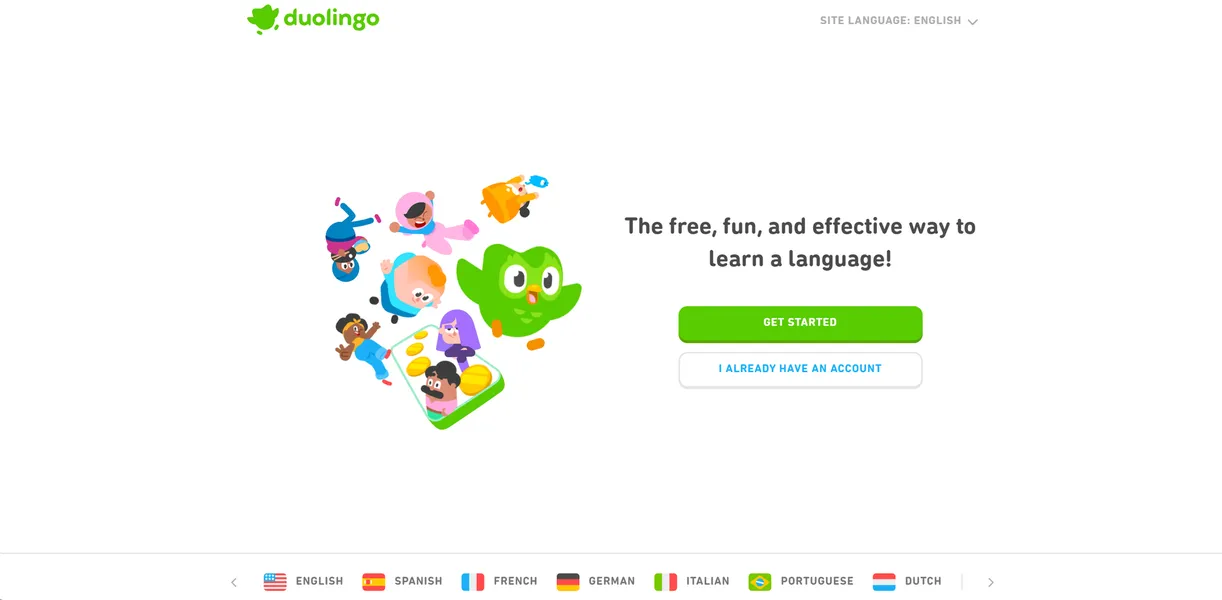
What is Duolingo?
From a technical standpoint, Duolingo is more than a language app; it’s a massively scalable, data-driven learning platform. It leverages a robust client-server architecture, delivering gamified educational content to millions of users across iOS, Android, and web clients. At its core, Duolingo functions as a service that abstracts the complexity of language acquisition into a series of interactive, bite-sized lessons. The platform’s success lies in its application of A/B testing and machine learning to continuously optimize its pedagogical methods, creating a personalized experience that adapts to user performance metrics in real-time. It’s an impressive feat of engineering designed to maximize user engagement and retention through carefully constructed feedback loops.
Key Features and How It Works
Duolingo’s architecture is built around a set of core features designed for iterative learning and user retention. The platform’s effectiveness stems from how these components work in concert to create a cohesive educational engine.
- Interactive Exercise Engine: The platform utilizes a multi-modal input system that processes user responses from listening, speaking, and writing exercises. This engine provides immediate, automated feedback, reinforcing correct patterns and identifying areas for improvement. The backend logic required to parse and validate this range of inputs at scale is a significant technical achievement.
- Personalized Learning Paths: Duolingo employs an adaptive learning algorithm to tailor curriculum delivery. Think of it like a CI/CD pipeline for your brain; it runs ‘tests’ (exercises) and adjusts the next ‘build’ (lesson) based on your performance, ensuring you’re always working on the most critical code—or in this case, vocabulary and grammar rules.
- Engagement and Retention Loops: Features like ‘Streaks’ and leaderboards are not just for fun; they are precisely engineered user engagement mechanics. They tap into behavioral psychology to create powerful retention loops, encouraging daily interaction with the service which, in turn, generates more data to refine the learning algorithms.
- Scalable Content Architecture: Offering courses in over 30 languages demonstrates a highly scalable and modular content management system. This architecture allows the platform to add new language courses with relative efficiency, treating each language as a distinct content module that plugs into the core learning engine.
Pros and Cons
No platform is without its architectural trade-offs. Here’s a developer’s perspective on Duolingo’s strengths and weaknesses.
Pros
- Massive Scalability: The freemium model serves as a brilliant user acquisition funnel, and the platform has proven its ability to handle a massive, concurrent user base without significant performance degradation.
- Robust Cross-Platform Support: The consistent user experience across web and mobile clients suggests a well-executed cross-platform development strategy, likely utilizing a combination of native code and web technologies.
- Data-Driven Pedagogy: The platform’s greatest strength is its relentless use of data to refine the learning process. This empirical approach to education is far more dynamic than static, traditional methods.
- API Availability: The existence of an API for integration, particularly for educational institutions (Duolingo for Schools), is a crucial feature that extends the platform’s utility beyond individual consumer use.
Cons
- Algorithmic Depth Limitations: While excellent for onboarding beginners, the platform’s algorithms currently lack the sophistication to effectively teach advanced linguistic and cultural nuances required for true fluency.
- Thin-Client Dependency: The heavy reliance on a persistent internet connection reveals a thin-client architecture. While this centralizes logic and simplifies updates, it severely limits functionality in offline or low-connectivity scenarios.
- Freemium Model Overhead: The ad-delivery system in the free tier can introduce performance latency and user experience friction, a common form of technical debt in ad-supported software.
Who Should Consider Duolingo?
Duolingo’s architecture is optimized for specific user profiles:
- Developers and Tech Professionals: An excellent tool for acquiring foundational knowledge of a new language for multicultural team collaboration or international business. The systematic, logical progression feels familiar to those accustomed to learning programming languages.
- Beginner to Intermediate Learners: The core target audience. The platform excels at building a strong vocabulary and grammatical foundation through repetition and gamification.
- Systematic Learners: Individuals who thrive in a structured, data-driven environment and appreciate the immediate feedback and progress tracking that the platform provides.
- Educational Institutions: Educators looking for a supplementary digital tool can leverage Duolingo for Schools to augment classroom learning with a standardized, trackable platform.
Pricing and Plans
Duolingo operates on a freemium model, making its core learning content accessible to everyone. For users seeking to remove limitations and enhance the experience, a premium subscription is available.
- Free Tier: Provides full access to all language courses, supported by advertisements and a limited number of ‘hearts’ or lives.
- Super Duolingo: Priced at approximately $12.99 per month, this premium plan offers an ad-free experience, unlimited hearts, offline lesson access, and personalized practice sessions to review mistakes.
Disclaimer: Pricing is subject to change. Please consult the official Duolingo website or app store listings for the most current information.
What makes Duolingo great?
Ever feel like traditional language textbooks are just static documentation with no interactive feedback? Duolingo’s true innovation lies in treating language education as a software problem to be solved with data and iterative design. Its greatness isn’t just in the gamification but in the massive A/B testing engine running under the hood. Every lesson, every user interaction, is a data point used to refine and optimize the learning experience for millions. It has successfully productized language learning, creating a highly engaging, low-friction service that has scaled globally. It’s a case study in building a sticky product that transforms a traditionally difficult task into an accessible daily habit.
Frequently Asked Questions
- How does Duolingo’s algorithm adapt to individual learning styles?
- Duolingo uses a machine learning model, often referred to as a spaced repetition system (SRS), which analyzes your accuracy on specific words and concepts. It schedules future reviews at increasing intervals as you prove mastery, focusing your practice on areas where you are weakest.
- Is there a public API for developers to integrate with Duolingo?
- While Duolingo has APIs for internal use and specific partners (like Duolingo for Schools), a fully public, documented API for third-party developers is not generally available. Developers can sometimes access user data via an unofficial API, but this is not officially supported and is subject to change.
- What is Duolingo’s technology stack?
- Duolingo’s specific stack is proprietary, but based on job listings and technical blogs, it is known to heavily use Python for backend services and data science, Scala, and Java. On the client side, they use native development for iOS (Swift) and Android (Kotlin/Java) along with web technologies like React.
- How does the platform handle speech recognition?
- Duolingo utilizes its own and third-party speech recognition technologies. The system is trained on millions of user voice samples to understand and evaluate pronunciation across a wide range of accents and dialects, providing real-time feedback on speaking exercises.
- Can Duolingo’s platform make me fluent?
- From a systems perspective, Duolingo is designed to build a strong foundation—a comprehensive vocabulary and a solid understanding of grammar (equivalent to A2/B1 level of the CEFR). However, achieving true fluency requires complex, real-world conversational practice, which is currently outside the scope of the platform’s core algorithmic capabilities.