

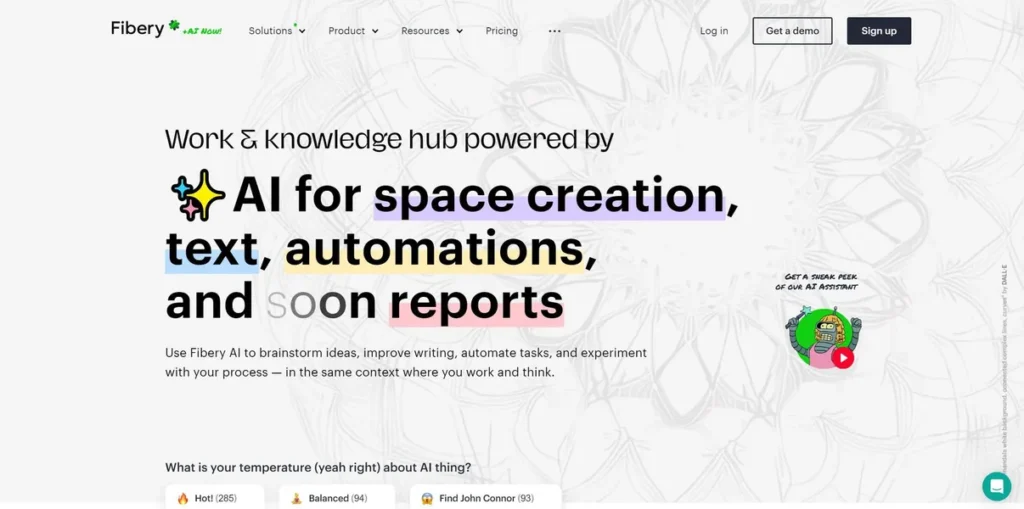
What is Fibery Ai?
Fibery Ai is an AI-enhanced work management platform engineered to serve as a central nervous system for organizations. From a technical standpoint, it transcends typical project management tools by providing a highly flexible, interconnected space where data, documents, and tasks coexist. For development and product teams accustomed to a fragmented toolchain—Jira for tickets, Confluence for docs, and a separate tool for roadmapping—Fibery aims to create a single source of truth. It integrates disparate functions like task management, strategic planning, and collaborative documentation into a unified, relational database structure. This approach is designed to reduce the context-switching and data fragmentation that often hinders engineering velocity and cross-functional alignment.
Key Features and How It Works
Fibery’s power lies in its adaptable architecture, allowing teams to construct their own ideal workspace rather than conforming to a rigid, pre-defined structure. For technical teams, this means building a system that mirrors their actual development lifecycle.
- Automated Workflows: Fibery allows teams to automate routine processes, such as updating a feature’s status when all associated tasks are completed or notifying a product manager when a bug is moved to QA. This functions like a lightweight CI/CD pipeline for operational tasks, reducing manual overhead and ensuring process consistency.
- Integrated Workspaces: The platform consolidates information and tools into a single view. By connecting to repositories like GitHub, communication hubs like Slack, and design tools, it allows engineers and managers to track development progress, review feedback, and access documentation without constantly toggling between applications.
- Customizable Data Models: Users can define their own ‘Types’ (e.g., Features, Bugs, Sprints, Customers) and establish relationships between them. This creates a powerful, navigable graph of information, enabling teams to see, for instance, which customer requests are linked to a specific feature and what bugs are blocking its release.
- Robust API Access: Think of Fibery Ai’s API as a universal power adapter for your entire tech stack. Just as a universal adapter lets you plug any device into any outlet, Fibery’s API allows you to connect disparate software tools, letting data flow freely between them without needing a custom-built solution for each connection. This is critical for integrating with proprietary internal systems or building custom data dashboards.
Pros and Cons
Fibery presents a compelling case, but its suitability depends on a team’s technical needs and willingness to invest in setup.
Pros:
- Exceptional Flexibility: Its core strength is the ability to build a bespoke system. You are not locked into a specific project management methodology; you can architect a workspace that perfectly fits your team’s workflow, whether it’s Scrum, Kanban, or a custom hybrid.
- Strong Integration Capabilities: The platform offers a solid list of native integrations and, more importantly, a well-documented API. This is a significant advantage for development teams that need to connect their work management tool to a broader ecosystem of engineering software.
- Unified Data Environment: By centralizing everything from high-level roadmaps to low-level bug reports, Fibery eliminates data silos. This ensures all stakeholders are working from the same information, which is invaluable for accurate planning and reporting.
- Technical Scalability: The underlying relational data model is built to handle complexity. As an organization grows, Fibery can scale to manage intricate webs of projects, products, and teams without collapsing into chaos.
Cons:
- Initial Configuration Overhead: The platform’s flexibility is a double-edged sword. Setting up a truly effective and customized workspace requires a significant upfront investment of time and thought. It is not a plug-and-play solution.
- Performance Considerations: While scalable, extremely complex workspaces with tens of thousands of entities and convoluted relational logic can introduce performance latency. Careful architecture is required to maintain optimal speed.
- Cloud-Only Architecture: As a pure SaaS solution, there is no on-premise option. This can be a non-starter for organizations with stringent data residency requirements or those that require absolute control over their software environment.
Who Should Consider Fibery Ai?
Fibery Ai is best suited for teams and organizations that view their work management system as a critical piece of infrastructure, not just a to-do list.
- Software Development & Product Teams: Its ability to link feature specs, user stories, tasks, bugs, and customer feedback into a cohesive whole makes it ideal for agile teams looking for end-to-end visibility.
- Systems Architects & DevOps Engineers: Teams that need to manage and document complex systems can leverage Fibery to map out dependencies, track infrastructure projects, and create a living knowledge base.
- Organizations Seeking Consolidation: Companies frustrated with paying for and managing multiple, disconnected tools (e.g., for task management, wikis, roadmapping) will find Fibery’s all-in-one approach both cost-effective and efficient.
- Technically-Minded Project Managers: PMs who want to build and refine their own processes will appreciate the platform’s ‘no-code database’ foundation.
Pricing and Plans
Pricing information was not available at the time of this review. The platform has historically offered different tiers, including a free option for small teams and paid plans that scale with user count and feature access. For the most accurate and up-to-date pricing, please visit the official Fibery Ai website.
What makes Fibery Ai great?
Tired of syncing disparate tools and managing a fragmented tech stack just to get a clear view of a project’s status? Fibery’s greatness lies in its fundamental design philosophy: it’s not just another project management application, but a flexible workspace builder. Unlike tools that impose a rigid structure, Fibery provides the building blocks (custom data types, relations, automations, and a robust API) to construct a system that mirrors how your team actually works. This ability to create a bespoke, interconnected information graph—where a single bug can be traced back to a customer interview and forward to a specific code commit—is its key differentiator. It treats work management as an engineering problem and provides an elegant, scalable solution.
Frequently Asked Questions
- How robust is Fibery Ai’s API for custom integrations?
- Fibery Ai is built with extensibility in mind, offering API access that enables deep, custom integrations. This allows technically proficient teams to connect proprietary internal tools, pipe data into BI dashboards for advanced analytics, and automate complex, cross-platform workflows far beyond what native integrations offer.
- Can Fibery Ai handle complex development workflows like GitFlow?
- Absolutely. Its high degree of customization and integration capabilities, particularly with platforms like GitHub and GitLab, allow teams to model intricate workflows. You can create automations that link branches, pull requests, and deployment statuses directly to features or tasks within Fibery, providing complete traceability from concept to production.
- Is Fibery Ai suitable for large-scale enterprise use?
- The platform is architected for scalability. Its relational data model and workspace structure are capable of managing complex, interconnected projects across large departments. For successful enterprise deployment, however, a well-planned information architecture is crucial to maintain performance and navigability as the scale increases.
- How does Fibery Ai address data privacy and security?
- As a cloud-based platform, Fibery Ai manages infrastructure security on behalf of its clients. Organizations handling sensitive project data should consult Fibery’s official documentation for details on their compliance certifications (e.g., SOC 2, GDPR) and data protection policies. The absence of an on-premise deployment option is a key consideration for enterprises with strict data sovereignty requirements.