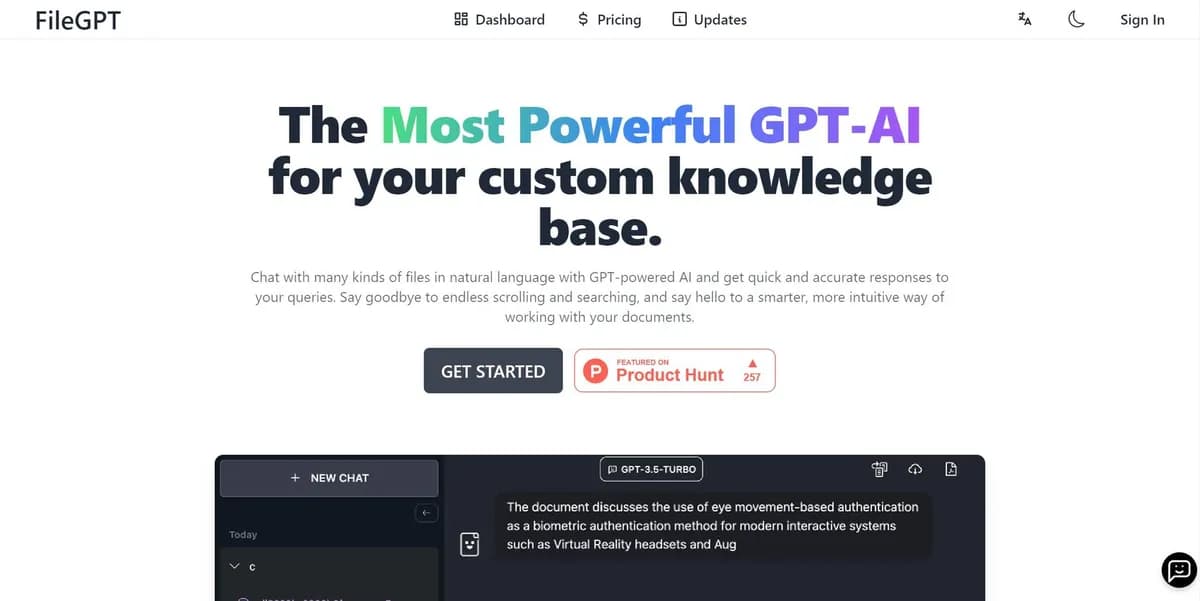

FileGPT is an AI document assistant that lets researchers and professionals query PDFs, audio files, and YouTube videos. It extracts structured data from 500-page legal contracts using semantic search. The 6,000 monthly token limit on the Basic plan restricts heavy users.
What is FileGPT?
Most document AI tools force you to read text, but FileGPT actually watches YouTube videos for you. You paste a two-hour product demonstration link, and the system transcribes the audio to answer specific technical questions.
FileGPT Inc. built this AI document assistant to solve information retrieval problems for researchers and legal teams. The platform uses semantic search (which maps meaning rather than exact keywords) to locate exact clauses across 500-page contracts.
- Primary Use Case: Extracting structured data from large document collections and media files.
- Ideal For: Legal professionals and academic researchers managing multiple sources.
- Pricing: Starts at $8.33/mo (freemium). The Basic plan offers 6,000 tokens but limits users to 10 files.
Key Features and How FileGPT Works
Media and Document Ingestion
- Multi-format Support: Processes PDF, TXT, DOCX, CSV, JSON, and Markdown files, limited to 200MB on Pro.
- Media Integration: Transcribes Audio, Video, and YouTube URLs directly, limited by background noise interference.
- OCR Technology: Extracts text from scanned images, limited by the resolution of the uploaded photo.
Search and Synthesis
- Smart Semantic Search: Uses vector embeddings to locate context, limited by the quality of the original text.
- Collection Management: Groups files into a single searchable knowledge base, limited to 20 files on Pro plans.
- Source Citations: Includes clickable references to the exact page, limited to text-based documents.
Deployment Options
- Website Embedding: Deploys the AI as a widget on external domains, restricted to the $40 Growth plan.
- API Access: Allows programmatic integration into custom workflows, limited to enterprise users.
FileGPT Pros and Cons
Pros
- Handles audio and video files directly, unlike text-only competitors like ChatPDF.
- Groups documents into collections to analyze entire folders of research papers at once.
- Generates transparent citations with exact page numbers to speed up manual fact-checking.
- Accepts individual file uploads up to 200MB to accommodate large technical manuals.
Cons
- Restricts Basic plan users to 6,000 monthly tokens, which heavy researchers will burn through quickly.
- Prices advanced features like website embedding at $40 per month, pricing out solo users.
- Drops transcription accuracy significantly when audio files contain multiple speakers or background noise.
- Clutters the user interface when users manage more than 10 active document collections.
Who Should Use FileGPT?
- Academic Researchers: You can analyze multiple research papers simultaneously within a single collection to find conflicting data points.
- Legal Professionals: You can summarize 500-page contracts to identify specific liability clauses and expiration dates quickly.
- Corporate Teams: You can embed a custom knowledge base chatbot on your website to answer customer FAQs.
- Budget Solo Users: The 6,000 token limit on the $8.33 Basic plan makes this a poor fit for heavy daily querying.
FileGPT Pricing and Plans
How does the token system affect daily use? FileGPT operates on a freemium model (we tested the Pro tier for this review). The free tier is a real, permanent plan for basic testing, not a disguised trial.
- Free Tier: $0/mo for basic functionality and testing.
- Basic: $8.33/mo ($100/yr) for 10 files, 100MB file size, and 6,000 monthly tokens.
- Pro: $15.00/mo ($180/yr) for 20 files, 200MB file size, 12,000 monthly tokens, and audio/video support.
- Growth: $40.00/mo ($480/yr) for website embedding and 36,000 monthly tokens.
- Elite: $81.67/mo ($980/yr) for basic analytics and 75,000 monthly tokens.
- Enterprise: Custom pricing for priority processing, 300,000 monthly tokens, and white-labeling.
How FileGPT Compares to Alternatives
Similar to ChatPDF, FileGPT lets you upload and query large text documents. Unlike ChatPDF, FileGPT processes audio and video files natively. ChatPDF focuses strictly on text, making it cheaper for users who only read PDFs. FileGPT justifies its higher price through multimedia support.
Humata AI targets enterprise users with strict data security needs. Humata AI charges based on pages processed rather than tokens. FileGPT uses a token system, which benefits users who ask complex questions about short documents. Humata AI works better for users who ask simple questions about massive archives.
The Final Verdict for Multimedia Researchers
FileGPT delivers high value for researchers who need to cross-reference text documents with video transcripts. The ability to query a YouTube video and a PDF manual in the same collection saves hours of manual transcription.
Solo users on a strict budget will find the token limits frustrating.
If you only need to read PDFs, ChatPDF offers a more focused and affordable experience.
The true limit of FileGPT remains its audio transcription accuracy in noisy environments.
We still do not know how well the platform scales when enterprise users push the 300,000 token limit. The core semantic search engine works exactly as advertised, provided your audio sources are clear.
User Reviews
No reviews yet. Be the first to share your experience!
Sign in to write a review.
Related articles
Guides and articles related to FileGPT.

Perplexity AI Tutorial: Maximize Your Research Workflows

The Personal AI Productivity Stack (2026): One Tool Per Job, Nothing Extra

Google Vision AI Explained (2026): Pricing Per 1,000 Units, Free Tier, and Alternatives

Claude vs Microsoft Copilot in Word, Excel and Outlook: Which Should You Actually Use (2026)
The Perplexity Due-Diligence Prompt Library: 10 Prompts That Surface Red Flags (2026)