

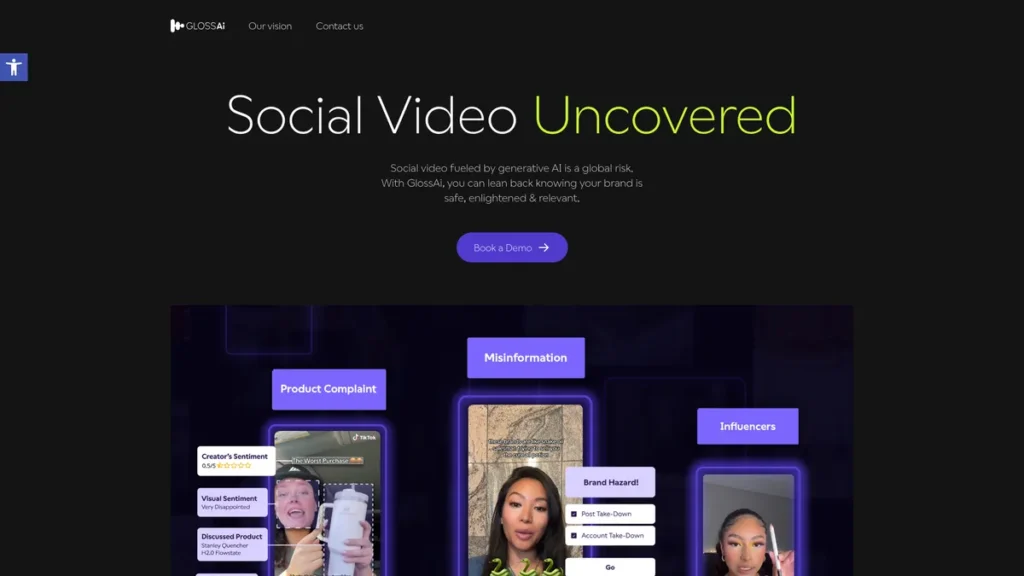
What is Glossai?
Glossai is an AI-powered media processing engine architected to programmatically repurpose long-form video and audio assets. From a technical standpoint, it functions as a cloud-based service that ingests media files and applies a series of transformations to generate platform-specific derivatives. The system is designed for high-throughput environments, enabling developers and marketing teams to automate the creation of short-form snippets, transcripts, and localized versions of content for distribution across multiple digital channels. Its core value proposition lies in its ability to offload complex media processing tasks, thereby reducing dependencies on manual editing suites and accelerating content velocity within an organization’s technology stack.
Key Features and How It Works
Glossai’s functionality is exposed through a user interface and, more critically for technical teams, a set of APIs. These features allow for deep integration into existing content management and distribution pipelines.
- Multi-Channel Repurposing: This is the core processing function. The system ingests a source media file and, based on defined parameters, executes transcoding, clipping, and reformatting operations to produce outputs optimized for various endpoints like TikTok, LinkedIn, or email clients.
- Editing Wizard: This feature provides a layer of configurable post-processing. It allows for the programmatic application of brand assets, such as watermarks and color palettes, ensuring that all generated content adheres to established style guides without manual intervention.
- Localization & Accessibility: Glossai offers a suite of services for transcription, dubbing, and translation across a large number of languages. These are accessible via API, enabling automated workflows for creating multi-lingual content tracks and accessibility features like captions.
- Prompt-Based Personalization: This is essentially a dynamic instruction set passed to the processing engine. Users or automated systems can send prompts that define the desired tone, style, or focus of the output clips, allowing for a high degree of customization on a per-channel or per-audience basis.
- Workflow Integrations: The platform supports over 100 pre-built integrations with various systems (CMS, CRM, etc.). This extensibility is crucial, as it allows Glossai to function as a component within a larger, event-driven architecture for content creation and distribution.
Pros and Cons
Pros
- Robust API for Automation: The API-first approach allows for seamless integration into CI/CD pipelines for content, enabling fully automated repurposing workflows.
- Scalability: The cloud-based infrastructure is designed to handle batch processing of large media libraries, making it suitable for enterprise-level demands.
- Reduced Development Overhead: The extensive library of pre-built integrations minimizes the need for custom connector development, accelerating time-to-market for new content workflows.
- Cost-Effective Processing: Offloads computationally expensive video rendering and transcoding tasks from internal infrastructure, leading to predictable operational costs.
Cons
- Abstraction Limitations: The high-level API might obscure fine-grained control over encoding parameters that a tool like FFmpeg would offer, which could be a limitation for highly specific technical requirements.
- API Rate Limiting: Lower-tier subscription plans may impose API call limits that could be a bottleneck for high-volume, real-time processing needs.
- Translation Nuances: While supporting many languages, the AI-driven translation models may not capture all cultural or contextual nuances, potentially requiring a manual quality assurance layer in the workflow.
Who Should Consider Glossai?
Glossai is particularly well-suited for technical teams and professionals responsible for managing and scaling content operations. This includes:
- MarTech Developers: Engineers building custom marketing automation platforms can integrate Glossai as a dedicated media processing microservice.
- DevOps and Media Engineers: Teams responsible for managing large-scale content pipelines can use Glossai to automate transcoding and distribution, reducing infrastructure complexity.
- CTOs at Media Companies: Technology leaders looking to increase content output without proportionally increasing headcount will find the platform’s automation capabilities highly valuable.
- Software Engineers: Developers adding video features to their applications can leverage Glossai’s backend to handle complex media manipulation tasks.
Pricing and Plans
Glossai operates on a freemium model, providing accessible entry points for evaluation and scaling options for production workloads.
- Free Basic: This plan offers a robust trial for developers and small teams to explore the feature set and test API integrations with limited usage caps.
- Pro Plan: Starting at $14 per month, this subscription tier provides higher usage limits, access to more advanced features, and increased API throughput suitable for professional and business use cases.
For enterprise-level requirements, including custom integrations, SLAs, and dedicated support, direct consultation with their sales team is recommended. Always verify the latest pricing and feature tiers on the official Glossai website.
What makes Glossai great?
Glossai’s most powerful feature is its comprehensive set of workflow integrations and its robust API, which allows for deep automation of the content lifecycle. This transforms video repurposing from a series of manual, post-production tasks into a programmable, scalable service. For a development team, this means content can be treated as code; a new long-form video committed to a repository can trigger an automated pipeline that generates, localizes, and distributes dozens of assets across multiple platforms without human intervention. This capacity for systematic automation and integration into a broader tech stack is what elevates Glossai from a simple editing tool to a critical piece of infrastructure for modern content operations.
Frequently Asked Questions
- How extensive is the Glossai API documentation?
- Glossai provides comprehensive API documentation with clear endpoint descriptions, request/response examples, and guides for developers. It is designed to facilitate quick integration into custom applications and workflows.
- Can Glossai handle large-scale batch processing of video files?
- Yes, the platform is architected to manage high-volume batch processing. Higher-tier subscription plans are specifically designed to support the throughput required by enterprises and large media companies.
- What security protocols are in place for uploaded media assets?
- Glossai employs standard cloud security measures, including data encryption in transit and at rest, to protect all uploaded content. For specific compliance requirements, it is best to consult their security documentation or support team.
- Does the Glossai API support webhooks for asynchronous job completion?
- Yes, the API supports webhooks or callback URLs. This allows developers to build event-driven systems where their applications are notified programmatically upon the completion of a media processing job, rather than having to poll for status updates.