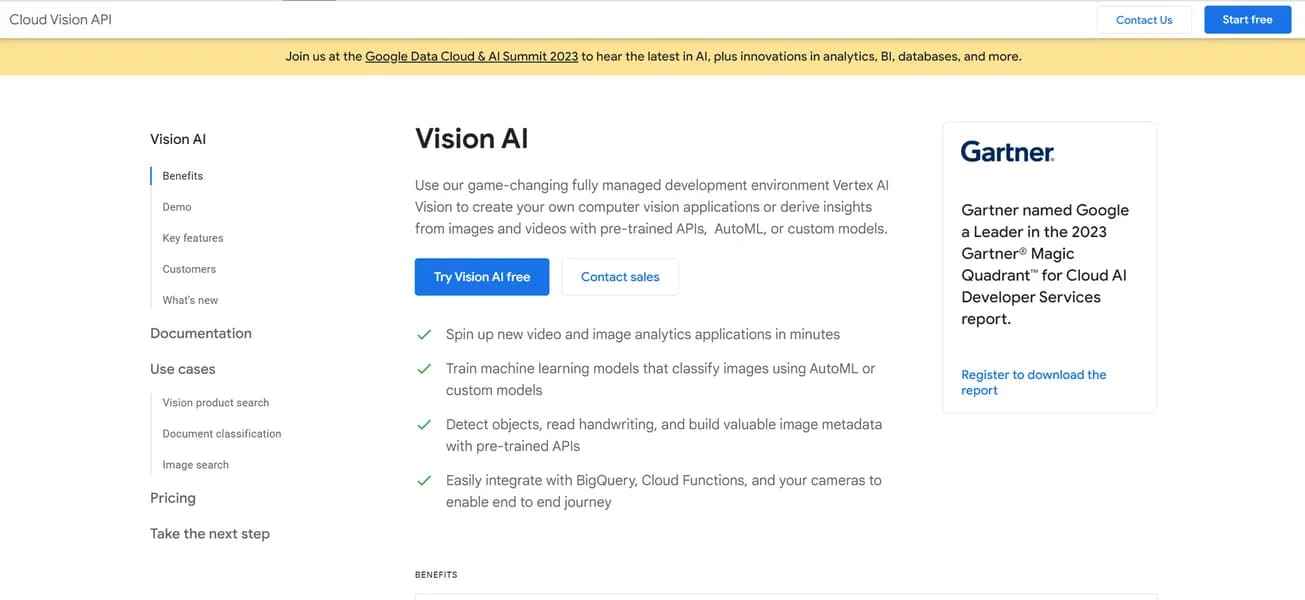

Google Cloud Vision AI provides pre-trained machine learning models for image analysis via REST APIs. Developers use it to extract text from PDFs and moderate user uploaded photos. It processes up to 2,000 images per batch request. The service prohibits facial recognition of specific individuals.
What is Google Cloud Vision AI?
A retail app needs to scan user uploaded photos of clothing and identify the exact brand logo and product category in milliseconds. Google Cloud Vision AI takes that raw image data and returns structured JSON labels.
Developed by Google LLC, this machine learning service operates as a REST and RPC API. It gives developers pre-trained models for object detection, optical character recognition, and facial analysis. Enterprise engineering teams use it to moderate user content and extract text from scanned PDFs.
- Primary Use Case: Automating document processing and moderating user uploaded images.
- Ideal For: Enterprise developers building applications on Google Cloud Platform.
- Pricing: Starts at $1.50 (per 1,000 units) – The free tier covers the first 1,000 units per month.
Key Features and How Google Cloud Vision AI Works
Image Classification and Moderation
- Label Detection: Identifies thousands of broad categories within an image. Limit: Returns a maximum of 100 labels per request.
- Safe Search Detection: Flags adult, medical, and violent content. Limit: Relies on five likelihood buckets rather than custom percentage thresholds.
Text and Document Extraction
- Optical Character Recognition (OCR): Extracts text from 50+ languages. Limit: PDF and TIFF files must not exceed 2,000 pages per batch request.
- Handwriting Recognition: Processes handwritten notes and receipts. Limit: Accuracy drops on low contrast or blurry scans.
Object and Face Analysis
- Face Detection: Locates multiple faces and reads associated emotions like joy. Limit: Google blocks facial recognition (identifying specific individuals) to comply with privacy policies.
- Object Localization: Draws bounding boxes around multiple items in one photo. Limit: Billed at a higher $2.25 rate per 1,000 units compared to basic labels.
Google Cloud Vision AI Pros and Cons
Pros
- Processes up to 2,000 images in a single asynchronous batch request.
- Native client libraries exist for Python, Java, Go, and Node.js.
- The OCR engine reads 50+ languages including right to left scripts.
- The free tier resets monthly and covers 1,000 units.
Cons
- High volume processing costs escalate at $1.50 per 1,000 units.
- Initial IAM permission setup requires specific Google Cloud architecture knowledge.
- Pre-trained models offer zero customization without upgrading to Vertex AI.
Who Should Use Google Cloud Vision AI?
- Enterprise engineering teams: Teams using BigQuery and Cloud Storage get native integration.
- Content moderation teams: Social platforms can flag violent or adult images before publication.
- Solo developers on a budget: The 1,000 free monthly units allow full API access for small projects.
- Not for custom model builders: Teams needing to train models on proprietary datasets should use Vertex AI instead.
Google Cloud Vision AI Pricing and Plans
The pricing model operates on a freemium usage basis. The free tier is a permanent monthly allocation, not a temporary trial.
- Free Tier: $0 per month. Covers the first 1,000 units across most feature categories.
- Standard Features: $1.50 per 1,000 units. Applies to labels, OCR, and face detection for usage between 1,001 and 5,000,000 units.
- Object Localization: $2.25 per 1,000 units. Billed at a premium rate for bounding box data.
- Web Detection: $3.50 per 1,000 units. The most expensive standard API call.
- Vertex AI Vision Streams: $10.00 per stream per month. Covers real time video processing for person blurring.
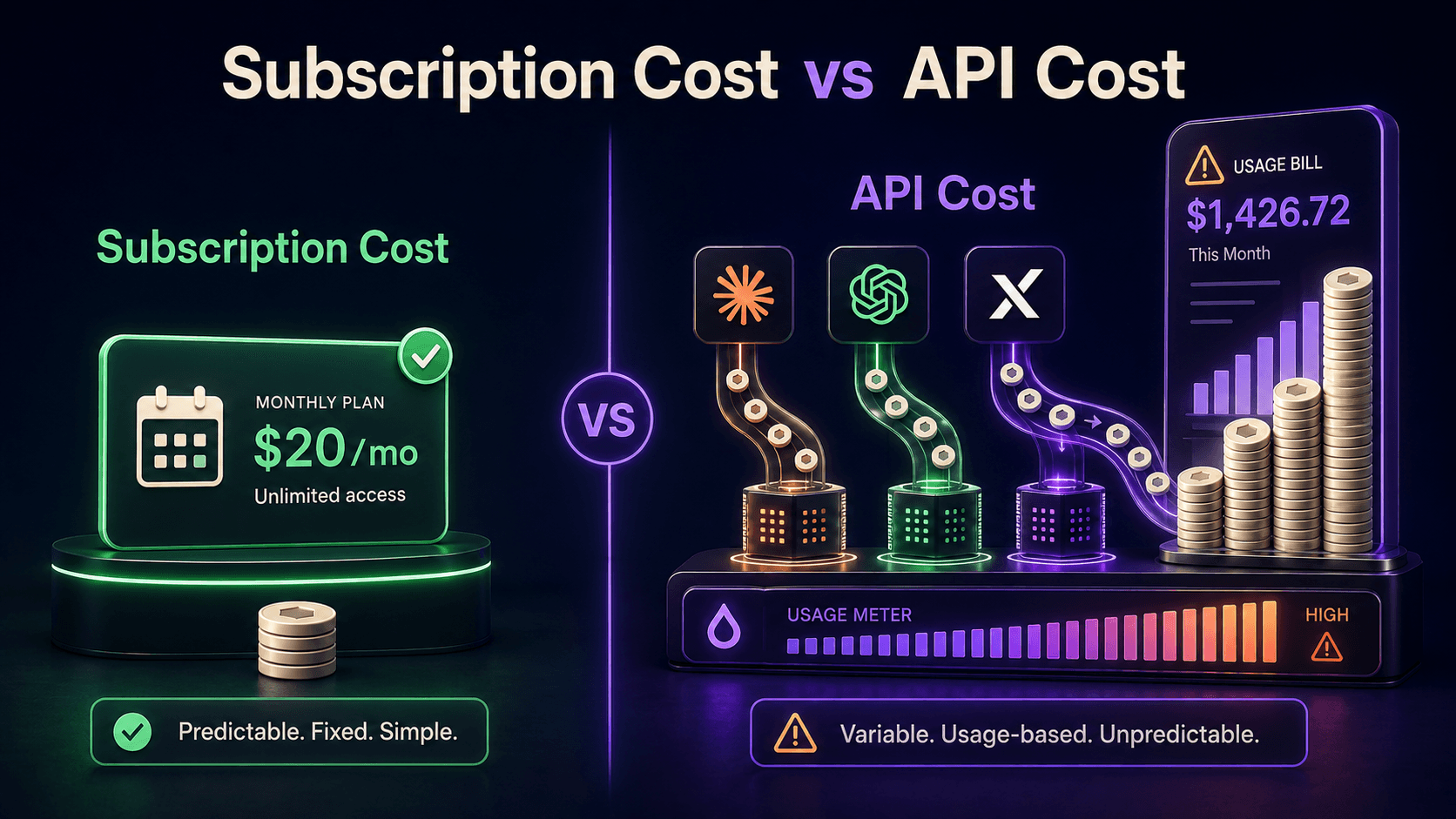
Costs escalate without warning if user uploads spike.
How Google Cloud Vision AI Compares to Alternatives
Similar to Amazon Rekognition but Google offers better multi-language OCR support for handwritten documents. Amazon Rekognition charges $1.00 per 1,000 images for its first million requests. Google charges $1.50 for the same volume. Amazon Rekognition allows facial recognition for known individuals, while Google prohibits it.
Unlike Azure AI Vision, Google Cloud Vision AI forces users into Vertex AI for custom model training. Azure AI Vision includes custom model training within its primary Vision Studio interface. Azure charges $1.00 per 1,000 transactions for basic OCR. Google provides a more generous free tier (1,000 units versus Azure’s limited free transactions).
Verdict for Enterprise Cloud Developers
Google Cloud Vision AI delivers reliable pre-trained image analysis for teams invested in the Google Cloud ecosystem. It is best for developers who need production ready OCR and content moderation without training their own models. Teams requiring facial recognition of specific individuals must look to Amazon Rekognition.
User Reviews
No reviews yet. Be the first to share your experience!
Sign in to write a review.
Related articles
Guides and articles related to Google Cloud Vision AI.
Google Vision AI Explained (2026): Pricing Per 1,000 Units, Free Tier, and Alternatives

Amazon Translate Review (2026): Pricing, Accuracy, and When to Pick an Alternative

Perplexity AI Tutorial: Maximize Your Research Workflows
Grok 4.3 API for Agents (May 2026): Pricing, Benchmarks, Migration
Does API Cost More Than a Subscription for Claude Opus 4.8, GPT-5.5, and Grok?