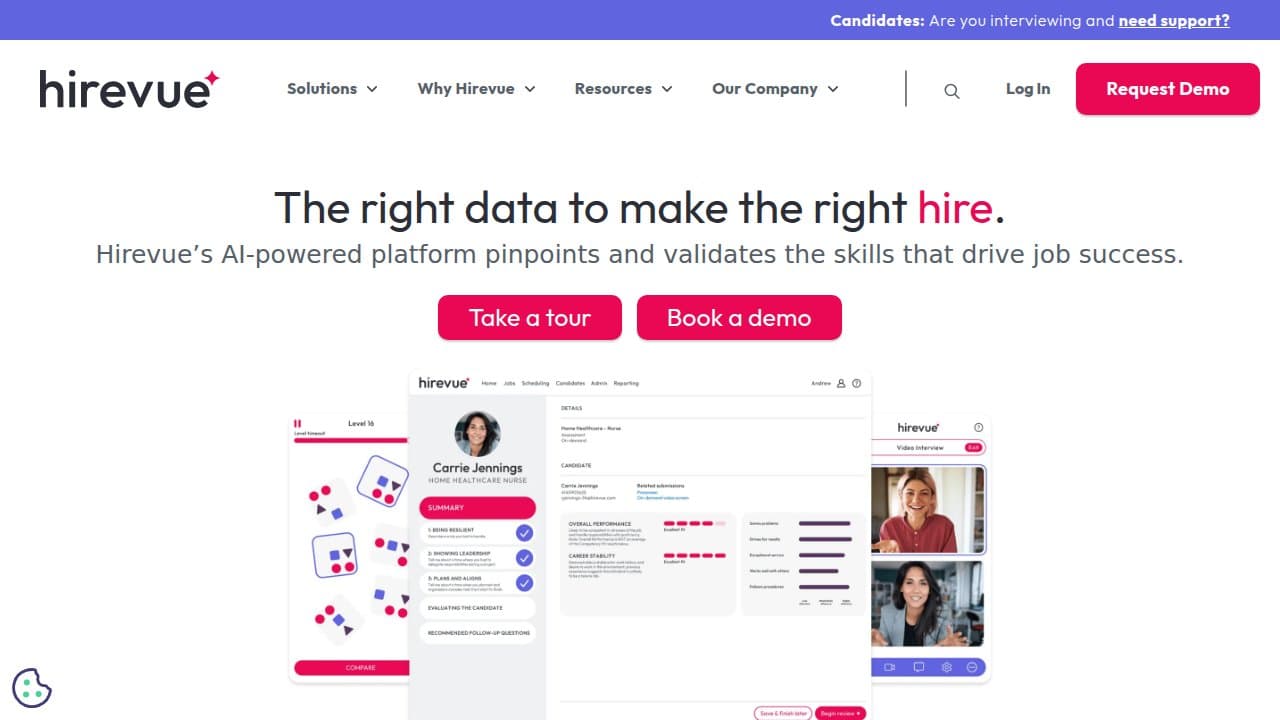

HireVue is an enterprise AI hiring platform combining structured video interviews, game-based assessments, and conversational screening tools. Used by 60% of Fortune 100 companies, it automates high-volume candidate evaluation with FedRAMP-grade compliance infrastructure.
HireVue is an enterprise talent assessment platform founded in 2004, built to automate structured video interviewing and AI-powered candidate screening at scale. The company serves more than 1,150 enterprise customers globally, including 60% of Fortune 100 companies, and has facilitated over 70 million video interviews. Its core mission is to help organizations move high volumes of candidates through structured, bias-reduced assessment workflows faster than traditional interview processes allow. HireVue is not a generic HR suite; it is a specialized platform for the evaluation step: screening, assessing, and ranking candidates before human interviewers make a decision.
The platform runs on three interconnected product lines. Video interviewing covers both live and on-demand (asynchronous) formats with competency-based question templates and ATS-integrated scheduling. AI assessments go deeper than resumes, using game-based evaluations, coding challenges, Virtual Job Tryouts, and role-based exercises to measure actual capability. A conversational hiring assistant handles candidate outreach, FAQ responses, scheduling, and screening dialogues across text, web chat, and integrated messaging channels. In October 2025, HireVue launched Interview Insights, a fourth product that uses real-time AI transcription and competency tagging to surface insights from live structured interviews and measure interviewer consistency across teams. The platform integrates natively with Workday, SAP SuccessFactors, Oracle, iCIMS, Greenhouse, and SmartRecruiters, and holds FedRAMP, SOC 2 Type II, ISO 27001, GDPR, and CCPA certifications.
What HireVue actually is in May 2026
HireVue occupies a specific position in the hiring technology stack: it is an assessment-layer platform, not a full applicant tracking system (ATS) or sourcing tool. Enterprises use it downstream of their ATS, typically after resume screening surfaces a large candidate pool. Candidates receive a link to complete a structured video interview on their own schedule. They record responses to competency-based questions with no interviewer present. HireVue's AI analyzes transcribed language across dozens of dimensions mapped to job-relevant competencies from a dataset exceeding 30 million prior assessment records. Hiring managers then review ranked candidates and AI-generated insights rather than watching every recording in full.
The assessment product line extends well beyond video. Game-based assessments present candidates with cognitive puzzles and pattern-recognition tasks designed by industrial-organizational psychologists to measure constructs like working memory, attention, and numerical reasoning without the cultural bias that standardized tests can introduce. Virtual Job Tryouts simulate actual work scenarios relevant to a given role. Coding assessments handle technical screening for engineering roles. Audio-only interview options accommodate candidates without reliable video access.
Interview Insights, launched in October 2025, extended HireVue's footprint into the live structured interview stage. Rather than replacing interviewers, it sits inside Zoom and Teams calls, captures transcripts in real time, tags candidate responses against pre-defined competency frameworks, and measures talk-time ratios to flag when interviewers are dominating conversations. The product targets a problem that high-volume hiring teams consistently face: standardized screening processes that break down once candidates reach human interviewers who go off-script or spend unequal time with different candidates.
Where HireVue sits versus Eightfold AI and Paradox
The three platforms are frequently grouped together in enterprise recruiting comparisons, but they operate through fundamentally different mechanisms and serve different points in the hiring funnel.
Eightfold AI operates on a skills ontology architecture that maps over one billion talent profiles to a proprietary skills graph. Its AI identifies transferable skills and predicts candidate potential by analyzing patterns across career histories rather than evaluating performance on a single assessment. Eightfold's autonomous agents scan both internal and external talent pools simultaneously, making it most powerful for full-pipeline orchestration: sourcing, internal mobility, succession planning, and workforce planning. HireVue does not source or predict potential from career trajectory; it extracts demonstrated competencies from recorded interview responses. The two platforms can and do coexist in enterprise stacks, with Eightfold handling sourcing and matching while HireVue handles assessment.
Paradox (and its AI assistant, Olivia) uses a conversational architecture: candidates interact with a 24/7 chatbot via text, web chat, or WhatsApp that qualifies them through natural dialogue, schedules them into interview slots, and sends onboarding nudges. The entire interaction feels like texting a recruiter. Paradox prioritizes frictionless candidate experience and rapid deployment (days, not months) over structured assessment depth. It delivers high qualification volume quickly and is particularly effective for high-volume hourly and frontline hiring where speed and ease of application matter most. HireVue's video format is more rigorous but creates more friction. Paradox has a Gartner score of 4.5/5 from 300+ users; HireVue sits at 4.4/5 from 150+ enterprise peers on the same platform.
The mechanical distinction in one sentence: Eightfold predicts potential from career history patterns; Paradox qualifies through conversation; HireVue measures demonstrated competency from structured recorded responses.
How the AI actually works inside HireVue
HireVue's AI is built on language and behavioral analysis derived from its proprietary dataset of 30+ million assessment records, mapped against known job performance outcomes. When a candidate completes a structured video interview, the platform transcribes the response and analyzes it across dozens of competency-relevant language dimensions, including vocabulary, topic coverage, communication clarity, and response structure. This language analysis drives the bulk of AI scoring today, following HireVue's January 2021 decision to remove facial analysis entirely (discussed below).
The platform does not use a single generative AI model to evaluate candidates. Its assessments are developed with industrial-organizational psychologists and calibrated against validated competency frameworks for specific role types. Built-in adverse impact testing, included in the Enterprise and Premium plans, runs statistical checks to detect differential outcomes by demographic group. This differs from most third-party auditing arrangements and is part of what supports HireVue's FedRAMP authorization and EEOC alignment claims.
Interview Insights works through a different mechanism: rather than scoring candidates, it captures and tags. AI transcribes the live interview, identifies when specific competencies are addressed in candidate responses, and surfaces those moments for the interviewer to review after the call. It also monitors interviewer behavior, flagging talk-time imbalances and question adherence gaps. This is closer to meeting intelligence tools like Yoodli than to traditional AI scoring, and it represents a deliberate shift toward augmenting interviewers rather than replacing their judgment.
"Through Hirevue, we now evaluate candidates from multiple perspectives, identifying individual traits, hidden abilities, and potential that might not be evident in a traditional, time-limited interview." - Ryoko Kaneko, Chief Manager, Human Resources Division, MUTB (Mitsubishi UFJ Trust and Banking), HireVue case study, 2024
"Hirevue has empowered our TA teams to become strategic talent partners and helped build our relationships with the broader organization. We've seen metrics we've never seen before. For example, we scheduled 8 candidates, 8 showed up for interviews, and 7 received offers. That's an unprecedented success rate." - Kimberly Raimondi, Director of Talent Acquisition, Swire Coca-Cola, HireVue case study, 2024
The friction and controversy users keep raising
HireVue's most significant incident shaped its product direction permanently. In January 2021, the company announced it had removed facial analysis from all hiring assessments. The feature, which had used computer vision to score candidates on personality traits inferred from facial expressions and micro-movements, drew sustained criticism from academic researchers, civil liberties organizations, and regulators. In 2019, the Electronic Privacy Information Center (EPIC) filed a complaint with the Federal Trade Commission alleging that the feature constituted "unfair and deceptive trade practices." HireVue disclosed that facial analysis had actually been discontinued in March 2020 and contributed only 0.25% to predictive power in most models. Critics remained skeptical and noted the company still used speech-based analysis methods in video. The incident generated lasting skepticism about HireVue's AI transparency practices and continues to surface in employer brand discussions to this day.
More recent friction is operational. The candidate experience on one-way video interviews generates measurably negative reactions. TrustPilot scores HireVue at 2.5/5, with candidates describing the one-way format as "humiliating" and "dehumanizing." The inability to ask clarifying questions, re-record responses, or understand evaluation criteria frustrates candidates and creates drop-off that employers absorb silently. One complaint filed against Intuit and HireVue specifically alleged bias against deaf and non-white applicants, raising accessible-design concerns the platform has not fully resolved.
On the enterprise buyer side, post-implementation support is a consistent weak point. Multiple Capterra reviewers note an attentive implementation team followed by minimal ongoing support once the account transitions to a standard support queue. Workflow rigidity compounds this: making mid-cycle changes to interview templates or evaluation frameworks requires significant reconfiguration effort, and the platform has no no-code automation workaround via Zapier. Mid-market ATS platforms including BambooHR, JazzHR, Lever, and Ashby lack native integrations, effectively limiting HireVue's addressable market to organizations already using Tier 1 HCM systems. AI scoring opacity also creates compliance review burdens for HR legal teams who cannot easily explain to rejected candidates how rankings were generated.
Compliance teams should note that HireVue updated its consent workflow in February 2026 to meet amendments to the Illinois AI Video Interview Act, which now requires explicit written consent before any AI analysis begins. Organizations using HireVue to screen Illinois candidates need to verify their implementation reflects this change. For firms monitoring AI regulation exposure, HireVue's compliance posture is genuinely more robust than most competitors, but the regulatory surface area for AI-assisted hiring is growing in multiple states simultaneously. Tools like UserTesting AI and Clay approach candidate-facing data collection from different regulatory angles worth comparing.
Who HireVue is for
HireVue fits a specific organizational profile: enterprises processing 30,000 or more applications annually, with a dedicated hiring operations function, running a Tier 1 ATS (Workday, SAP, Oracle, iCIMS, Greenhouse), and prioritizing consistent assessment at scale over candidate experience warmth. The platform's compliance infrastructure makes it particularly well-suited for federal contractors or heavily regulated industries where FedRAMP authorization and EEOC-aligned adverse impact reporting are non-negotiable requirements. Unilever reported saving 50,000 hours of candidate time over 18 months and achieving a 16% increase in diversity hires. Swire Coca-Cola cut time-to-fill from 48 days to 30 days with 3.5 days from application to offer in optimized roles. MUFG expanded its university recruiting diversity by 19% while handling a 61% increase in interview volume without additional headcount.
Skip HireVue when: the organization processes fewer than a few thousand applications per year, when there is no dedicated hiring ops owner to manage configuration and adoption, when candidate experience is a competitive differentiator in your talent market, when the primary ATS is BambooHR, JazzHR, Lever, or Ashby, or when rapid deployment is required (HireVue's minimum implementation timeline is 6+ weeks, often longer for full enterprise configuration). Startups, high-growth scaleups that need flexibility, and companies hiring for executive or creative roles where relationship impression matters early in the process are consistently better served by lighter tools. For candidates researching AI-assessed interview tools, understanding how HireVue differs from traditional screening is worth comparing against Yoodli for interview practice preparation.
User Reviews
No reviews yet. Be the first to share your experience!
Sign in to write a review.
Related articles
Guides and articles related to HireVue.
AI User Testing in 2026: The Tools That Test Your Product While You Sleep
RFP and Proposal Auto-Fill: The Agent That Handles 80% of the Repeating Questions (2026)

Google Vision AI Explained (2026): Pricing Per 1,000 Units, Free Tier, and Alternatives
Turn Any AI Agent Into a Superagent: The 12-Integration Stack (2026)
Coding Ate Enterprise AI (2026): The $4B Use Case, Anthropic’s Share, and Seat vs API Math