



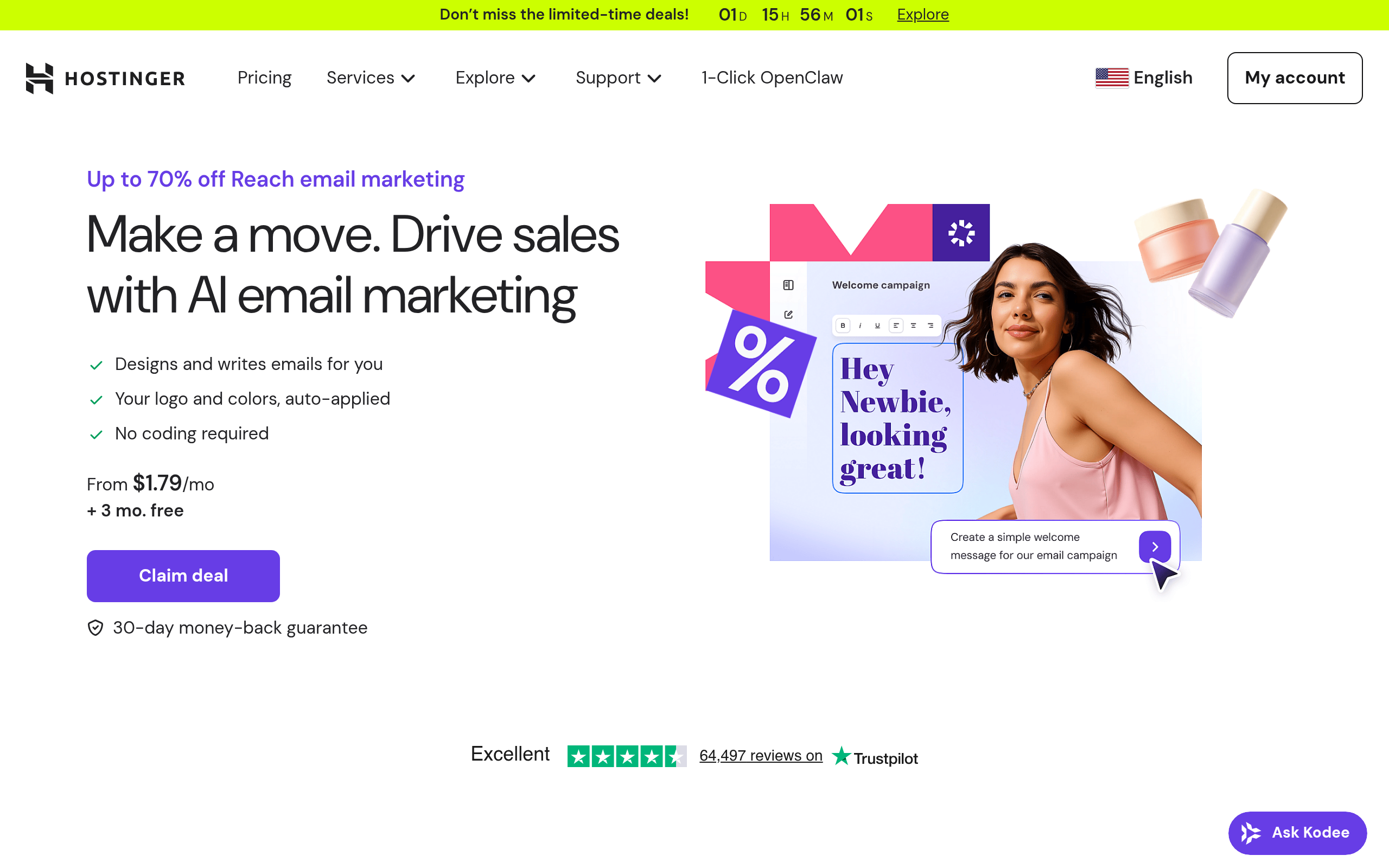
What is Hostinger Reach?
You run a small bakery and want to email a weekly coupon to your local customers. Instead of paying a premium for a complex marketing suite, you can build and send that campaign directly from your website dashboard. This is the exact scenario Hostinger Reach targets.
Developed by Hostinger International Ltd., Hostinger Reach is an AI-powered email marketing platform designed for small businesses. It helps users create, automate, and manage email campaigns using generative AI tools. The platform integrates directly into the Hostinger ecosystem, making it an obvious choice for users already hosting their websites there.
- Primary Use Case: Automating welcome email sequences for new subscribers captured through Hostinger website forms.
- Ideal For: Small business owners and solo creators who need basic email marketing on a strict budget.
- Pricing: Starts at $1.59 (freemium). An extremely low entry price for basic campaign management.
Key Features and How Hostinger Reach Works
AI Content Generation
- Subject Line Creator: Generates personalized subject lines based on campaign goals, limited to 5 AI credits per month on basic plans.
- Body Copy Assistant: Writes full email drafts using AI, sharing the same 5-credit monthly limit.
Campaign Design and Management
- Drag-and-Drop Editor: Provides a visual builder with 50 responsive email templates for mobile and desktop.
- Subscriber Management: Imports contacts via CSV or manual entry, capped at 500 subscribers on entry plans.
- Spam Testing: Checks deliverability and spam scores before sending to protect your sender reputation.
Tracking and Automation
- Analytics Dashboard: Tracks opens, clicks, and bounce rates in real time for every sent campaign.
- Automation Workflows: Sets up triggers for welcome emails, though advanced logic requires higher-priced tiers.
- Unsubscribe Management: Automates opt-out requests to maintain GDPR compliance without manual list scrubbing.
Hostinger Reach Pros and Cons
Pros
- Native integration with Hostinger hosting provides a unified dashboard for website owners.
- The $1.59 per month entry price makes it one of the cheapest paid email tools available.
- Built-in AI credits help non-writers generate professional copy without leaving the editor.
- The beginner-friendly interface requires zero technical knowledge to launch a first campaign.
Cons
- Entry-level paid plans restrict users to just 5 AI credits per month.
- Subscriber and sending limits are significantly lower than competitors at similar price points.
- The platform lacks advanced third-party integrations compared to dedicated tools like Klaviyo.
- Advanced automation logic is locked behind higher-priced tiers.
Who Should Use Hostinger Reach?
- Budget-conscious solo founders: The $1.59 monthly starting price keeps overhead low while building an initial audience.
- Existing Hostinger customers: Users already hosting their sites on Hostinger gain a unified workflow without managing multiple logins.
- Beginner marketers: The drag-and-drop editor and 50 pre-built templates make campaign creation simple.
- Not for high-volume senders: E-commerce brands sending daily blasts will quickly exceed the 3,500 monthly email cap.
Hostinger Reach Pricing and Plans
Hostinger Reach uses a freemium model with strict limits on lower tiers.
The Free Tier costs $0 per month and provides basic functionality with limited credits. You can test the interface, but you cannot run a full marketing operation here.
The Yearly Plan costs $1.59 per month (billed annually, of course). It allows up to 500 subscribers and 3,500 emails per month. You also receive 5 AI credits for content generation.
The Monthly Plan costs $5.99 per month. It includes the exact same limits as the Yearly Plan (500 subscribers, 3,500 emails, 5 AI credits) but offers month-to-month billing flexibility.
Higher Tiers start at $6.99 per month. These plans increase your AI credits to 30 or more and raise your subscriber and sending limits.
How Hostinger Reach Compares to Alternatives
Similar to Mailchimp, Hostinger Reach offers a visual builder and basic automation. Mailchimp provides far more advanced third-party integrations and complex automation logic. However, Mailchimp charges significantly more for its paid tiers. Hostinger Reach wins on pure price for users who only need basic features.
Unlike MailerLite, Hostinger Reach ties directly into a specific hosting ecosystem. MailerLite offers a more generous free tier, allowing up to 1,000 subscribers and 12,000 monthly emails. Hostinger Reach restricts its $1.59 plan to just 500 subscribers and 3,500 emails. You should choose MailerLite if you need higher volume on a tight budget.
Best Email Tool for Hostinger Loyalists
Hostinger Reach delivers exactly what it promises for small businesses already using the Hostinger platform. E-commerce brands needing complex automation should look elsewhere.
If you need advanced segmentation and higher sending limits, MailerLite is a better alternative.