



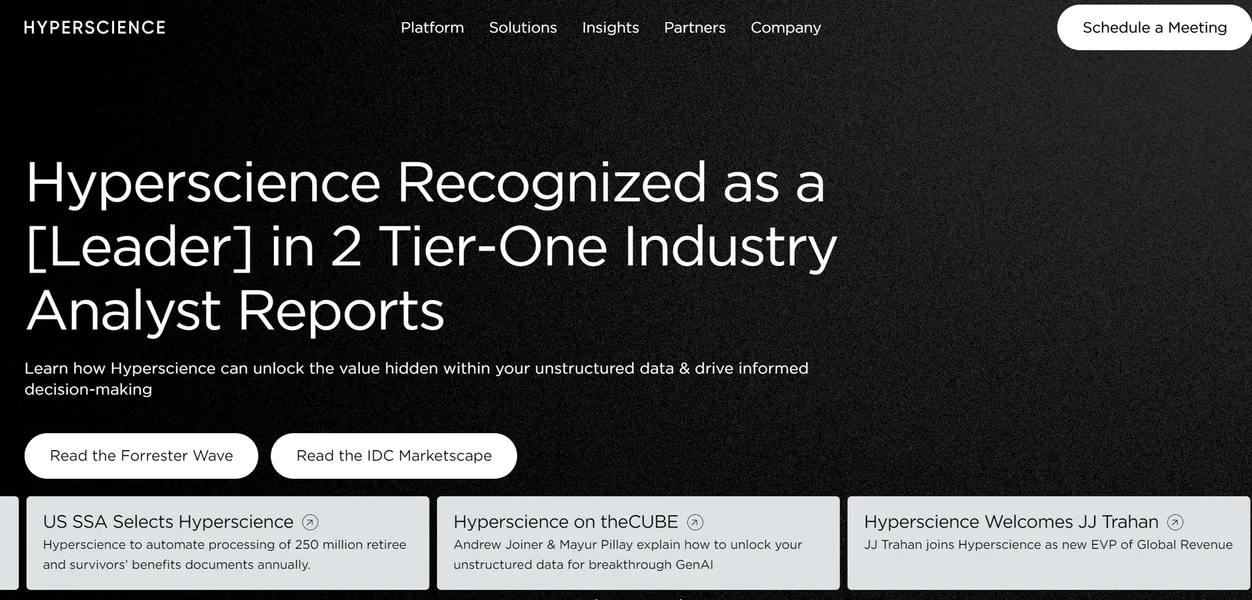
What is Hyperscience?
A mortgage processor receives a 50-page application containing typed bank statements, handwritten tax forms, and low-contrast ID scans. Manual data entry takes hours and introduces errors. Hyperscience reads these mixed formats, extracts the required fields, and flags only the illegible text for human review. Processing time drops from hours to minutes.
Developed by Hyperscience, Inc., this enterprise AI platform solves the unstructured data problem for financial, insurance, and government sectors. It replaces legacy optical character recognition systems with machine learning models that read cursive and messy handwriting. Large organizations use it to clear document backlogs and reduce manual data entry costs.
- Primary Use Case: Automating data extraction from mixed handwritten and typed documents.
- Ideal For: Enterprise operations teams processing high volumes of complex forms.
- Pricing: Starts at $6.99 (Pro) – Unusually low entry price for enterprise software.
Key Features and How Hyperscience Works
Intelligent Document Processing
- Proprietary OCR: Reads handwritten and low-quality text scans. Limit: Struggles with completely illegible scribbles requiring human context.
- Automated Classification: Sorts documents into 100+ predefined categories. Limit: Custom categories require manual training data to reach high accuracy.
Quality Control and Validation
- Human-in-the-Loop (HITL): Routes low-confidence extractions to human operators. Limit: Requires dedicated staff to monitor the review queue.
- Field-Level Validation: Cross-references extracted data against external databases. Limit: Depends entirely on the speed of the connected external API.
System Integration and Security
- API Integration: Connects with ERP systems like SAP and Oracle via RESTful APIs. Limit: Requires custom development work for legacy on-premise databases.
- Deployment Options: Runs as SaaS, on-premises, or in private clouds. Limit: On-premises deployment demands high-spec server hardware.
Hyperscience Pros and Cons
Pros
- Superior handwriting recognition handles cursive and low-contrast scans better than generic OCR engines.
- Enterprise scalability allows large global institutions to process over 1 billion pages annually.
- Reduces manual document processing costs by up to 90% in financial sectors.
- Adaptive learning improves accuracy over time based on human corrections.
Cons
- Licensing and implementation fees often prove prohibitive for small businesses.
- Initial workflow mapping and integration require dedicated IT resources.
- On-premises versions require expensive server environments to maintain processing speed.
Who Should Use Hyperscience?
- Enterprise Operations Teams: Banks and insurers processing thousands of handwritten forms daily see immediate ROI.
- Government Agencies: Organizations digitizing historical records benefit from the secure, air-gapped deployment options.
- Small Businesses: Solo operators or small teams with low document volumes will find the setup process and technical requirements overwhelming.
Hyperscience Pricing and Plans
Hyperscience offers a tiered pricing model with a free trial available. (The Pro tier functions primarily as a testing sandbox).
Pro Early Bird costs $6.99 per month billed annually. It includes AI trial credits and core features.
Pro costs $8.99 per month billed annually. It provides standard core features and AI credits.
Premium costs $17.99 per month billed annually. It includes unlimited basic models and a higher credit allowance.
Enterprise features custom pricing tailored for large organizations with specific headcount and volume requirements.
The low entry tiers act more like extended trials for testing the API before committing to the expensive Enterprise tier.
How Hyperscience Compares to Alternatives
Similar to ABBYY, Hyperscience targets large-scale document processing. ABBYY relies on template-based extraction, which works well for standardized invoices. Hyperscience handles highly variable, unstructured documents much better. ABBYY requires less initial configuration for standard business forms.
Unlike Kofax, this tool uses a proprietary machine learning approach rather than traditional OCR rules. Kofax offers broader legacy system integrations out of the box. Hyperscience wins on raw accuracy for messy handwriting. Kofax remains a safer choice for companies invested in older Microsoft enterprise environments.
Rossum competes directly in the AI document extraction space. Rossum focuses on accounts payable and invoice processing with a cloud-first approach. Hyperscience offers broader use cases across government and insurance sectors. Rossum provides a faster setup time for standard financial documents.
Final Verdict for Enterprise Document Processing
Hyperscience delivers unmatched accuracy for large organizations drowning in handwritten forms and unstructured data.
Small businesses should look elsewhere.
Teams needing quick invoice processing should consider Rossum instead.