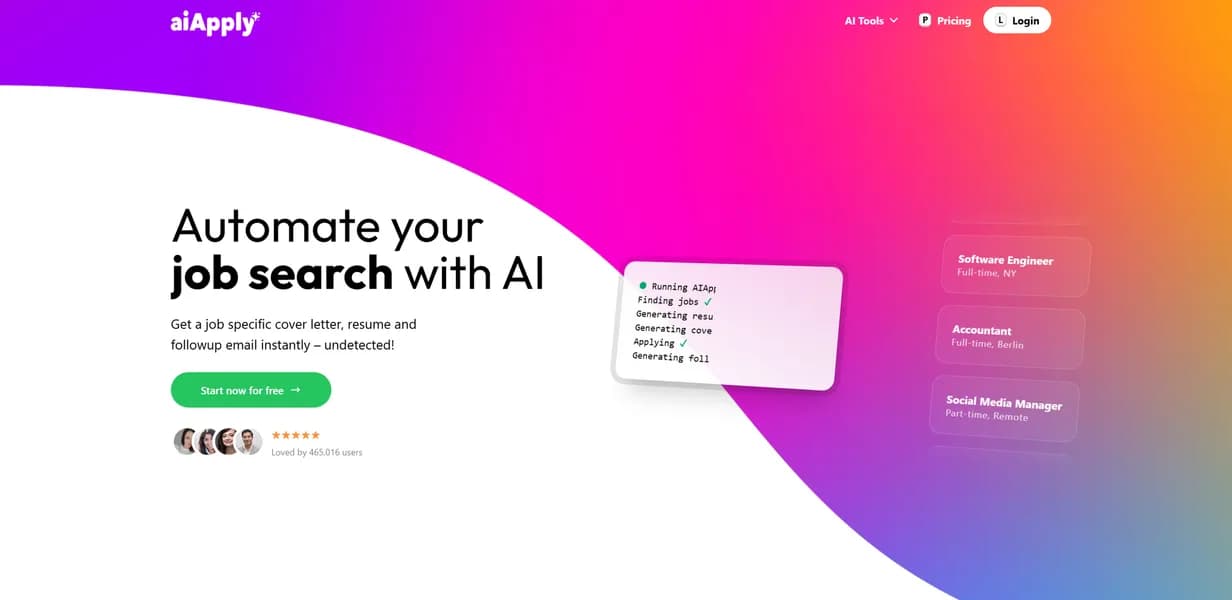

iApply is an AI job search automation platform that tailors resumes and submits applications across 100 job boards. It helps active job seekers save time by auto-filling forms and optimizing keywords. However, the auto-apply bot struggles with complex, non-standard application forms.
What is iApply?
iApply is an automated job application engine and resume builder. It takes your base resume, rewrites it to match specific job descriptions, and submits the application for you.
Developed by iApply AI Inc., this platform targets job seekers who want to play the volume game. It solves the repetitive nature of modern job hunting by handling the manual data entry required on sites like LinkedIn and Indeed.
- Primary Use Case: Automating job applications on LinkedIn and Indeed using pay-as-you-go credits.
- Ideal For: Active job seekers applying to dozens of roles weekly.
- Pricing: Starts at $12 (freemium) – Pay only for the automation credits you actually use.
Key Features and How iApply Works
Application Automation
- Auto-Apply Bot: Submits applications to over 100 job boards with a single click, limited to standard form layouts.
- Chrome Extension: Saves and applies to jobs from your browser, limited to supported major platforms.
- Job Tracker: Manages active applications with status updates, capped at 500 active jobs.
Resume and Profile Optimization
- AI Resume Tailoring: Analyzes job descriptions to insert high-impact keywords, limited by the user base experience.
- ATS Optimization: Scans resumes against common Applicant Tracking System filters, limited to standard ATS formats.
- LinkedIn Optimizer: Suggests improvements for headlines and about sections, limited by the lack of industry-specific nuance.
Interview Preparation
- Interview Copilot: Provides real-time AI answers during live Zoom calls, limited by internet connection stability.
- Mock Interview Tool: Records practice sessions and gives feedback, limited to general behavioral questions.
iApply Pros and Cons
Pros
- Reduces time spent on repetitive form-filling tasks across different sites.
- Matches keywords with high accuracy to help resumes pass initial ATS screenings.
- Provides real-time interview assistance as a safety net for nervous candidates.
- Offers flexible credit-based pricing so users pay only for actual automated submissions.
Cons
- Fails to complete complex, non-standard application forms without manual help.
- Restricts the free tier, making the $12 Pro plan mandatory for real use.
- Lags during live interviews if your internet connection drops.
Who Should Use iApply?
- Volume job seekers: People applying to hundreds of roles will save hours using the auto-apply bot.
- Nervous interviewees: Candidates who freeze during live calls benefit from the real-time Copilot suggestions.
- Senior executives: High-level roles require networking and customized pitches, making automation tools ineffective.
iApply Pricing and Plans
The Free Plan costs $0 per month. It includes limited cover letter generation, basic resume scanning, and job board access. This tier acts more like a trial than a usable product.
The Pro Plan costs $12 per month. It unlocks unlimited resume creation, full interview prep tools, real-time interview assistance, and ATS optimization.
Auto-Apply Credits start at $10. Users buy pay-as-you-go credits for automated job submissions. You can buy 10 credits for $10 or 100 credits for $39.
How iApply Compares to Alternatives
Similar to Teal, iApply offers a centralized job tracker and resume builder. Teal focuses on organizing the search and tracking contacts. iApply focuses much more on the actual submission process with its auto-apply bot. Teal offers a more generous free tier for basic tracking.
Unlike LoopCV, which automates the search and apply process based on parameters, iApply keeps the user in the loop. You still pick the jobs using the Chrome extension (a process taking seconds per job), and iApply handles the form filling. LoopCV works better for hands-off searching, while iApply gives you more control over where your resume goes.
The Verdict for Active Job Seekers
iApply works best for entry-level and mid-level candidates playing the numbers game. If you apply to 50 jobs a week, the $39 credit pack pays for itself in saved time.
The real-time interview copilot is a unique addition.
Just do not rely on it with a weak Wi-Fi connection.
Candidates targeting niche industries should look elsewhere. The auto-apply bot fails on obscure job boards. If you want a free tool just to track applications, Teal is a better choice. The honest limit here is the auto-apply accuracy. We still do not know how well it handles custom workday forms.
User Reviews
No reviews yet. Be the first to share your experience!
Sign in to write a review.
Related articles
Guides and articles related to iApply.

The Personal AI Productivity Stack (2026): One Tool Per Job, Nothing Extra

Perplexity AI Tutorial: Maximize Your Research Workflows

Undetectable AI Review (2026): What It Does, What It Costs, and 7 Alternatives

AI Content Automation Services: What a Done-For-You Setup Includes (and Costs)

The AI Content Automation Stack: 7 Tools That Run a Full Blog Without a Team