

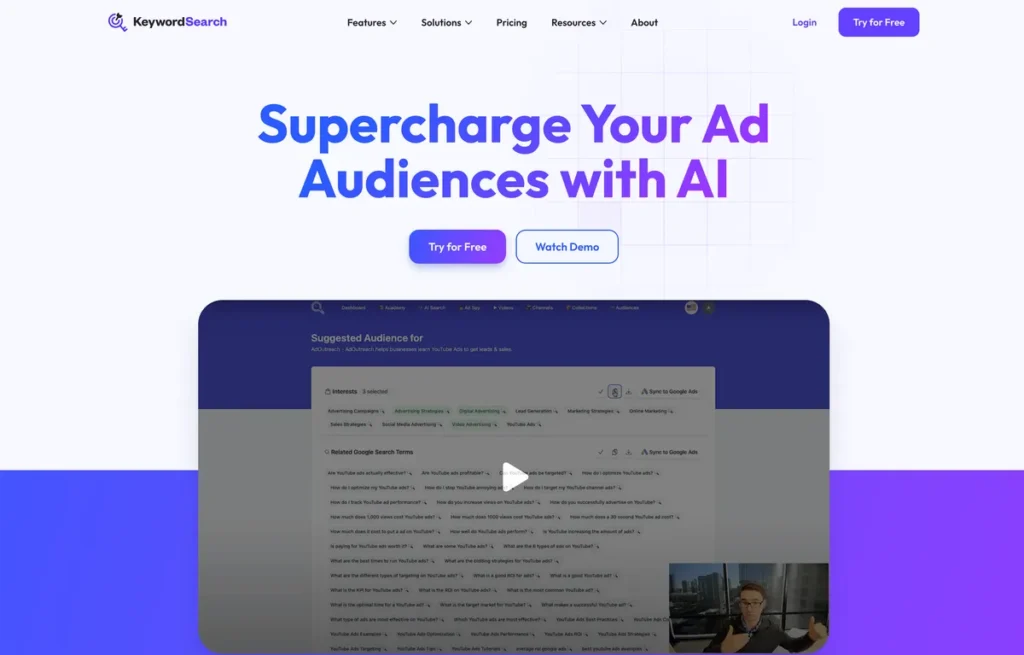
What is KeywordSearch?
KeywordSearch is a specialized platform that leverages AI and machine learning models to optimize digital advertising campaigns within the Google and YouTube ecosystems. From a technical standpoint, it functions as a service layer that automates and enhances complex data analysis tasks historically performed manually by marketers. By processing user-provided business data and market signals, the platform generates structured outputs—such as highly segmented audience profiles and semantically related keywords—designed for direct deployment into Google Ads. It serves to increase the efficiency, precision, and scalability of ad campaign creation and management by minimizing manual data handling and leveraging algorithmic insights.
Key Features and How It Works
KeywordSearch is built around a core set of modules designed to streamline ad campaign workflows. The system’s architecture focuses on data processing, analysis, and direct integration.
- AI Audience Builder: This core component is an algorithmic engine that ingests business descriptions, website URLs, and target customer profiles. It processes this information to generate complex, high-performing audience segments. The output is a structured set of targeting parameters ready for deployment, bypassing the often-tedious manual configuration in Google Ads.
- Keyword Research & Topic Expansion: This feature utilizes Natural Language Processing (NLP) models to perform semantic analysis on seed keywords. It expands initial concepts into comprehensive topic clusters and related search terms, providing structured data that informs both paid ad campaigns and organic content strategy. The system automates the discovery of long-tail keywords and related content angles.
- YouTube Ad Spy: Functioning as a competitive intelligence module, this tool scrapes and analyzes publicly available data on competitor YouTube ad campaigns. It extracts and presents structured metadata, including ad creatives, targeting parameters, and performance statistics. This provides developers and marketers with actionable data for reverse-engineering successful strategies without building custom scrapers.
- Google Ads Integration: A critical feature is the platform’s direct, one-click sync with the Google Ads API. This integration creates a seamless data pipeline, allowing AI-generated audiences to be pushed directly into a user’s Google Ads account. This automation reduces deployment time and eliminates the potential for human error during manual data transfer.
Pros and Cons
From a software development and systems integration perspective, KeywordSearch presents a clear set of advantages and limitations.
Pros
- Workflow Automation: The direct API integration with Google Ads is a significant technical advantage, automating the critical step of audience deployment and reducing operational overhead.
- Data-Driven Precision: The platform’s algorithms can analyze datasets at a scale and speed unattainable through manual analysis, uncovering non-obvious correlations to define precise audience segments.
- Structured Competitive Data: The Ad Spy feature provides valuable, pre-processed competitive intelligence, saving development teams the effort of building and maintaining their own data scraping and analysis tools.
- Scalability: The system is designed to generate and deploy campaign assets rapidly, enabling marketing teams to scale their advertising efforts efficiently across numerous campaigns or client accounts.
Cons
- API Specificity: The tool’s architecture is tightly coupled with the Google and YouTube APIs. This specialization provides depth but limits its utility for teams managing campaigns across multiple ad networks like Meta or LinkedIn.
- Algorithmic Opacity: As with many AI-driven systems, the models generating audience suggestions can operate as a “black box,” making it difficult for technical users to audit the logic or debug unexpected targeting outcomes.
- Data Ingestion Constraints: The platform’s performance is heavily dependent on the quality of the initial user input. Its flexibility in handling varied or unstructured data sources for the AI models is a potential area of concern for advanced use cases.
Who Should Consider KeywordSearch?
KeywordSearch is best suited for professionals and teams who value data-driven efficiency and operate primarily within the Google advertising ecosystem.
- Marketing Teams with Lean Dev Resources: Organizations that require sophisticated audience targeting capabilities without the budget for custom in-house development will find the platform’s automation highly valuable.
- Performance Marketing Agencies: Agencies managing multiple client accounts can leverage the tool to standardize and scale their campaign creation processes, ensuring consistent quality and improved performance.
- Data-Driven Content Strategists: Professionals focused on SEO and content can utilize the keyword expansion and competitive analysis features to inform their organic content roadmaps with data-backed insights.
- E-commerce Businesses: Online retailers can use the platform to refine product ad targeting on Google Shopping and YouTube, connecting with high-intent customer segments more effectively.
Pricing and Plans
KeywordSearch operates on a paid subscription model. The service offers a free trial period, allowing prospective users to evaluate its core functionalities and integration capabilities before committing to a plan. Pricing begins at $30 per month, with various tiers available to accommodate the needs of different users, from individual content creators to large advertising agencies. For the most current and detailed pricing information, consulting the official KeywordSearch website is recommended.
What makes KeywordSearch great?
The single most powerful feature of KeywordSearch is its AI Audience Builder and its direct, one-click integration with the Google Ads API. This combination transforms the platform from a simple research tool into a robust workflow automation engine. The value lies not just in the algorithm’s ability to identify performant audience segments, but in the seamless data pipeline that pushes this complex configuration directly into the advertising platform. This functionality minimizes latency between insight and execution, reduces the risk of manual entry errors, and frees up technical and marketing resources to focus on higher-level strategy rather than implementation details. The platform effectively abstracts away the complexity of modern audience creation, delivering a scalable solution for high-stakes digital advertising.
Frequently Asked Questions
- How does KeywordSearch integrate with Google Ads? Is it API-based?
- Yes, KeywordSearch utilizes a direct, authorized connection to the Google Ads API. This allows for seamless, one-click syncing of AI-generated audiences from the platform directly into the user’s Google Ads account, ensuring data integrity and efficiency.
- What kind of input data is required to power the AI Audience Builder?
- The AI engine typically requires inputs such as a detailed business description, the company’s website URL, and characteristics of the ideal customer. It processes this information to identify patterns and generate relevant audience targeting parameters.
- Can the data from the YouTube Ad Spy feature be exported or accessed via an external API?
- The platform primarily presents the competitive ad data within its user interface for analysis and strategic planning. While direct external API access for the Ad Spy data is not a stated feature, the structured insights provided in-app are comprehensive for campaign modeling.
- Is the platform’s functionality limited to the Google ecosystem?
- Yes, the core features of KeywordSearch are specifically designed and optimized for Google Ads and YouTube. Its strength lies in this specialization, offering deep integration rather than broad, multi-platform support.