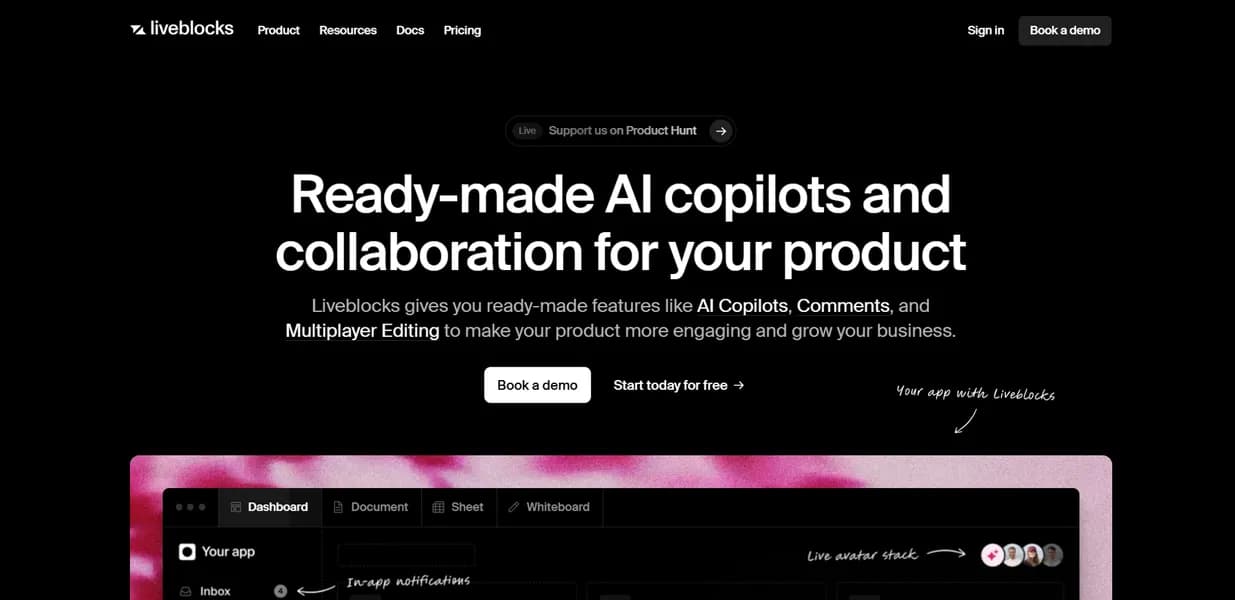

Liveblocks provides infrastructure for developers building real-time collaborative features like live cursors and state synchronization. It uses Conflict-free Replicated Data Types to manage complex JSON states across multiple users. While it saves months of backend engineering, high-traffic applications face rapid cost increases due to its monthly active room pricing model.
What is Liveblocks?
Over 70 percent of modern web applications now include some form of multiplayer collaboration. Liveblocks provides the backend infrastructure to build these real-time features. Developers use its specialized SDKs and globally distributed WebSockets to add live cursors, state synchronization, and threaded comments to web applications.
Liveblocks Inc. built this platform for frontend developers who want multiplayer experiences without managing complex WebSocket servers. It handles the difficult math behind Conflict-free Replicated Data Types. This allows teams to focus on user interface design rather than data conflict resolution.
- Primary Use Case: Adding real-time cursors, state sync, and comments to React applications.
- Ideal For: Frontend development teams building collaborative SaaS products.
- Pricing: Starts at $30/mo (freemium) — Generous free tier for prototyping, but scales fast with active rooms.
Key Features and How Liveblocks Works
Real-Time Presence and Storage
- Presence: Tracks cursors and online status. Limited to 50 simultaneous connections per room on the Pro plan.
- Storage: Uses CRDTs for syncing complex JSON states across clients. Storage size limits depend on your specific pricing tier.
- History: Provides undo and redo functionality. This feature relies on the storage engine capacity.
Collaboration UI Components
- Comments: Offers customizable UI components for threaded discussions. Developers must write custom CSS to match complex design systems.
- Text Editor Plugins: Includes adapters for Lexical, Slate, and Tiptap. It only supports these specific editor frameworks.
Developer Tools and Integrations
- Webhooks: Triggers external workflows upon room creation. Delivery guarantees vary based on your selected pricing tier.
- DevTools: Provides a browser extension for inspecting state. This extension only works in Chromium-based browsers.
Liveblocks Pros and Cons
Pros
- Reduces development time by providing pre-built infrastructure for complex CRDT logic.
- Supports up to 50 simultaneous connections per room on Pro plans.
- Offers excellent developer experience with comprehensive documentation and strict TypeScript support.
- Includes flexible UI components that allow deep customization to match existing app designs.
Cons
- Pricing scales fast for high-traffic applications due to the monthly active room metric.
- Requires a steep learning curve for developers unfamiliar with CRDT concepts.
- Creates vendor lock-in because core real-time logic ties to proprietary infrastructure.
Who Should Use Liveblocks?
- Frontend Developers: Teams building React apps can add multiplayer features fast using native hooks.
- SaaS Startups: Early-stage companies can use the free tier to test collaborative features before committing budget.
- Solo Developers: The steep learning curve for CRDT concepts makes this overkill for simple hobby projects.
Liveblocks Pricing and Plans
The platform uses a freemium model based on monthly active rooms.
- Free: Costs $0 per month. Includes 500 monthly active rooms, 10 projects, 3 team members, and 10 simultaneous connections per room. This is a real free tier suitable for prototyping.
- Pro: Costs $30 per month. Keeps the 500 room base but charges $0.03 per extra room. Increases simultaneous connections to 50 per room. Extra team seats cost $10 each.
- Team: Costs $600 per month. Includes 10 team members and the same 50 connections per room limit.
- Enterprise: Custom pricing. Adds multi-region hosting, SCIM, SLAs, and advanced security features.
The monthly active room metric creates unexpected costs if users open many distinct documents.
How Liveblocks Compares to Alternatives
Similar to Pusher, Liveblocks provides real-time WebSocket infrastructure. Pusher focuses on basic pub/sub messaging and broad language support. Liveblocks targets complex state synchronization for frontend frameworks like React. Developers building simple chat apps choose Pusher, while those building collaborative design tools prefer Liveblocks.
Unlike Ably, which offers a massive global edge network for generic real-time data delivery, Liveblocks provides pre-built UI components. Ably requires developers to build their own conflict resolution logic. Liveblocks handles this using CRDTs (a feature that saves weeks of engineering time).
The Ideal User for Liveblocks
Frontend teams building collaborative SaaS products get the most value from Liveblocks. The native React hooks and pre-built UI components reduce time to market.
Teams building simple notification systems should look elsewhere. The complex CRDT infrastructure adds unnecessary overhead for basic messaging. If you only need simple pub/sub capabilities, Pusher offers a more straightforward implementation path.
Expect Liveblocks to expand its native UI component library over the next 12 months, moving further away from pure infrastructure toward a complete frontend collaboration toolkit.
User Reviews
No reviews yet. Be the first to share your experience!
Sign in to write a review.
Related articles
Guides and articles related to Liveblocks.

Replit Pricing Explained (2026): Core vs Pro and Effort-Based Agent Billing

Google Vision AI Explained (2026): Pricing Per 1,000 Units, Free Tier, and Alternatives
Cursor 3.3 Build-in-Parallel Setup: Real-World Refactor Guide
AI User Testing in 2026: The Tools That Test Your Product While You Sleep

Perplexity AI Tutorial: Maximize Your Research Workflows