Llama is Meta's family of open-weight language models, from the 2023 originals through Llama 4's multimodal MoE releases. Free to download and self-host, the models power thousands of derived tools and enterprise pipelines worldwide.
Llama is the family of open-weight large language models built and released by Meta Platforms. First published in February 2023, the family has grown through four major generations and become the most forked model lineage in AI history, powering over 20,000 derivative models on Hugging Face. Unlike closed-model providers, Meta releases the actual model weights for download: researchers, developers, and companies can run Llama locally on their own hardware, fine-tune it on private datasets, and redistribute modified versions without paying per-token API fees.
The current flagship generation, Llama 4 (released April 5, 2025), shifted from dense transformers to sparse Mixture-of-Experts (MoE) architecture and added native multimodal capability. Llama 4 Scout delivers 17 billion active parameters from a 109-billion-parameter pool across 16 experts, with an advertised 10-million-token context window and the ability to fit on a single server-grade GPU. Llama 4 Maverick scales to 400 billion total parameters across 128 experts with 17 billion active at inference time and a 1-million-token context window. Both models process text and images together via early fusion. Access is free for self-hosting; third-party providers like Together AI, Fireworks, and Groq serve the models via API at rates starting around $0.08 per million input tokens for Scout.
Llama at a glance, April 2025
The Llama 4 release on April 5, 2025 shifted the family from dense transformers to sparse Mixture-of-Experts (MoE), where each token activates only a subset of specialized "expert" subnetworks rather than the full parameter set. Two models are publicly available:
Llama 4 Scout (17B/109B): 17B active, 109B total, 16 experts, 10M token context (instruction-tuned). Fits on a single H100 GPU with quantization. Trained on up to 40 trillion tokens spanning 200 languages.
Llama 4 Maverick (17B/400B): 17B active, 400B total, 128 experts, 1M token context (instruction-tuned). Available in BF16 and FP8. Requires multi-GPU or distributed serving at full precision.
Llama 4 Behemoth (~2 trillion total parameters): Announced in April 2025 but not publicly released as of April 2026. Designed as Meta's frontier research model with ~288B active parameters and native video understanding.
The earlier Llama 3.x generation remains widely deployed. Llama 3.3 70B and Llama 3.1 8B are still preferred by many developers for coding pipelines, partly because their dense architecture has more predictable serving behavior than Llama 4's MoE structure.
What Llama actually delivers
For teams with strict data privacy requirements, Llama's value is straightforward: your data never leaves your infrastructure. Legal discovery platforms, hospitals processing patient records, defense contractors analyzing sensitive documents, and financial institutions with regulatory data-handling obligations all deploy Llama for exactly this reason. The weights download once; inference runs entirely inside your own environment.
The ecosystem Llama has attracted is its second major advantage. Ollama, llama.cpp, vLLM, and Text Generation Inference (TGI) all support Llama natively. AWS Bedrock, Google Vertex AI, and Azure all offer hosted Llama endpoints. Hugging Face hosts the model weights with native Transformers integration. If a developer needs to run a model locally, fine-tune on domain data, or connect to an inference backend, there are established tutorials and production-tested tooling for every step.
Fine-tuning is the third pillar. LoRA and QLoRA via Hugging Face PEFT let teams adapt Llama to narrow domains: contract analysis, clinical note summarization, regulatory compliance. Closed-model vendors do not permit this.
"Ollama + Llama 3.1 8B. If it does not do what you need after a week of real use, then you understand the gap well enough to make a better choice." -- r/LocalLLaMA community thread, 2025
Where Llama breaks -- the failure modes users keep hitting
The Llama 4 generation's reception in the developer community was sharply negative in ways that deserve honest coverage.
Long-context degradation at scale. Llama 4 Scout's 10-million-token context claim does not hold up in practice beyond 256K tokens. The models were pre-trained on sequences up to 256K tokens; the 10M number applies to instruction-tuned fine-tuning that extends the positional encoding but does not guarantee reasoning quality at full length. Independent benchmarks found accuracy dropped to 15.6% on complex retrieval tasks at extended lengths. Gemini retained 90%+ performance at equivalent lengths in the same tests. Implementation-level bugs in vLLM's pipeline parallelism mode caused garbage outputs on Llama 4 at 64K+ tokens, documented in multiple GitHub issues.
"Llama Scout and Llama Maverick look deeply disappointing -- disappointing on the level of 'people think they have to be misconfigured to be this bad.'" -- Hacker News discussion thread, April 2025
Coding performance below expectations. Llama 4 Maverick scored 16% on the Aider Polyglot coding benchmark, trailing Qwen 2.5 Coder despite being 10 times larger in active parameters. On SRE-focused coding benchmarks it came in last at 69.5% accuracy, 6% below DeepSeek V3 and 18% behind GPT-4o. Developers noted that Llama 3.3 70B, the previous generation, outperformed Llama 4 Maverick on some coding tasks. Teams with coding-first workloads found little reason to migrate forward.
No small consumer models in Llama 4. The Llama 3.2 generation included 1B and 3B models that ran on consumer hardware and mobile devices. Llama 4 launched with only Scout (109B total) and Maverick (400B total). The smallest publicly available Llama 4 model requires server-grade hardware, effectively locking out the hobbyist and MacBook developer segments who drove much of Llama 3's adoption. This is a structural gap, not a configuration issue.
Output quality described as bland. Multiple developer analyses noted that Llama 4's outputs were verbose and generic compared to competitors. One consistent observation: the models produce lengthy, emoji-adjacent responses rather than precise, direct answers. For production use cases requiring tight instruction following, some teams found Llama 3.1 models more predictable.
Llama vs. Mistral vs. Qwen
All three are open-weight model families. The differences are architectural, licensing, and benchmark-level.
Mistral (Mistral AI, France): Mistral Small 4 (March 2026) uses a MoE architecture with 119B total parameters but only 4 experts active per token, yielding approximately 6B active parameters per inference -- less than half of Llama 4 Scout's 17B active. Smaller active footprint means lower inference cost per token at equivalent hardware. License is Apache 2.0: fully permissive, no MAU cap, no downstream restrictions, no attribution requirement. Mistral's context window is 256K (smaller than Scout's claim, but closer to what the hardware actually delivers reliably). Mistral does not have the same volume of community derivative models, but its cleaner license has made it the default choice for startups concerned about Llama's 700M MAU clause.
Qwen (Alibaba, China): Qwen 3.5/3.6 also uses a MoE architecture at roughly 397B total parameters with 17B active, making it directly comparable to Llama 4 Scout in active compute. License is Apache 2.0 with no restrictions. Qwen leads on coding benchmarks as of 2025-2026: Qwen 2.5-Coder-32B topped coding leaderboards, and Qwen 3.6 Plus scores 78.8% on SWE-bench against Llama 4 Maverick's approximately 70%. By early 2026, Qwen overtook Llama in aggregate Hugging Face downloads with nearly 1 billion cumulative downloads. Derivative model share on Hugging Face reached 69% for Qwen versus Llama's 11% by February 2026. The primary concern with Qwen is that it is developed by Alibaba, raising data-lineage and geopolitical compliance questions for some enterprise buyers that do not apply to Llama.
Bottom line: Llama 4's active parameter counts exceed Mistral's at similar total scale, and the ecosystem is larger than both competitors'. But Mistral and Qwen both use Apache 2.0 with no commercial restrictions, and Qwen leads on coding at comparable active compute.
The license catch -- what 700M MAU actually means
Meta's Llama 4 Community License Agreement grants royalty-free rights to use, modify, and distribute the weights in commercial products, with one hard limit: if your product or service has more than 700 million monthly active users, your license terminates automatically and you must contact Meta to negotiate a separate agreement. Meta has no obligation to grant that agreement, can impose any terms, and can decline without explanation.
This threshold sounds enormous until you consider that it applies to the product as a whole, not to the AI feature specifically. A company with 800 million users that wants to add a Llama-powered support chatbot to a corner of its platform is technically outside the license. The clause also aggregates across affiliates: a corporate group's combined user counts matter, not just a single subsidiary's.
Legal analysts have noted that the 700M MAU restriction and the OSI's formal open-source definition are incompatible: Llama is more accurately described as "source available" than open source, despite Meta's marketing language. This matters for procurement teams that require OSI-approved licenses for software used in production systems.
Mistral and Qwen, by contrast, release under Apache 2.0. No user cap, no attribution requirement, no negotiation needed.
Best use cases and when to skip Llama
Where Llama earns its place:
Enterprise data privacy pipelines: Legal, healthcare, finance, and defense teams deploying RAG over internal documents where data sovereignty is non-negotiable. The open weights mean inference runs entirely within your infrastructure.
Fine-tuning for narrow domains: Teams that need a model that understands proprietary terminology, specific regulatory language, or domain-specific reasoning. LoRA/QLoRA fine-tuning on Llama is well-documented and supported by the entire Hugging Face toolchain.
High-volume applications with low per-token cost requirements: Self-hosting Llama on your own GPU cluster costs far less at scale than paying proprietary API rates. For applications generating hundreds of millions of tokens per month, the economics favor open weights.
Research and experimentation: Interpretability researchers, alignment teams, and red-teamers who need white-box access to model weights for probing internal representations.
When to skip Llama:
Your primary need is coding assistance: Qwen 2.5-Coder and DeepSeek Coder outperform Llama 4 on coding benchmarks at comparable active parameter counts. If coding is the main use case, the choice is clear.
You need a reliable 1M+ token context window: The 10M Scout and 1M Maverick context claims do not hold up in real retrieval benchmarks beyond 256K tokens. Gemini 1.5/2.5 is the correct tool for genuine needle-in-a-haystack tasks at very long context.
You want a chat interface without engineering: Llama ships weights, not an application. Getting a working chat interface requires Ollama, llama.cpp, or a third-party hosted endpoint. Non-technical users should use Claude, Gemini, or ChatGPT directly.
Your company has or expects 700M+ MAU: The license structure requires negotiation with Meta above this threshold. Mistral or Qwen under Apache 2.0 are structurally simpler for large platforms.
Getting started with Llama
The fastest local path is Ollama: install it, run ollama pull llama3.2 for a 3B model on consumer hardware, and access it via ollama run llama3.2 or a local API at localhost:11434. Llama 4 Scout requires a server-grade GPU; quantized versions via llama.cpp run on high-VRAM consumer machines. For cloud API access without self-hosting, Together AI and Fireworks serve Scout at ~$0.08/M tokens and Maverick at ~$0.15-$0.30/M tokens. Hugging Face hosts the weights under the meta-llama organization; Transformers v4.51.0+ supports Llama 4 natively including multimodal inputs.
User Reviews
No reviews yet. Be the first to share your experience!
Sign in to write a review.
Featured in collections
Curated lists that include Llama.
Related articles
Guides and articles related to Llama.

Nous Hermes 4: The Self-Hosted Open-Weight Agent Brain (2026)
Grok 4.3 API for Agents (May 2026): Pricing, Benchmarks, Migration
Run Open Source AI Models Locally: Battle-Tested Guide
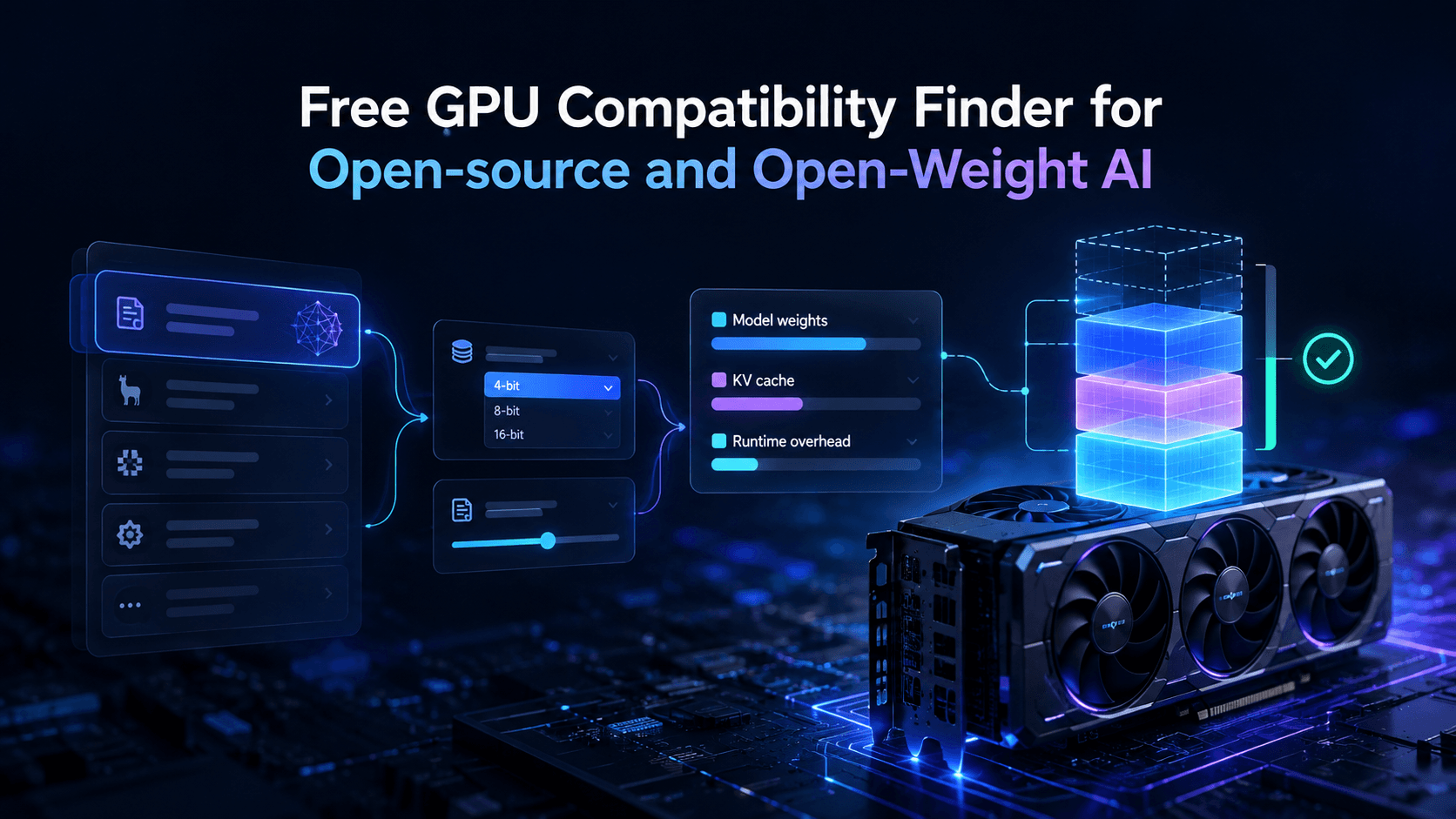
Vantaige Launches the LLM VRAM Calculator: A Free GPU Compatibility Finder for Open-source and Open-Weight AI
Google Vision AI Explained (2026): Pricing Per 1,000 Units, Free Tier, and Alternatives