

What is Magic Studio?
Magic Studio is a comprehensive suite of AI-powered tools designed for both programmatic and manual image manipulation. Functioning as a high-level abstraction layer over complex computer vision models, it provides a powerful toolkit for developers and creatives. Its core capabilities include precise object and background removal, text-to-image synthesis using generative AI, and high-fidelity image upscaling. The platform is accessible through two primary interfaces: a streamlined web-based GUI for direct user interaction and a developer-centric API that allows for the integration of its features into custom applications, automated workflows, and backend services. This dual-access approach makes it a versatile solution for a wide range of visual content processing needs.
Key Features and How It Works
Magic Studio’s functionality is built upon sophisticated machine learning models, exposed through simple interfaces. Here is a technical breakdown of its key features:
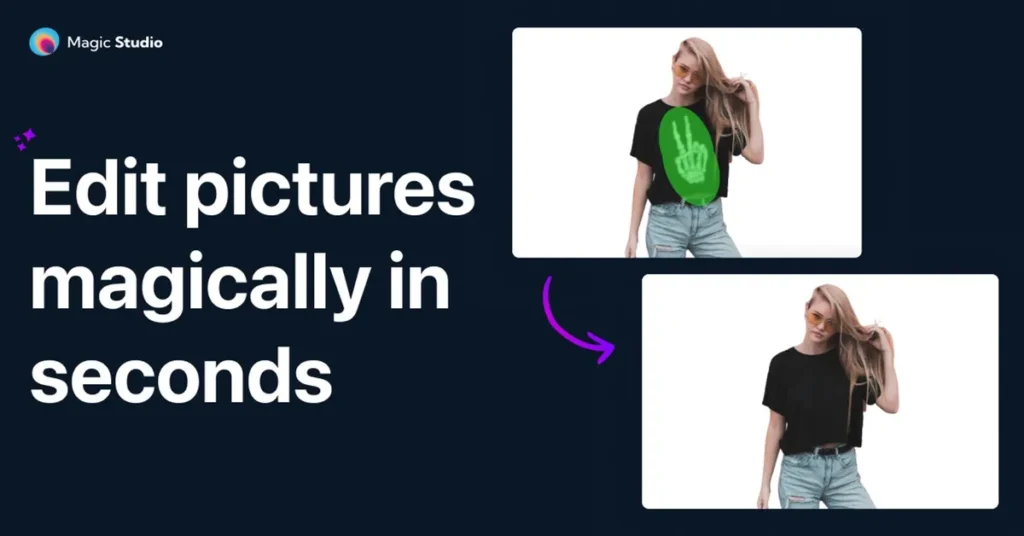
- AI-Powered Editing: This feature leverages a combination of semantic segmentation networks and generative inpainting algorithms. The system first identifies and isolates user-specified objects, people, or text within an image’s pixel data. Subsequently, a generative model fills the removed area with contextually appropriate content, resulting in a clean, artifact-free edit.
- Background Transformation: The platform employs advanced segmentation models to generate a precise alpha mask for foreground subjects. This process effectively separates the primary subject from its background, allowing for either complete removal (to create a transparent PNG) or replacement with a new scene or solid color, all achievable via a single API call.
- Text-to-Image Creation: At its core, this functionality utilizes a large-scale diffusion model. It translates natural language prompts into high-dimensional vector representations, which then guide a denoising process to synthesize a coherent image from random noise. This allows for the rapid generation of visual assets from abstract textual descriptions.
- Upscaling Capabilities: To increase image resolution without the typical blurring associated with standard interpolation, Magic Studio uses a Super-Resolution Generative Adversarial Network (SRGAN). This model has been trained to hallucinate high-frequency details, effectively creating new pixel information that is statistically consistent with high-resolution imagery, enabling upscaling to 4K.
- API Access: For developers, the REST API is a critical feature. It provides programmatic access to the entire suite of tools, allowing for the automation of image processing pipelines. This enables batch processing, real-time image manipulation within applications, and seamless integration with existing content management or digital asset management systems.
Pros and Cons
Pros
- API Availability: The provision of an API is a significant advantage, enabling scalable, automated image processing and integration into custom software solutions.
- Computational Abstraction: The service offloads the immense computational cost and complexity of hosting and running large AI models, eliminating the need for dedicated GPU infrastructure.
- High-Efficiency Processing: The platform executes complex editing and generation tasks with low latency, drastically reducing the time required for workflows that would otherwise depend on manual intervention.
- Reliable Model Performance: The underlying models deliver high-fidelity results for core computer vision tasks, producing professional-grade output for object segmentation, inpainting, and super-resolution.
Cons
- Integration Limitations: The service may lack pre-built connectors for specific third-party platforms and enterprise systems, potentially requiring custom development work against its API for full integration.
- Limited Model Configurability: The API may not expose all underlying model parameters, limiting the fine-grained control that developers could achieve by running and tuning open-source models directly.
- Desktop/API Focus: While a mobile application exists, optimal control and performance are found on the desktop UI or through API calls, suggesting that mobile use cases are secondary.
Who Should Consider Magic Studio?
From a technical standpoint, Magic Studio is an ideal solution for various teams and businesses:
- E-commerce and MarTech Platforms: Developers can integrate the API to automate product image cleanup, standardize backgrounds across entire catalogs, and programmatically generate lifestyle or marketing imagery at scale.
- Software Development Teams: Teams building applications with user-generated content can leverage the API to enhance image quality, moderate content, or add powerful creative features without building an in-house AI stack.
- Digital Agencies with High-Volume Needs: Agencies can build internal tools on top of the Magic Studio API to streamline their creative workflows, allowing for rapid asset generation and modification across numerous client campaigns.
- Content Management Systems (CMS): Integrating Magic Studio can provide CMS users with native AI-powered image editing capabilities, enhancing the value of the core platform.
Pricing and Plans
Detailed pricing information, including specific tiers for API usage and credits, was not available for this review. The platform offers a free tier for exploring basic functionality and a Pro plan that unlocks a more extensive set of features and presumably higher usage limits. For the most accurate and up-to-date pricing, please visit the official Magic Studio website.
What makes Magic Studio great?
How often have development cycles been bottlenecked by the need for custom visual assets or tedious manual image edits? Magic Studio’s greatest strength lies in its effective abstraction of complex machine learning pipelines into a set of accessible and performant tools. It provides a robust service layer that handles the immense challenges of model deployment, inference optimization, and hardware management. For a development team, this means gaining access to state-of-the-art computer vision capabilities through simple API endpoints, dramatically accelerating time-to-market for visually rich applications and services without the need for a dedicated ML engineering division.
Frequently Asked Questions
- How does the Magic Studio API handle authentication and rate limiting?
- The API likely utilizes standard API key-based authentication for securing endpoints. Rate limiting is typically implemented on a per-key basis and tiered according to the user’s subscription plan to ensure service stability and fair usage across all clients.
- Are there SDKs available for popular programming languages?
- While a direct REST API offers universal compatibility, platforms like Magic Studio often provide official or community-supported SDKs for languages like Python, JavaScript, and PHP to simplify integration and reduce boilerplate code. Developers should consult the official documentation for available libraries.
- What is the typical latency for an API request, such as background removal?
- API latency for AI-driven image processing is dependent on image resolution and server load. However, for a service rated highly on performance, one can expect optimized inference pipelines to return results for common tasks like background removal in a range of 500 milliseconds to 2 seconds.
- Can the text-to-image model be fine-tuned with custom brand data?
- The ability to fine-tune generative models with proprietary data is an advanced feature. While the base API provides access to a powerful general model, specific information regarding custom fine-tuning capabilities for brand-specific asset generation would need to be confirmed in the platform’s documentation for enterprise-level plans.