
What is MakerBox?
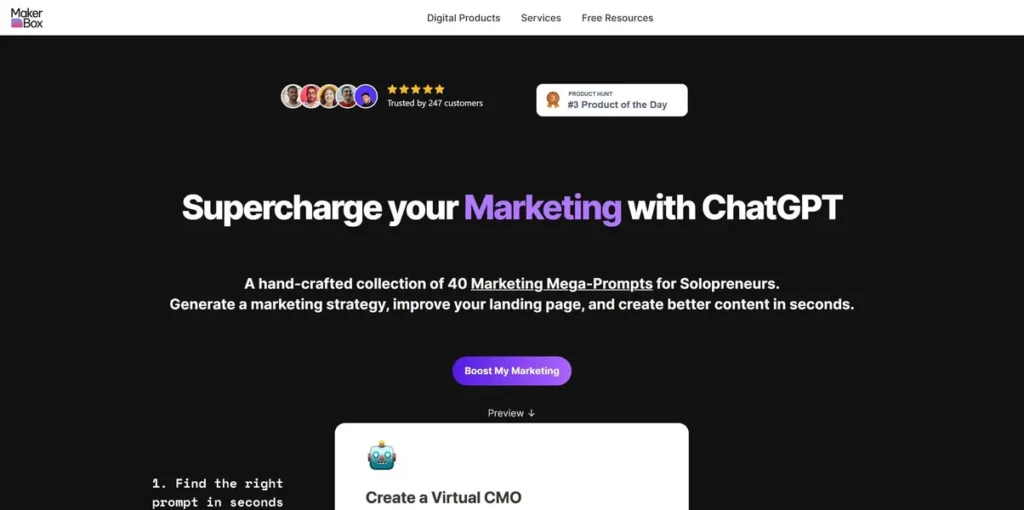
From a technical standpoint, MakerBox is a specialized, static dataset of 70 pre-engineered prompts. It functions as a structured input library designed to interface with OpenAI’s ChatGPT. The core purpose of this tool is to provide a validated set of queries for a large language model (LLM), enabling solopreneurs to generate predictable and high-quality marketing outputs without needing to develop prompt engineering expertise. It essentially serves as a ‘promptware’ package, abstracting the complexity of crafting effective LLM inputs for a specific vertical—digital marketing for solo operators.
Key Features and How It Works
MakerBox operates on a simple principle: providing high-quality inputs to a sophisticated processing engine (ChatGPT). Its features are manifestations of this core function.
- Curated Prompt Library: The system’s primary asset is a collection of 70 static text prompts. These have been engineered to address common marketing tasks, from strategy to content creation. From a development perspective, this is a finite dataset that does not appear to have an API for dynamic updates or expansion.
- LLM-Dependent Strategy Development: MakerBox does not develop strategies itself. Instead, its prompts are structured queries that instruct an external AI, like ChatGPT, to perform the analysis and generate strategic frameworks. The quality of the output is a function of both the prompt’s structure and the underlying model’s capability.
- Templated Content Personalization: The prompts include placeholders and variables, allowing users to input specific parameters such as target audience or product features. This templating enables the LLM to generate personalized content at scale.
- Workflow Efficiency: The primary value proposition is a reduction in the time and cognitive load associated with prompt engineering. It provides a boilerplate library that eliminates the trial-and-error phase of interacting with an LLM for marketing tasks.
- One-Time vs. Subscription Access: While previously offered with lifetime access, the model appears to be shifting, which has implications for long-term support and versioning compatibility with future LLM updates.
Pros and Cons
A technical evaluation of MakerBox reveals a clear set of advantages and limitations.
Pros:
- Reduced Prompt Engineering Overhead: Significantly lowers the barrier to entry for producing quality AI-generated content by providing pre-vetted inputs.
- Predictable Outputs: Using a standardized set of prompts leads to more consistent and reliable results compared to ad-hoc querying.
- Low Technical Barrier: Implementation is straightforward, requiring only the ability to copy, paste, and modify text within the ChatGPT interface. No API keys or integration logic needed.
- High Signal-to-Noise Ratio: A curated list avoids the inconsistent quality found in vast, open-source prompt repositories.
Cons:
- Lack of Scalability: A static library of 70 prompts offers finite utility. The system lacks an API for programmatic access, preventing integration into automated workflows or larger content systems.
- Platform Dependency: The prompts are specifically tuned for ChatGPT. Their performance and behavior on other LLMs (e.g., Claude, Gemini) are not guaranteed, creating vendor lock-in.
- Uncertain Update Path: For a tool dependent on a rapidly evolving technology like LLMs, the lack of a clear versioning and update strategy for the prompts is a significant concern. Prompts optimized for GPT-4 may be suboptimal for future models.
Who Should Consider MakerBox?
MakerBox is architected for a non-technical user base focused on execution speed. It is an optimal solution for solopreneurs, freelancers, and small marketing teams who operate primarily within the ChatGPT ecosystem and lack dedicated prompt engineering resources. These users benefit from a proven, out-of-the-box solution that accelerates content creation. However, the tool is not suitable for software developers, marketing technologists, or enterprises looking to build scalable, automated content pipelines. Anyone requiring API access for integration into custom applications or multi-LLM workflows will find the tool’s architecture restrictive.
Pricing and Plans
MakerBox operates on a freemium subscription model, indicating a shift towards providing ongoing service rather than a one-time product sale. This structure suggests that users can expect updates and support, which is critical for a tool dependent on the evolving AI landscape.
- Free Plan: This entry-level tier provides access to a limited subset of the marketing prompts. It is designed for users to evaluate the quality and utility of the prompts before committing to a subscription.
- Pro Plan ($14/month): The Pro plan unlocks the complete dataset of 70+ marketing mega-prompts. This subscription typically includes access to all future prompt updates, ensuring compatibility and optimization with the latest versions of underlying AI models, along with dedicated user support.
What makes MakerBox great?
MakerBox’s most powerful feature is its highly curated, niche-specific dataset of prompts. In an environment saturated with generic and often ineffective prompt examples, MakerBox provides a pre-vetted, high-quality library engineered for a single domain: solopreneur marketing. This focus ensures that each prompt is not just a template but a well-constructed query designed to elicit a valuable and relevant response from the target LLM. From an engineering perspective, its value lies in the quality of its data. It successfully solves the ‘cold start’ problem for users who need to leverage AI for marketing but lack the specific expertise in prompt design, delivering a reliable and efficient input system.
Frequently Asked Questions
- Does MakerBox offer an API for programmatic integration?
- No, MakerBox is designed as a library of text prompts for manual use within the ChatGPT user interface. It does not currently provide an API for integration into automated workflows or custom software.
- Are the prompts updated for new versions of ChatGPT?
- The shift to a subscription model strongly suggests an intent to provide ongoing updates. Subscribers to the Pro plan should expect prompts to be revised and optimized for new capabilities in future LLM versions, though the specific update frequency should be verified.
- Can these prompts be used with other AI models like Google’s Gemini or Anthropic’s Claude?
- While the prompts are standard text and can be used with any LLM, they were specifically engineered and tuned for ChatGPT. Performance, formatting, and the quality of the output may vary significantly on other platforms due to differences in their underlying architecture and training data.
- What is the technical prerequisite for using MakerBox?
- The required technical skill is minimal. Users need to be proficient in using a web browser and the ChatGPT interface. No knowledge of coding, APIs, or software development is necessary to use the prompt library.